

Mehrangarh Fort Jodhpur: Timings, Entry Fee & What to See
Updated on June 28, 2026
Contents
Introduction: A Strategic Hilltop Fort and Its Founding History
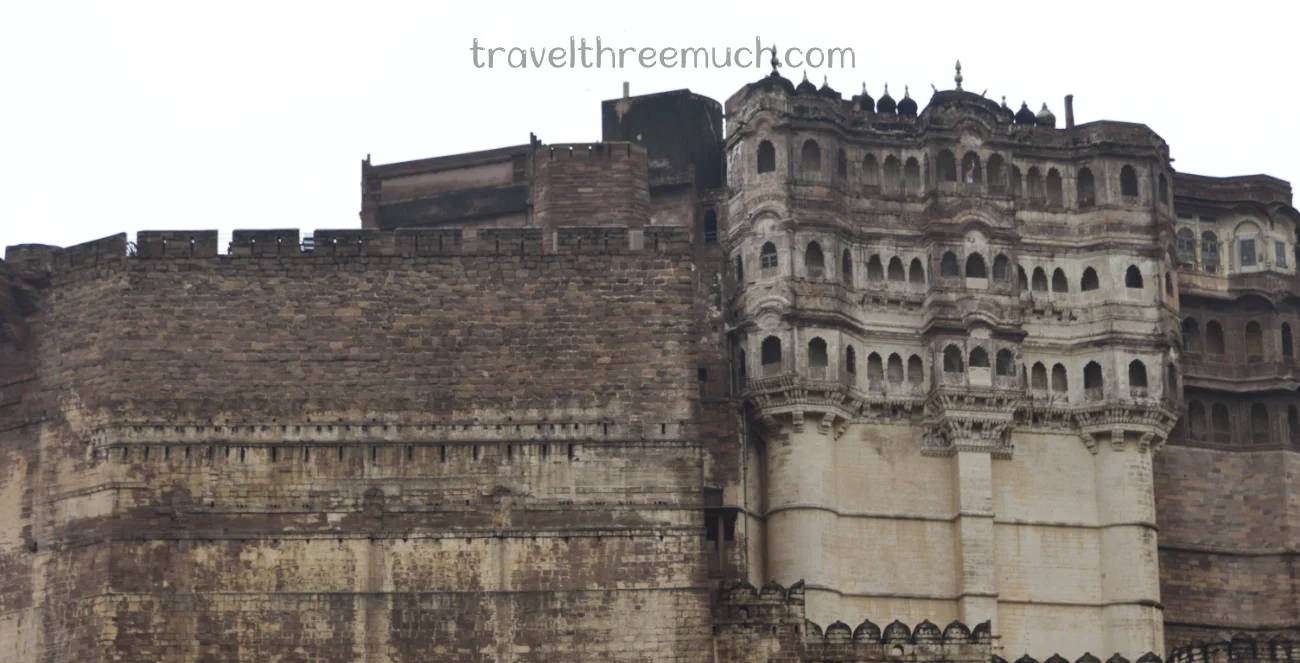
Mehrangarh is a hilltop fort in Jodhpur. It commands a strategic view of the plains below. Rao Jodha started the construction of the fort in the 15th century CE. Maharaja Jaswant Singh added the majority of the sections in the 17th century CE.
Mehrangarh’s origins lie in the tumultuous times of the Rajput kings. Reeling under the attack of the Mewar Rajputs, Rao Jodha lost his father to treachery. Rao Jodha ceded the thousand-year-old Mandore fort to the attackers and had to flee to Marwar to save his life. 15 years passed before he was able to retake the Mandore fort. The events led him to believe that Mandore no longer offered sufficient security. So, Rao Jodha decided to change his capital from Mandore to Jodhpur.
Plan Your Trip: Timings and Entry Fees
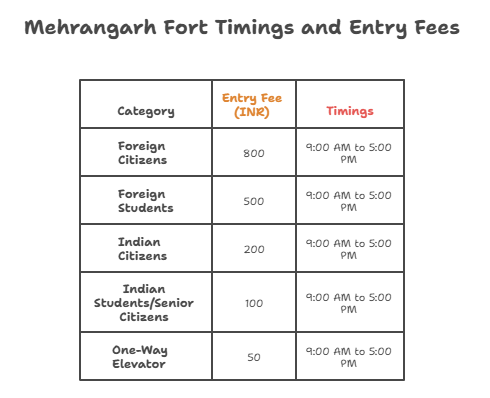
Tickets can be booked online here. 12th May is considered the founding day of the Mehrangarh fort. On this day, entry is free to all visitors.
 Getting to Mehrangarh Fort
 Getting to Mehrangarh Fort
Jodhpur is the nearest airport. Mehrangarh Fort is 10 km from Jodhpur Airport. Other major cities with airports closest to Jodhpur are Jaipur (340 km) and Delhi (620 km). Jodhpur is the nearest railway station, and Mehrangarh Fort is 5 km from the station. Jodhpur is well-connected by road to other cities in Rajasthan. Mehrangarh Fort is 4 km by road from the Jodhpur bus stand. Mehrangarh can be reached by shared transport from Jodhpur. The fort is 2 km from the old town and about 10 km from the city centre, by road.
The Ascent: Gates, Legends, and Architecture
The Main Entrance and Gateways
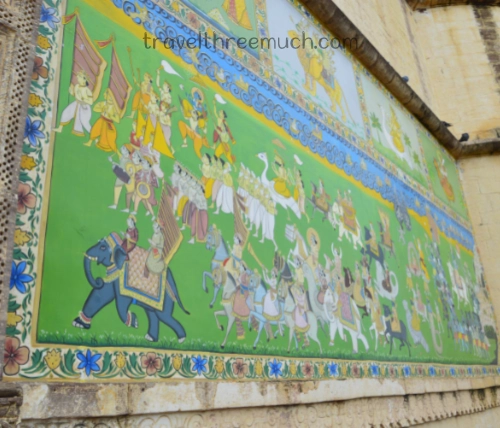
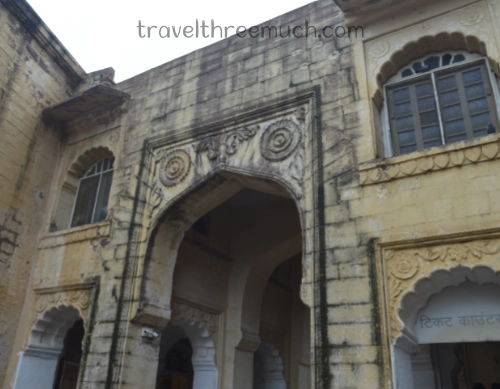
We started our day in Mehrangarh from the Fort Parking. A short trek later, we found ourselves at the entrance gateway – Jai Pol. The gateway was built in 1806 CE by Maharaja Man Singh to commemorate Jodhpur’s victory over the combined forces of Jaipur and Bikaner. The gateway was decorated with delicate stucco work of floral motifs. On the left side of the gateway, a massive mural depicted scenes from the royal Rajput court life. The panel on top depicted a king and queen on horseback. The panel immediately below it depicted a group of nobles and priests from the fortress welcoming a party.
The mural to the right of the doorway depicted the deities of the Hindu pantheon arriving at the fortress. The holy trinity of Brahma, Vishnu and Shiva, the elephant-headed Ganesh, a goddess on a lion, a swan and a rooster, the king of gods Indra atop his white elephant, the gods governing the nine planets, are all depicted in a procession.
Just inside the gateway was the ticket counter. If you want to buy a ticket at the fortress directly, this is the entrance you should use to start your trek. It is recommended to book tickets online to avoid queues if you’re visiting on a weekend or on a holiday.
Accessibility and the Route through Seven Gates
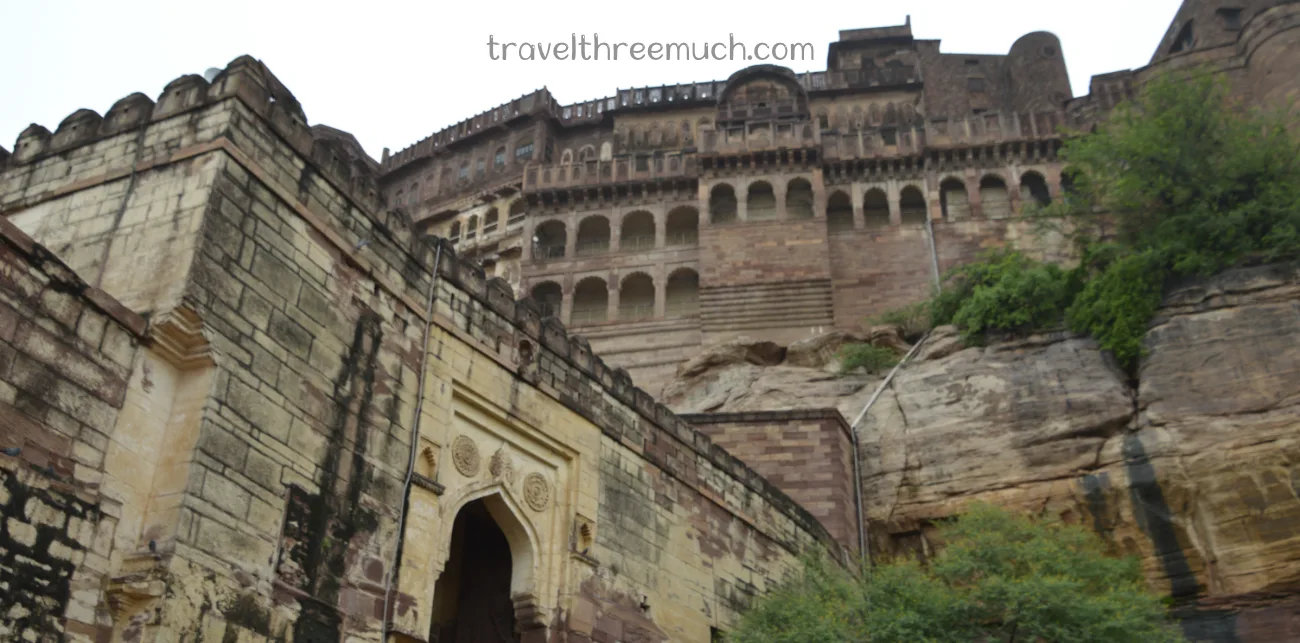
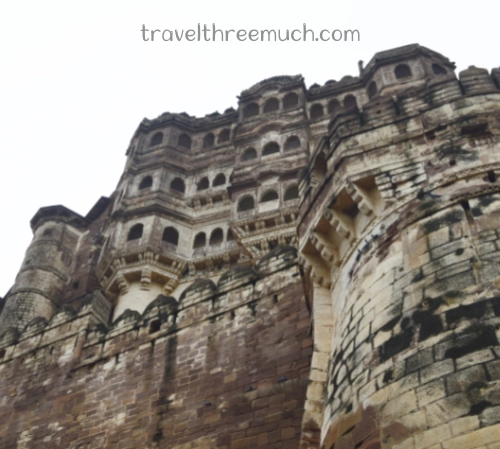
Directly after this, the path branches into two forks. The fork to the left takes you to an elevator station. For a fee, the elevator goes directly to the upper level of the fort, meant as an aid to those with accessibility needs. The fork to the right leads to a path that winds through seven gates (including Jai Pol) all the way to the Jodhpur old town. We decided to go down this path. After Jai Pol, we passed through two smaller gates. Maharaja Ajit Singh commissioned the Fateh Pol to commemorate victory over the Mughals in 1707 CE. Gopal Pol was the next gate. The next gate was the Dodh Kangra Pol. Constructed by Maharaja Maldeo, the gate still bears the scars of bombardment by the armies of Jaipur in 1808 CE. Just past this gate, a courtyard opened out with cannons placed on the fort’s ramparts. Panoramic views of Jodhpur city greeted us. One of the famous cannons, named Khilkila, was placed here.
There are two entrances to Mehrangarh Fort. One entrance, to the southwest of the fort, leads to the old town. It is a walking path through seven gates from Fateh Pol to the main entrance, Jai Pol. The other entrance, at the car park, is to the northeast of the fort.
The Curse and Rajaram Meghwal’s Sacrifice
Rao Jodha chose a rocky hilltop to build a fort. The hill was called Bhakucheeriya (bird mountain in the local tongue), and its sole occupant was Chidiyanathji (lord of the birds), an ascetic. Rao Jodha sought the help of another warrior ascetic, Karni Mata, to drive out Chidiyanthji. Chidyanathji’s departing words were a curse on Rao Jodha and his descendants. He cursed that the area’s occupants would face a perennial water shortage and that any attempts to build a fortress would fail. Rao Jodha sought the angry ascetic’s forgiveness. The ascetic, moved by the king’s pleas, gave him a solution, albeit a very difficult one.
A person had to be buried alive of their own volition in the foundations of the fort. Only this could break the curse and preserve the rulers’ stronghold. Hearing this, the despondent king all but gave up his dreams of building the fort. A man by the name of Rajaram Meghwal offered his life for the kingdom’s sake. Since then, the rulers of Jodhpur have ensured that descendants of the Meghwal are well cared for. The site where Meghwal was buried is marked today by a plaque that reads Rao Jodhaji’s Falsa (Rao Jodhaji’s Gate). We passed by this plaque on the way to Amrit Pol. Maharaja Maldeo also commissioned this gate.
Loha Pol (Iron Gate) and the Sati Handprints
The path from Amrit Pol to the Loha Pol (Iron gate) is a steep ramp. Gigantic doors topped with iron spikes to stop elephants framed the gateway. On the walls of this gateway are the handprints of fifteen royal women, who committed Sati (an act of the widows’ immolation on the pyre of their husbands).
Past this was the last gate leading to the palace complex. This gate is named Suraj Pol (Sun gate). The fortress’s name, Mehrangarh, is also an evolution of Mihir Garh (Fort of the Sun). All these associations with the sun stem from the Rajputs’ claim to be mythical descendants of the Sun god.
The Palace Complex: Royal Halls and Courtyards
A courtyard led to the first of many galleries in the various palaces within the fortress.
As we exited the gallery, we found ourselves in Shringar Chowk. A raised platform with a marble throne atop it under the open skies was a curious setting. We learnt that it is traditional for every new ruler of Jodhpur to be announced on this throne. This practice endures to the present day!
Moti Mahal, Sheesh Mahal, and Phool Mahal
We visited the Moti Mahal (Pearl Palace). This is the oldest surviving of the ‘period rooms’ of the Mehrangarh Fort. Sawai Raja Sur Singh built this in the early 17th century CE. It was a hall of public audience. The gilded stucco and mirror work of the ceiling, and the highly polished chunam walls of the hall, lend it an air of opulent elegance.
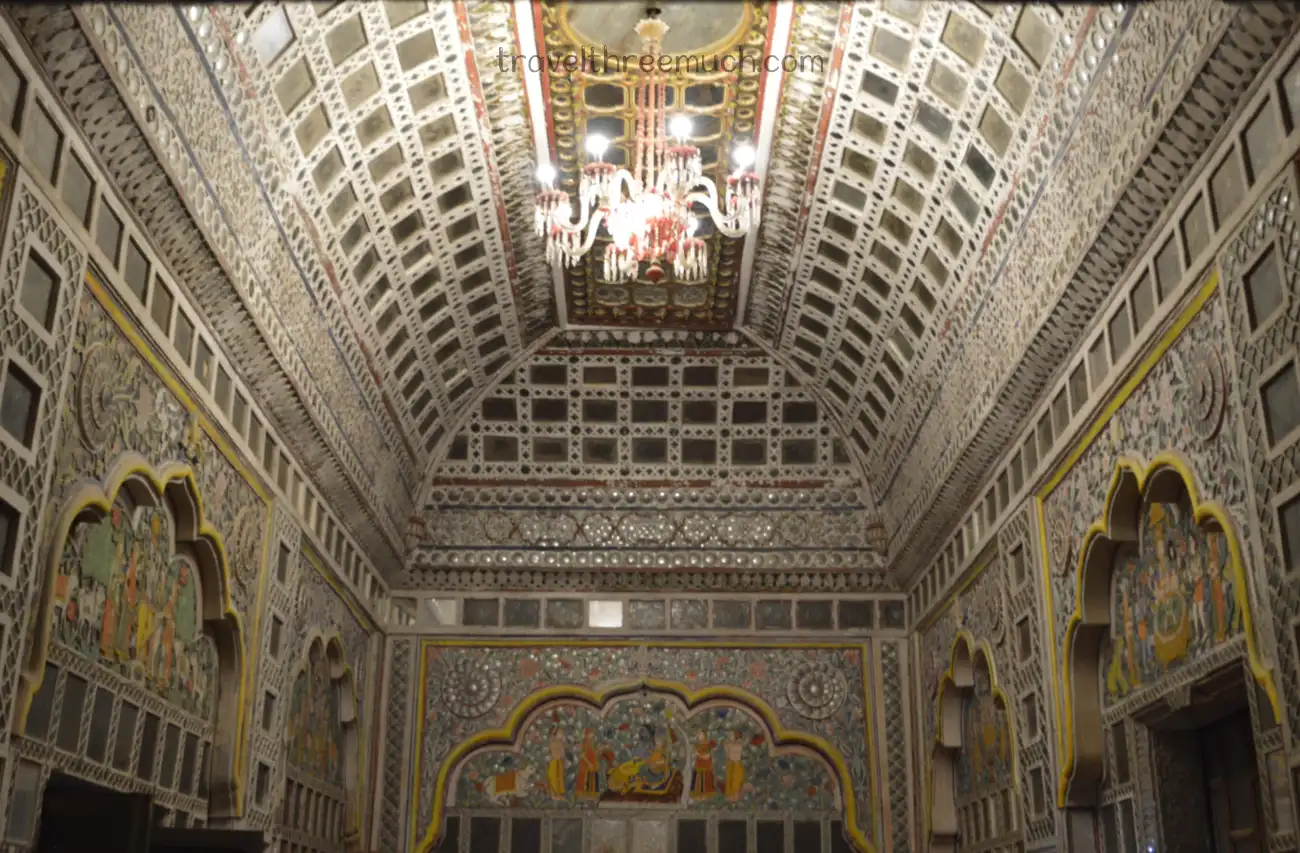
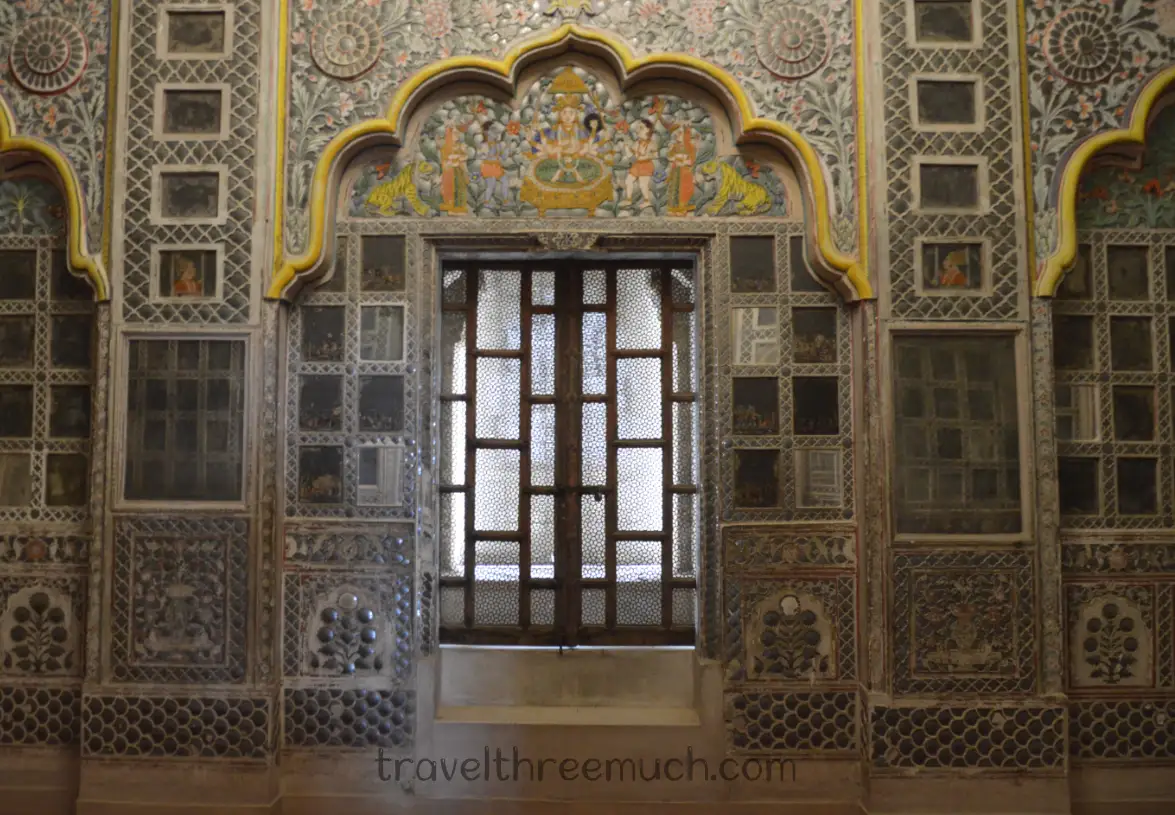
A characteristic of Rajput palaces is the Sheesh Mahal (Mirror Palace). It is said that the mirror work is so profuse that a single flame is sufficient to illuminate the entire chamber. In the Mehrangarh Sheesh Mahal, no surface was left undecorated. Richly painted stuccos featured Rajput deities of Karni Mata, Brahma, Vishnu, Shiva and Ganesha, as well as scenes from Krishna’s life. This room was the private chamber of Maharaja Ajit Singh. The piece on the floor used to be the original centrepiece of the ceiling. The European chandelier and the renovated ceiling are from the 19th century CE.
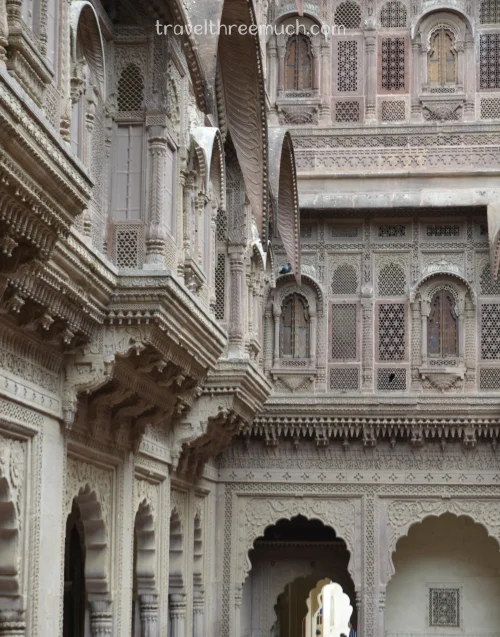
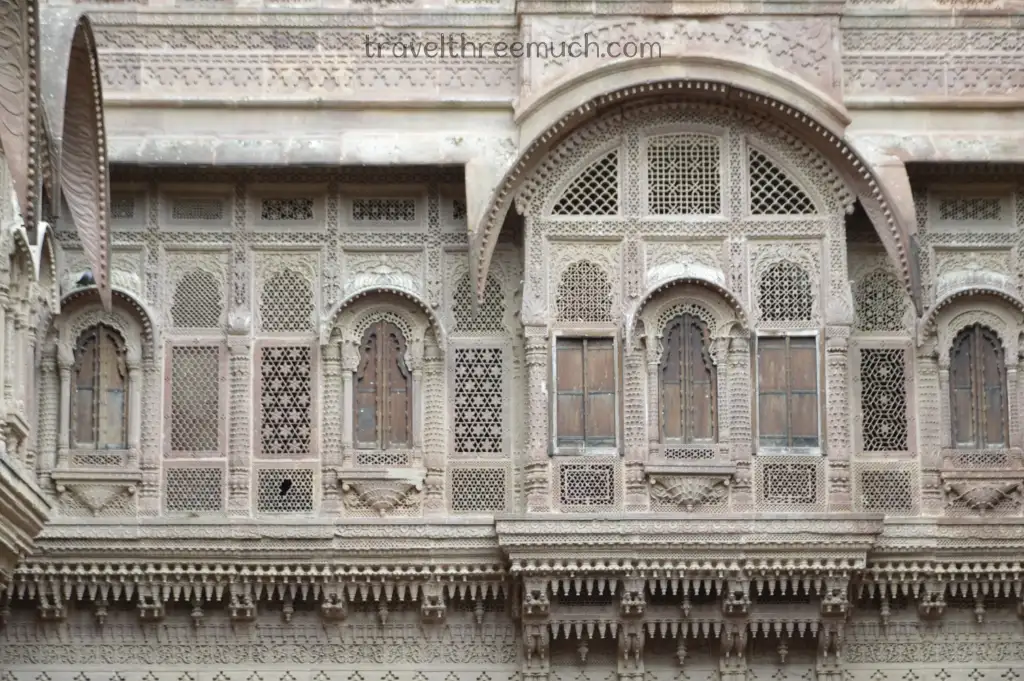
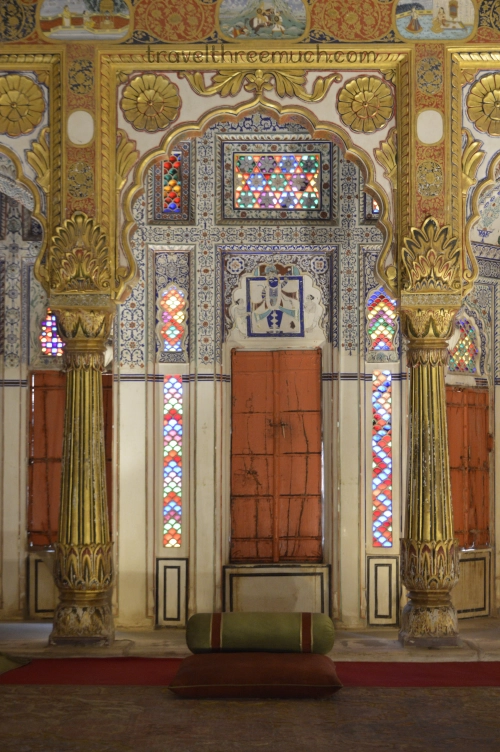
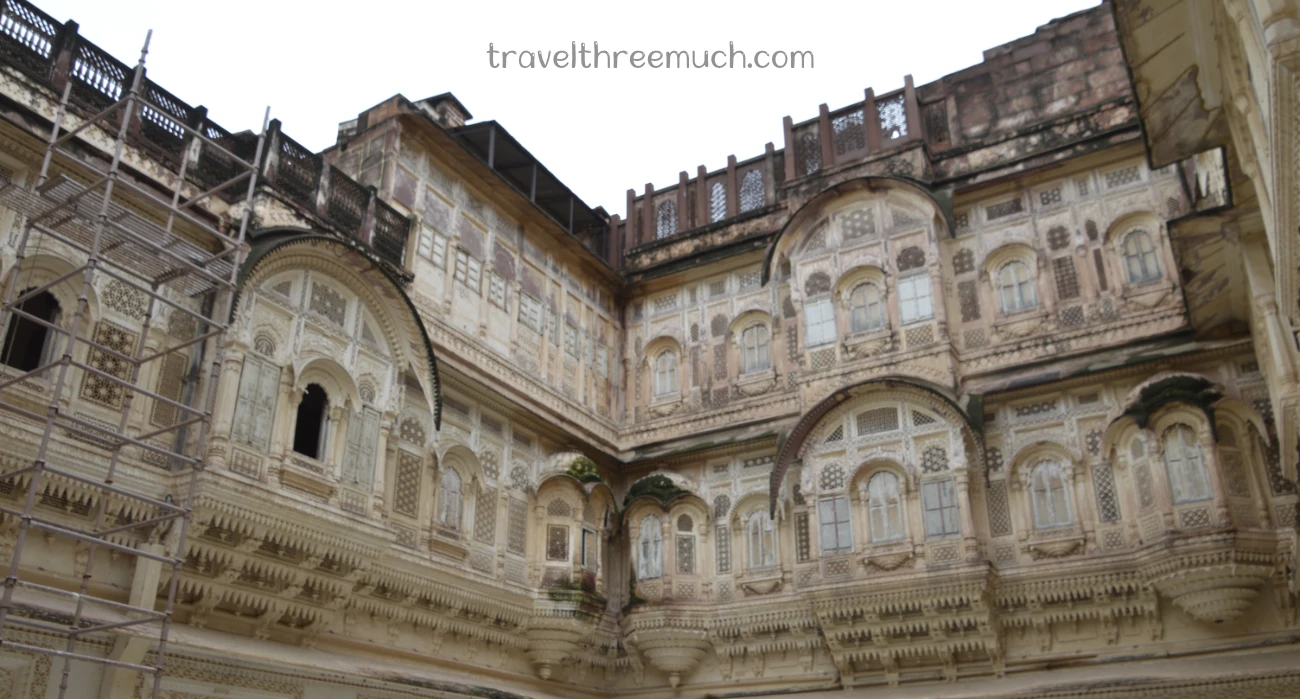
The next room was our most favourite of all the galleries in the fort. The Phool Mahal (Palace of Flowers) was a private audience hall for royal men built in the 18th century CE by Maharaja Abhay Singh. The morning light playing on the stained glass, the gilded ceiling, arches, pillars, and elegant paintings of erstwhile royals and gods made this look like a scene straight out of fairy tales. Don’t forget to take in the views of exquisite jharokas and the signature droopy arched roofs of the other balconies from the corridor, right outside this room!
Takht Vilas and the Zanana Deodi
The next room was the bed chamber of Maharaja Takht Singh in the 19th century CE. This room is called the Takht Vilas. The room was filled from floor to ceiling with ornate paintings. Stained glass windows and hanging Christmas baubles from the ceiling, courtesy of the British, completed the juxtaposition of Western aesthetics.
Next was the Jhanki Mahal (Palace of Views). The palace was meant as a viewing gallery for the royal women. The palace has latticed windows called jharokas that keep the women from being seen. The palace also has a collection of cradles and swings for the infants of the royalty, as well as for worshipping deities.
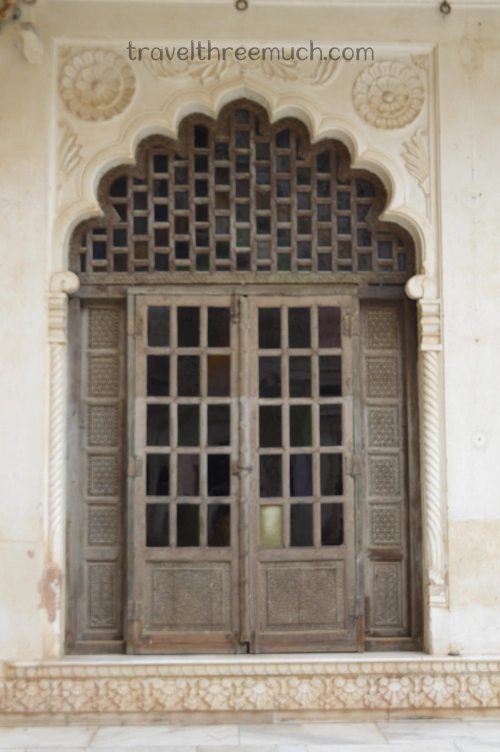
The last stop was the Zanana Deodi. This Palace of the Queens was the enclosure meant for the queens of the Maharaja. They could view the courtyard (chowk) through the pierced windows or jaalis, but the women remained unseen by anyone from the courtyard.
Museum Galleries: Armory, Howdahs, and Arts
Elephant Howdahs and Palanquins
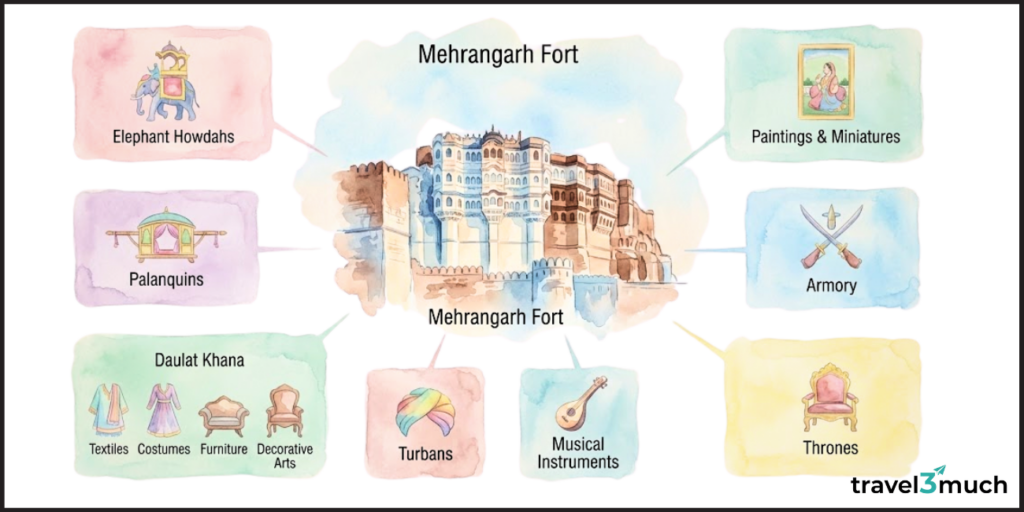
This gallery displayed the various howdahs and palanquins collected by the erstwhile royals of the fortress. Howdahs are structures fastened to elephants. Kings and nobles used them to tour their dominions in style. Howdahs of various sizes and styles illustrated the shifting sensibilities of fashion, influenced by colonialism. Palanquins were generally used by womenfolk. There were different palanquins for different uses. Palanquins for weddings, in which the bridal retinue travelled to the groom’s house, were starkly different from those used by the royal family for state occasions. The centrepiece of this gallery was the Mahadol, or the Grand Palanquin. A part of Maharaja Abhay Singh’s war spoils from Gujarat in the 18th century CE, the glass and carved wooden palanquin required 12 bearers. Delicate peacocks, plants and floral motifs, and the arched roof reminiscent of Mughal-Rajput fusion architecture made it seem like a palace in motion!
Armory (Sileh/Shastra Khana)
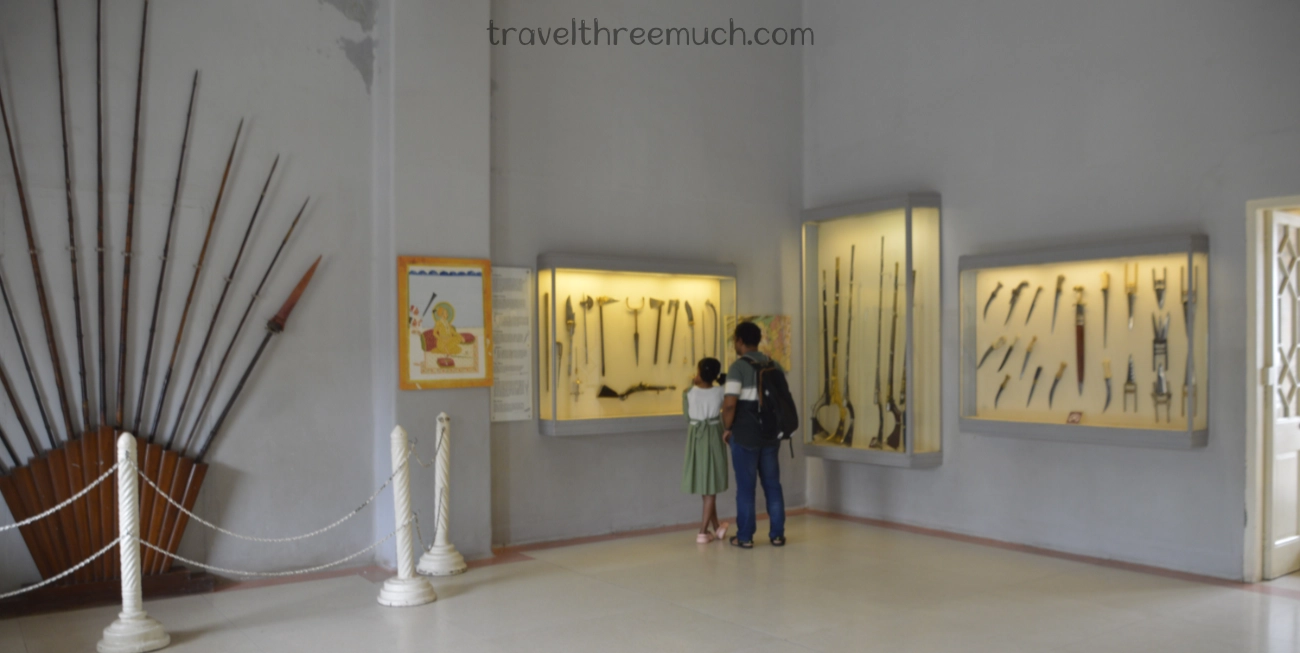
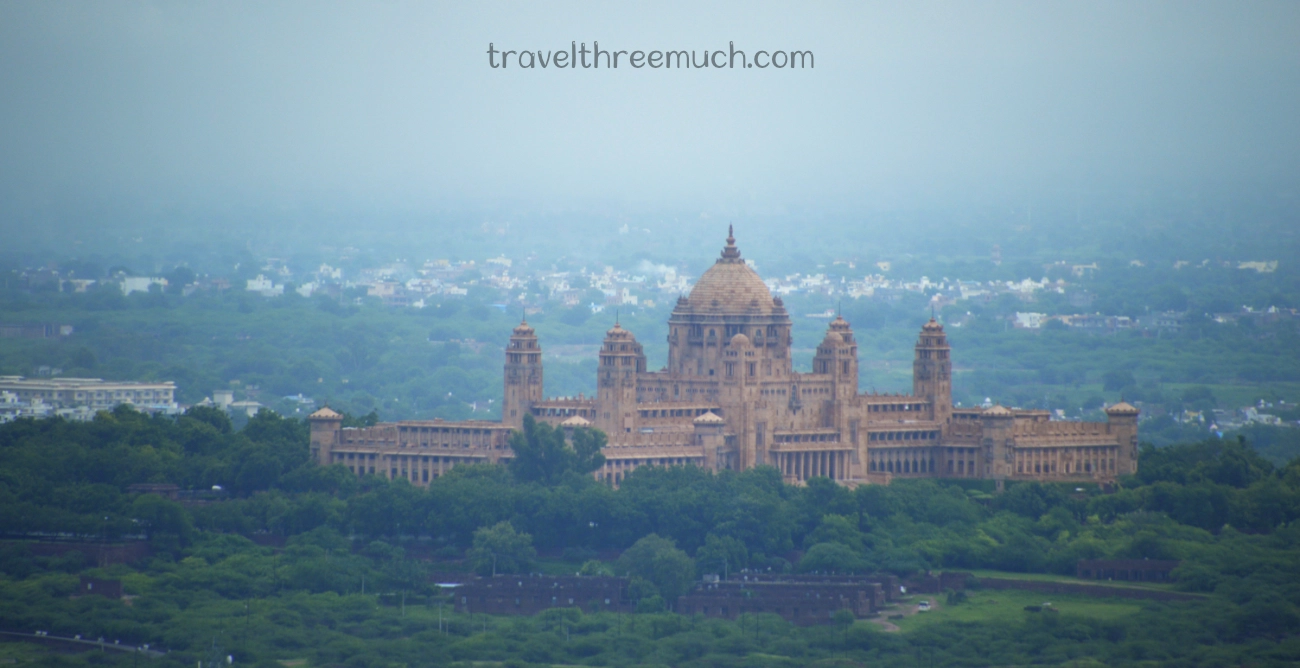
The Sileh/Shastra Khana (Armoury) was our next stop. The Rajputs’ innovation in warfare was impressive. A variety of knives, daggers and swords were on display. The highlight was a punch dagger (katar) with an internal blade sheathed by two split blades. The mechanism is actuated by pulling the hand grips together. When the blades are unfolded inside an enemy in close combat, the results would be devastating! Another curiosity was a ‘knifeaxe’ that incorporated a smooth-bore rifle in the handle. The barrel cap incorporated a concealed dagger. We could see the Umaid Bhawan Palace in the distance. The palace is a private residence, with a portion managed by the Taj Group as a hotel and another part converted into a museum.
The next gallery showcased masterpieces of art which were also functional weapons. Delicate calligraphic inscriptions in Devanagari and Persian on a cannon’s barrel contrasted sharply with its destructive power. Extraordinarily detailed scenes of a hunt in progress on the hilt of a sword, fashioned like the bust of a lion, bear testimony to the heights metalworking rose under the royals’ patronage. Leather and cotton shields richly decorated with silver threadwork, exquisite forged katari (daggers), elaborately painted torana to be used as decorations during wedding, and maud meant as a headdress during the wedding to conceal the groom and bride from each other, silverware, and another cannon with the barrel patterned after the mythical makara (fusion between a crocodile and a wild boar) were all fascinating to see and learn about.
Paintings and Textiles
Our next stop was a gallery dedicated to the Rajasthani school of paintings and decorative arts. The gallery had an interesting assortment of natural materials and handmade brushes. The paintings also highlighted the motifs used in Marwar and Jodhpur paintings, to make them easily recognisable. Scenes from Krishna’s life, celebration of the Holi festival, and scenes from royal life featured prominently in the paintings showcased here. Richly brocaded textiles with gold and silver-threaded embroidery were displayed, protected from the elements in glass cases.
Galleries within Mehrangarh fort:
Amenities, Dining, and Activities
Dining Options
- Eats: Chokelao Mahal Cafe Mehran Palki Cafe Vaara Cafe
- There are dining options inside the Mehrangarh fort. Chokelao Mahal, Cafe Mehran, Palki Cafe and Vaara Cafe are available options. You can find more details here. There’s also a souvenir shop that sells decor, handicrafts, publications by the Museum Trust of the fort and curios.
Activities and Filming Location
- Flying Fox conducts zip-lining from the Mehrangarh fort. If you’re looking for an adventure fix, you can give this a try.
- Location for movies’ shooting: Jungle Book (1994) Dark Knight Rises (2012)
- The Mehrangarh fort is also the location for movie shoots. Jungle Book (1994) and Dark Knight Rises (2012) are among the more famous movies shot here.
Don’t miss Rao Jodha Park
Most people leave Mehrangarh and head straight back to the city, but we recommend stopping at Rao Jodha Park first. It’s an ecological restoration project that looks like a lunar landscape. Walking the "Yellow Trail" gave us some of our favorite shots of the fort towering above the rocky desert.
Temples and Natural Heritage
There are two interconnected lakes which serve as catchment areas for the fortress. Ranisar Lake was commissioned in 1459 CE by Queen Jasmade Hadi, wife of Rao Jodha. Padamsar Lake was commissioned in 1459 CE by Queen Padmini, wife of Rao Jodha.
The fortress has two temples – one dedicated to Chamunda Mataji and another devoted to Nagnechiji.
What Other Travelers Ask
How much time do you need to explore Mehrangarh Fort fully?
It takes about 4 to 5 hours to see all the fortress’s exhibits. So plan your day accordingly.
Early morning visits are highly recommended as the afternoons can get quite warm.
What are the must-see palaces and attractions inside the fort?
While the whole fort is beautiful and stunning, Sheesh Mahal, Moti Mahal and Phool mahal are beautiful.
Are there temples inside Mehrangarh Fort?
Yes, there are two temples inside the fort: the Chamunda Mataji Temple and the Nagnechi Ji Temple. Maa Chamunda is the ishta devi (patron goddess) of Jodhpur’s royal family and the temple continues to receive royal patronage to this day.
What is the best time of year to visit Mehrangarh Fort?
The state of Rajasthan experiences warm weather through the year. And since summers can get quite hot, the best time would be November to January. We visited in August during the onset of Jodhpur’s monsoon season and that was quite pleasant. We in fact, loved the mild drizzles. It made the whole trip quite memorable.
Essential Visitor Tips and Planning Tips
- Carry an umbrella or wear a hat if you’re visiting Jodhpur in the warmer months. Stay hydrated if you’re visiting in the warmer parts of the day.
- Carry cash with you, as we did run into malfunctioning point-of-sale machines and a lack of mobile network at a few places in the fort.
- If your schedule allows, consider adding the Rao Jodha Desert Rock Park and Jaswant Thada to your itinerary.
Thank you for making it this far. If you are planning a visit to Jodhpur, do read about the Blue city walking tour here.

Prasanna Vasudevan
Prasanna is the Primary Writer and Technical Expert behind the posts. He is responsible for the detailed facts, historical context, and logistical breakdowns. He has a deep love for mountains, history, nature, and is the family's expert packer.
Leave a Reply