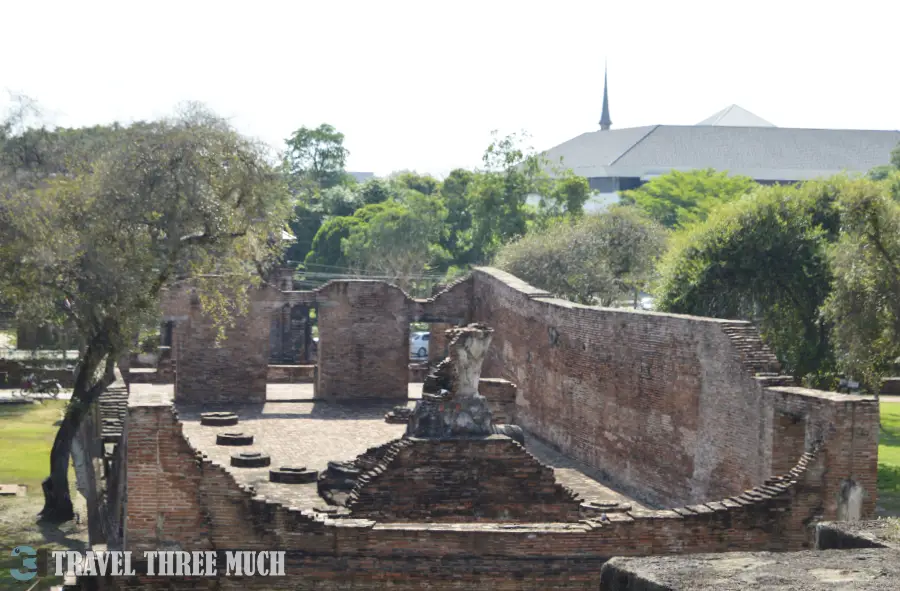

Ayutthaya ruins — temples and chedis of the UNESCO World Heritage Historical Park, Thailand

Ayutthaya Day Trip from Bangkok: Temples, Ruins & Complete Visitor Guide

Updated on July 4, 2026

Contents

    Ever since we planned a trip to Thailand, Ayutthaya remained a constant in our itinerary, amidst other changes to plans.

    So, we pored over Google Maps and other references to figure out a path that would take us through the Ayutthaya Historical Park and the other attractions in the city. Join us on a captivating journey through Ayutthaya, where we’ll delve into its glorious past and contemplate the impermanence of even the mightiest empires.

    planplanettm Ayutthaya Historical Park : Quick facts

    • UNESCO status: World Heritage Site since 1991
    • Kingdom founded: 1350 CE by King Ramathibodi I
    • Entry fee (most temples): 50 THB per person. Thai nationals and children: free.
    • Combined pass: Available for Fine Arts Department–managed sites — ask at the first
      temple ticket counter. Prices are revised annually; verify current rate on arrival.
    • Wat Lokkayasutha: Free entry. Open 8:00 AM to 4:30 PM.
    • General timings: 8:00 AM to 5:00 PM or 6:30 PM. Individual timings noted per temple.
    • Time needed: 6–7 hours minimum for 8 key temples. Full day strongly recommended.
    • Dress code: Shoulders and knees covered at all temples. Sarongs at entrances if needed.
    • Getting around: Bicycle rental 50–80 THB/day (Oct–Feb). Tuk-tuk 700–1,000 THB/day (Mar–May).
    • Best time: November to February. Avoid May–June (intense heat at open-air sites).
    • Photography: Permitted at all outdoor areas. At Wat Maha That: crouch — never stand
      taller than the Buddha head.
    How to Reach Ayutthaya from Bangkok

    Ayutthaya is 80 km away from Bangkok and can be combined with the Bang Pa-In Palace. It is preferable to plan this trip on weekdays rather than the weekends, to beat the crowds. Since most of the spots are places of worship, dress appropriately abiding by Buddhist temple attire rules.

    Four options from Bangkok:

      • By train (recommended): Hua Lamphong or Bang Sue Grand Station → Ayutthaya.
        1.5–2 hours. Third class: 15–35 THB. Second class: 60–100 THB. No booking needed
        for third class. Check current schedules at railway.co.th. From Ayutthaya station:
        4 THB ferry across the river, then tuk-tuk to the first temple.
      • By minivan: Mo Chit BTS or Victory Monument → Ayutthaya. ~1.5 hours. 60–80 THB.
      • By bus: Northern Bus Terminal (Mo Chit) → Ayutthaya. 1.5–2 hours. 50–60 THB.
      • By private transfer or day tour: 1,500–3,000 THB per person including guide.

    However, despite all the meticulous planning, thanks to similar sounding names, we found ourselves in the temple we had planned to visit last, as our first venue of the day! Although this created a minor detour in our plans, we had enough free time left in the plans to account for such snafus.

    Wat Yai Chai Mongkhon history

    History of Ayutthaya

    Ayutthaya, a radiant kingdom in Southeast Asia, thrived for over 400 years. Ayutthaya’s rulers fostered art, engineering marvels, and a strong military. The last king, a solitary figure, witnessed his legacy turn to ash. Ayutthaya’s fall echoed a harsh truth: empires crumble, leaving only a smoky lesson for all to see. Join us on a captivating journey through Ayutthaya, where we’ll delve into its glorious past and contemplate the impermanence of even the mightiest empires.

    The Ayutthaya Kingdom was founded in 1350 CE by King Ramathibodi I (U Thong), on a river island at the confluence of the Chao Phraya, Pa Sak and Lopburi rivers. The surrounding
    water served as a natural moat. Over four centuries, 33 kings ruled here.

    At its peak in the 17th century, Ayutthaya was one of Asia’s most prosperous trading cities. Portuguese, Dutch, French, Chinese, Japanese and Persian merchants all kept permanent quarters here. The population exceeded one million — larger than contemporary London or Paris.

    The Khmer architectural influence you see in the tall prang towers (Wat Ratcha Burana, Wat Phra Ram) came directly from the Khmer Empire, which Ayutthaya defeated in the 15th century.
    This is the same ancient Indian temple vocabulary adapted by different cultures — which is why these towers feel familiar if you have visited Angkor Wat or South Indian temples.

    The city fell in 1767 CE when Burmese forces completed a 14 month siege. The destruction was systematic: temples stripped of gold, statues decapitated, manuscripts burned. The
    capital moved to Thonburi, then Bangkok. What you walk through today is what survived — structures too large to demolish, left standing after the gold was taken.

    UNESCO designated Ayutthaya a World Heritage Site in 1991. The site covers 289 hectares.

    Top Temples to Visit in Ayutthaya

    Wat Yai Chai Mongkhon

    Thus we reached Wat Yai Chai Mongkhon at 10 AM. The temple is open on all days from 8 AM to 5 PM and has ample space for car parking. Entry fee for non-Thai people is 50 THB per person payable in cash at the entrance gate, and free entry for Thai citizens and kids.

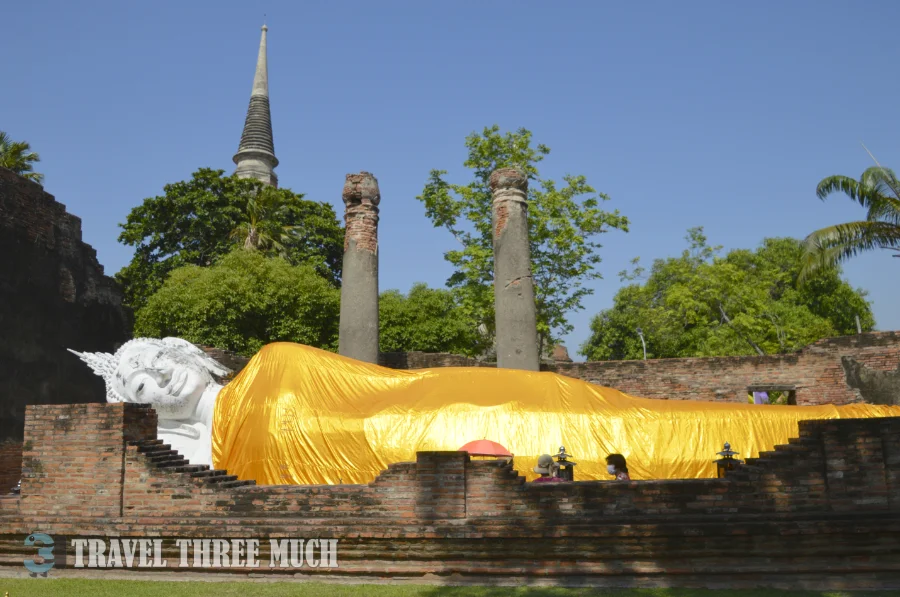
    The first structure is a vihara (Viharn in Thai), a hall serving as a place for meditation and prayer. The vihara is open to the sky with a giant reclining Buddha made of bricks covered in white plaster.

    The Buddha’s serene expression against the blue sky, the rich brown hues of the bricks, the golden shawl draped on the Buddha, and the baby pink lotus flower offerings by the faithful, made for a peaceful setting. Just past this vihara is the Ubosot or the ordination hall, used for important religious ceremonies.

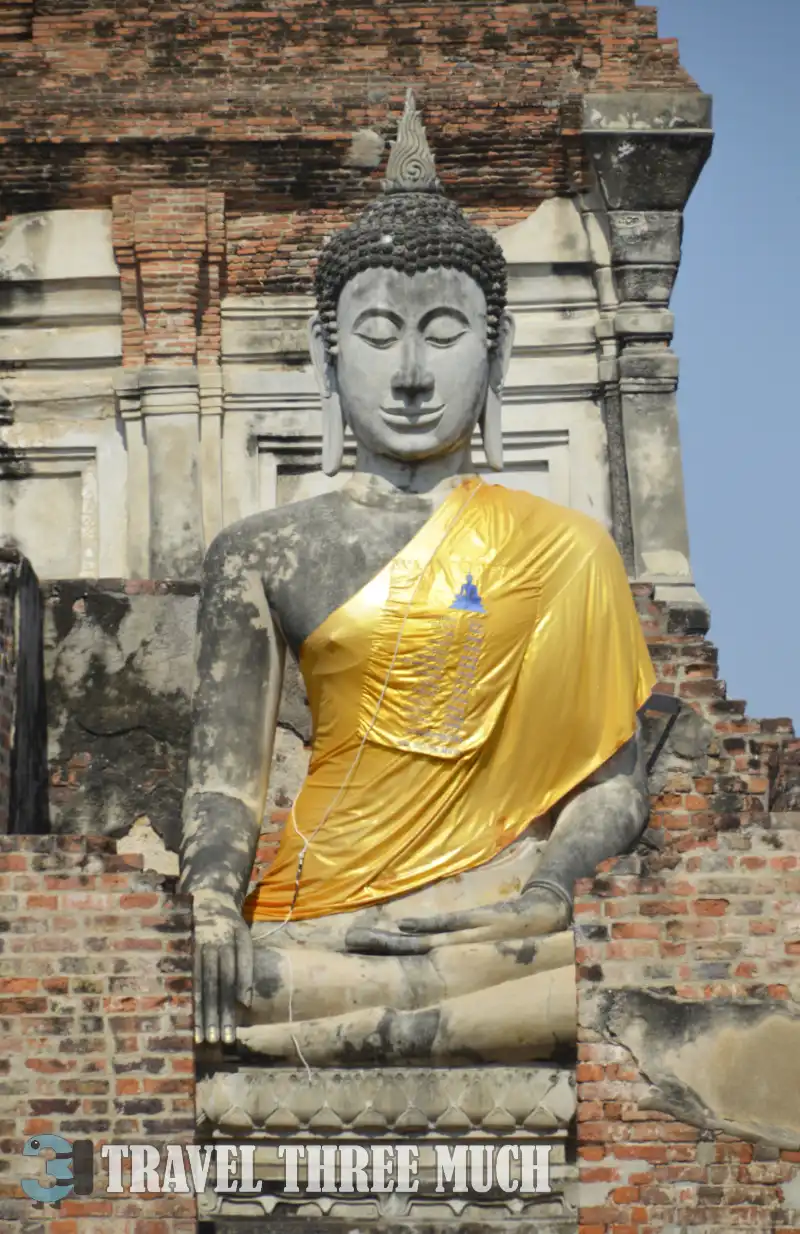
    The principal ‘chedi’ or tower of the shrine is immediately opposite the entrance of the Ubosot hall. Two giant Buddhas on tall pedestals surrounded by protective brick enclosures sit on either side of the steps that lead up to the chedi.

    The structure

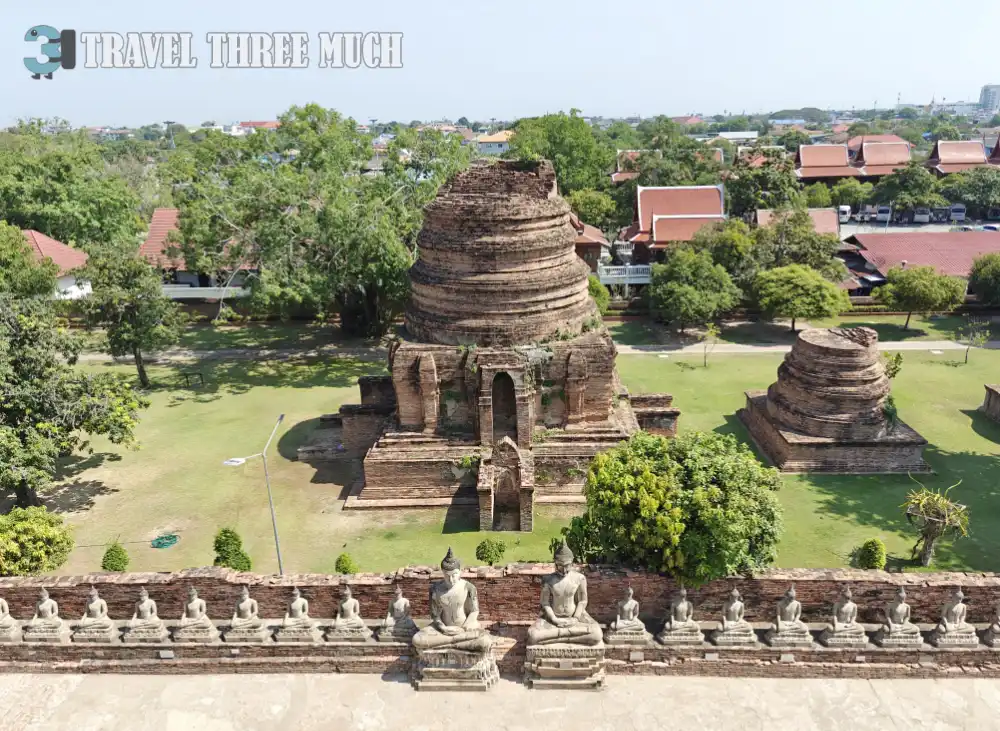
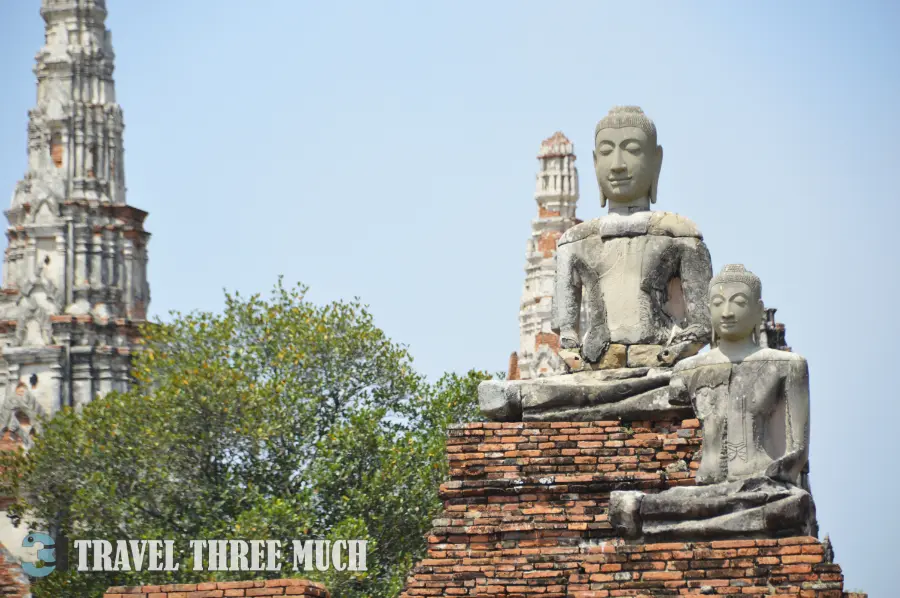
    The first level of the chedi has smaller chedis at the four corners. The views of Ayutthaya are spectacular from this level and help us understand the scale of the temple. From here, one can see the remains of the viharn with a plaster statue of a seated Buddha delivering a sermon to his five principal disciples. The courtyard around the main chedi has a row of Buddha statues, mostly in the Maravijaya pose, except for a few, which are seated in the lotus posture. As we go up the stairs to the next level of the main chedi, we come to the reliquary chamber. There was a shaft at the centre of the chamber descending into the depths of the chedi, where the relics were housed. There were eight statues of the Buddha in the lotus posture, in alcoves within this level.

    Ayutthaya 1_03

    The temple’s history

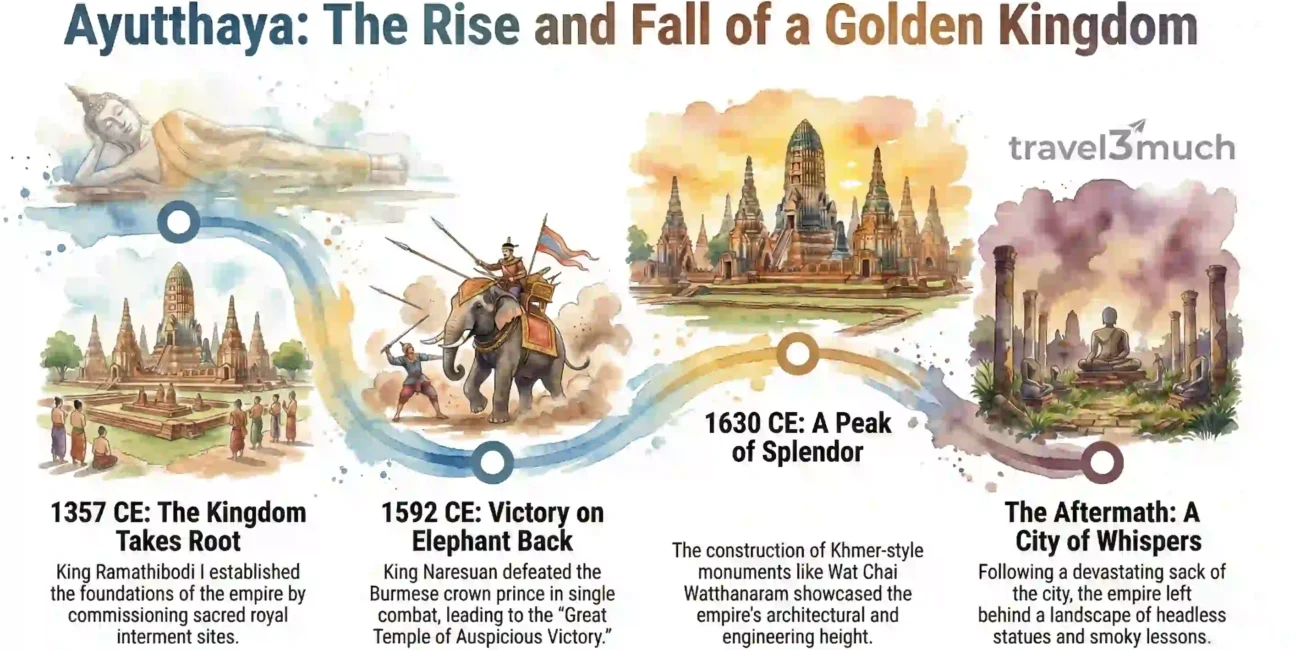
    There are a few historical events associated with this temple – the origins of this temple lie in the interment of the mortal remains of two princes of the Ayutthaya kingdom, under the orders of King 68 Ramathibodi I, in 1357 CE. King Naersuan defeated the Burmese crown prince and slew him during an elephant-back single combat in 1592 CE.

    To commemorate this victory, the king ordered temple restorations here and an expansion and possibly bestowed it its present name, which in Thai means “The Great Temple of Auspicious Victory“.

    We then went to a viharn with a roof and an altar with Buddha figures. The walls decorated with simple murals capture the dynamic poses of the forces of good and evil as the Buddha calls upon Mother Earth to witness his enlightenment and victory over the demon Mara’s temptations.

    Wat Chai Waathanaram

    We then made our way to the next spot for the day – Wat Chai Waathanaram. We had mentioned that we had wanted to go to Wat Chai first to our cab driver and he took us to Wat Yai Chai Mongkhon instead of Wat Chai Watthnaram! 😀 For the remainder of the trip, we sent him the Google locations of the next stops in the itinerary and it worked like a charm! 🙂

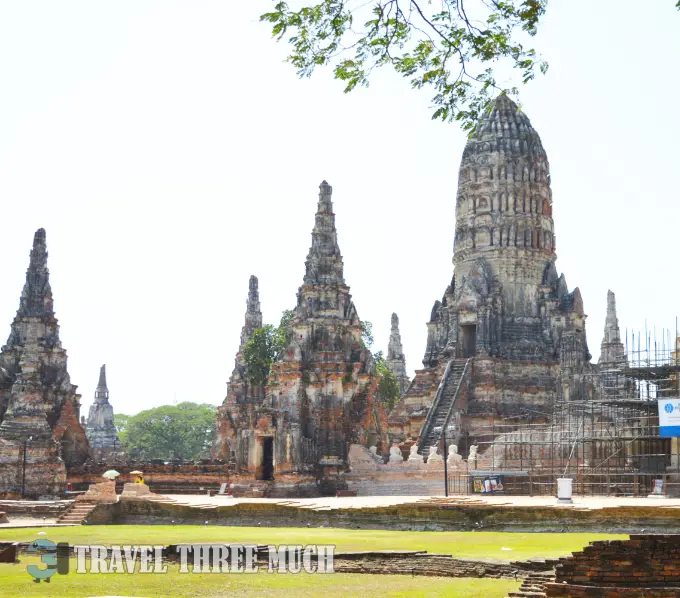
    Wat Chai Watthanaram is a temple built on the bank of the Chao Phraya River in 1630 CE. The main prang (temple tower) stretching towards the sky is visible long before you reach the parking lot. The entry fee is 50 THB per person, with free entry for kids. We visited in the summer, and we saw there was a stall with umbrellas that could be borrowed for a stroll around the temple complex.

    A short walk from the entry gate, past a bell-shaped stupa, we reached the outer wall of the square plan which had 8 chedis (towers used as reliquaries) in total (4 at the corners, and 4 at the central points).

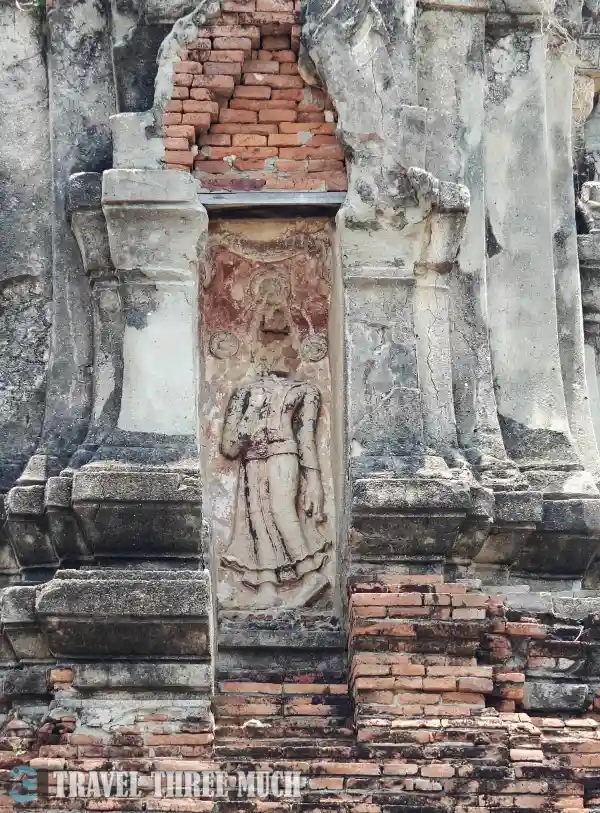
    The outer walls of the chedis used to be decorated with stucco work of episodes from the Buddha’s life, a few fragments of which are intact today.

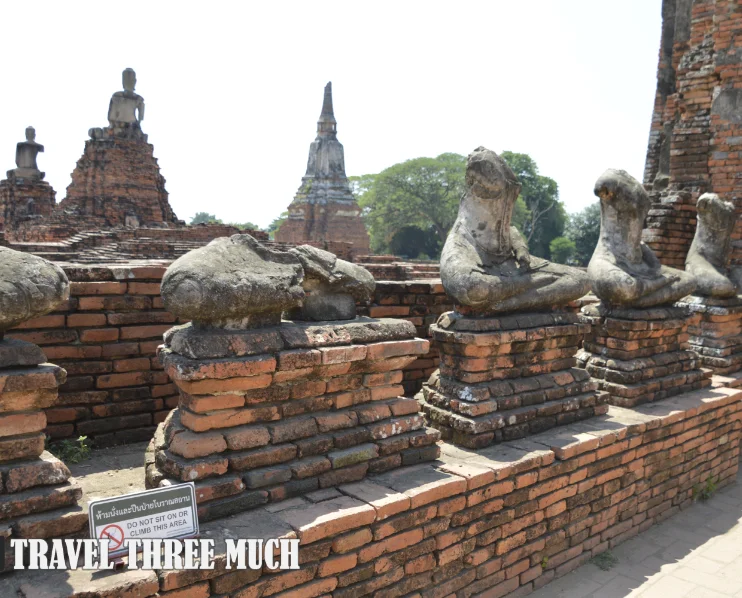
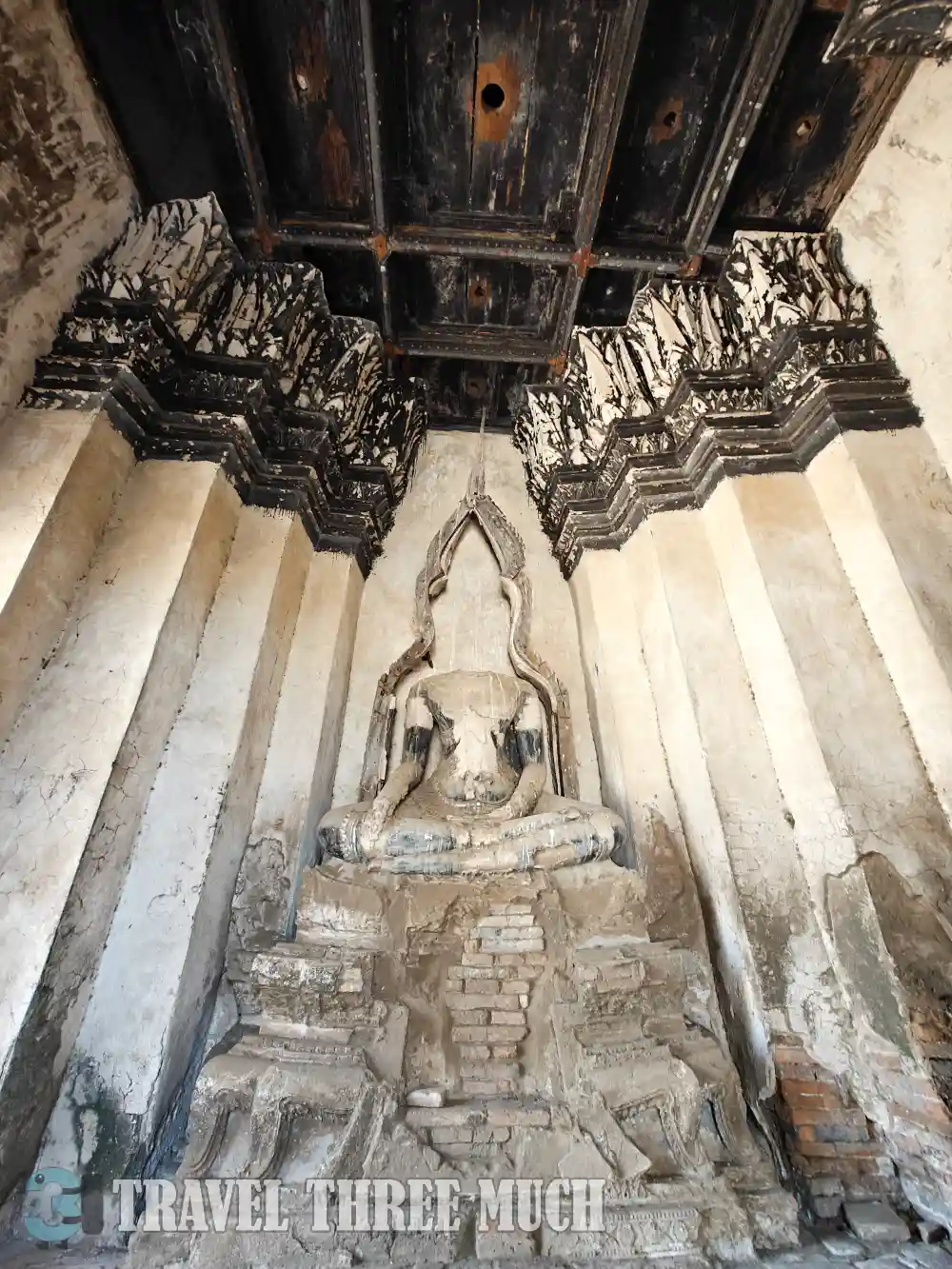
    We moved to the inner passage through a break in the wall.The arrangement was similar to the Wat Yai Chai with rows of Buddha statues, seated in perfect symmetry on brick plinths.

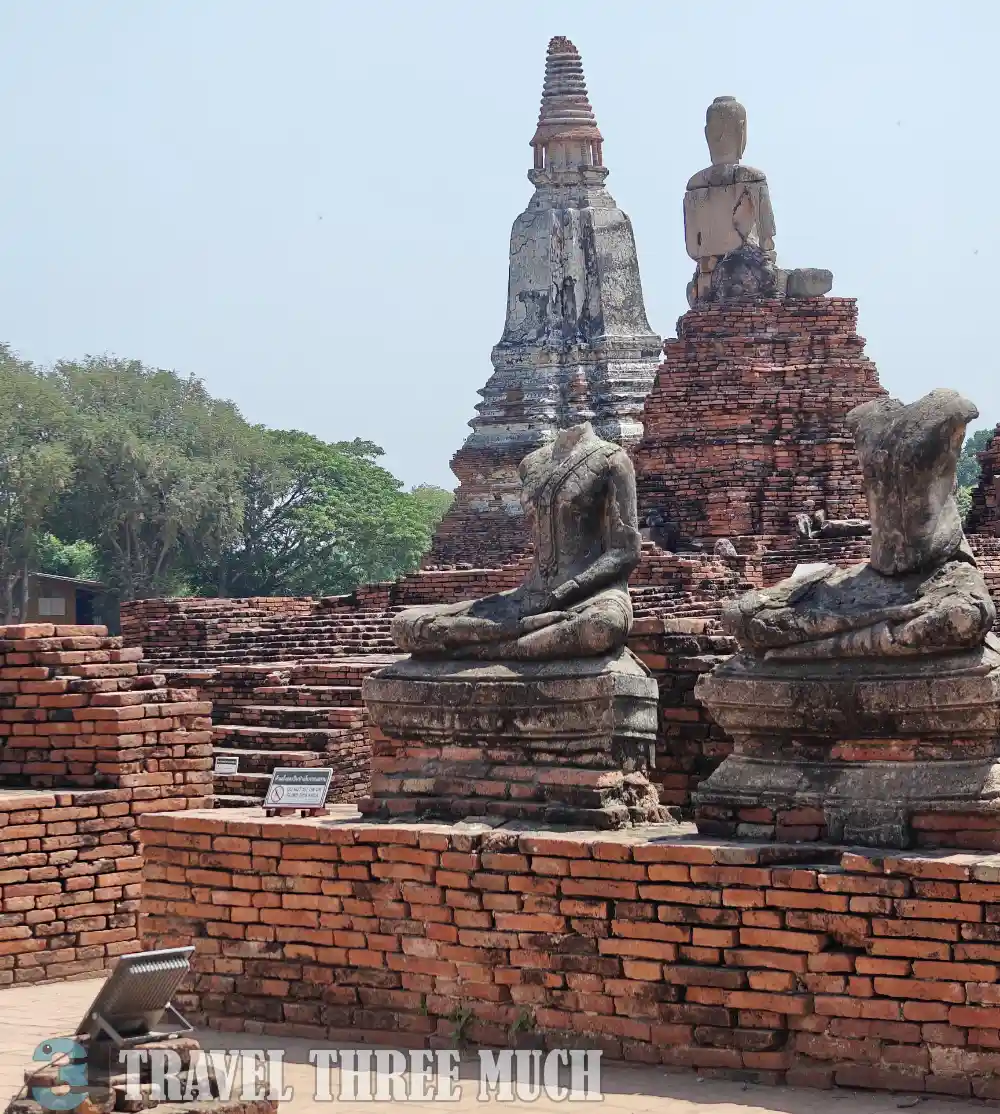
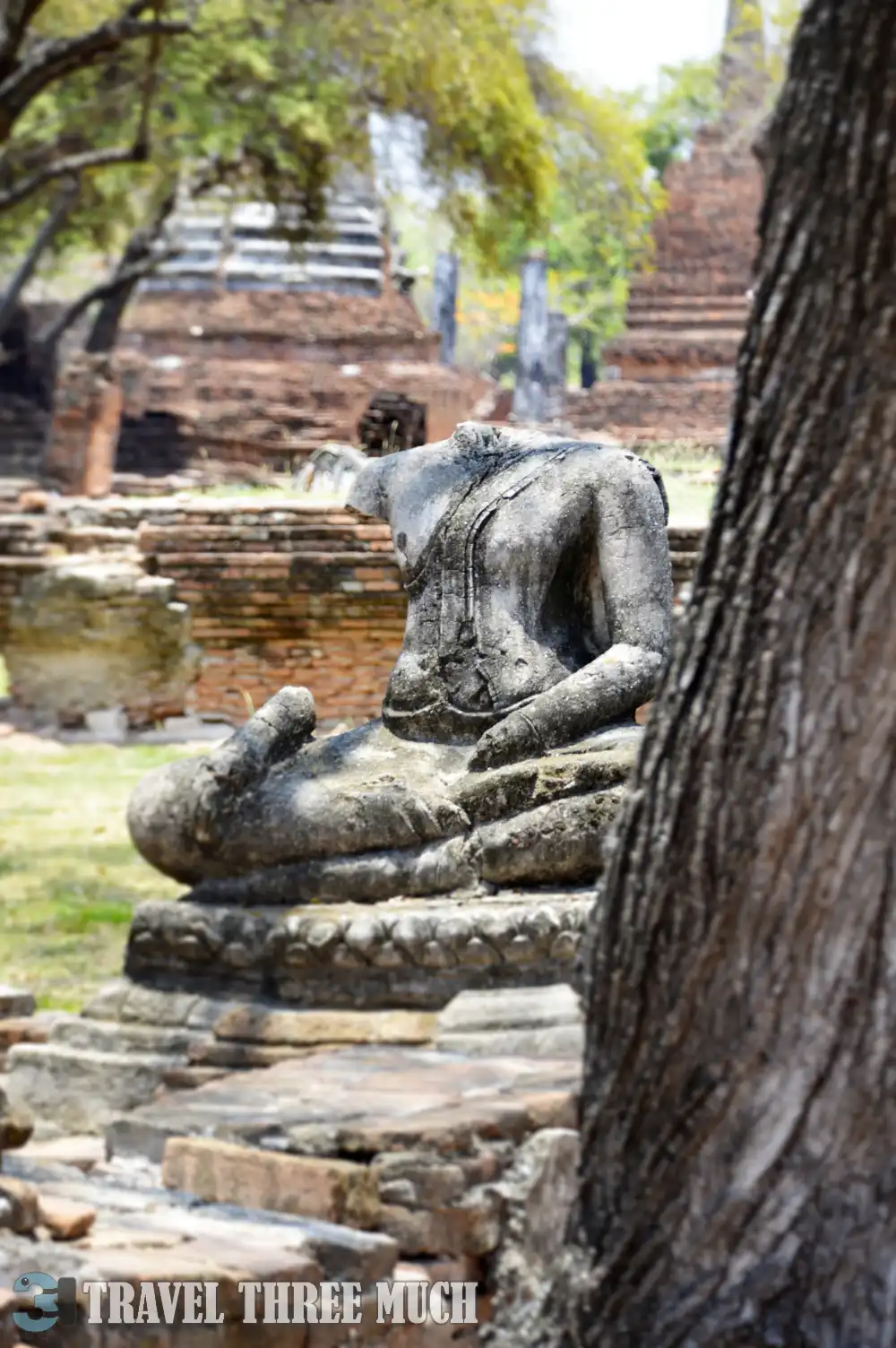
    Only a few statues retain their heads after the devastating sack of the city, and the remnants of the pillars that would have supported the roof above the statues, showing in a few places give us a glimpse of how magnificent the complex would’ve looked when intact.

    Each of the eight chedis of the outer wall had a giant seated Buddha and the inner walls were decorated with murals, once again of which only portions remain. The temple was undergoing restoration when we visited it.

    So we could only peek into some of the outer chedis and not enter them due to barricades and scaffolding. From the bits and pieces of the platforms, the headless statues, and the framing structure with stylized flames and fragments of stucco embellishments, we could imagine what majesty these alcoves would’ve exuded.

    The platform on which the main prang sits has two levels. A short flight of stairs leads to the first level. This level has four small prangs at the corners.

    A longer flight of steep stairs on each of the four sides of the main prang leads to a chamber. It is forbidden to climb any of these levels. The entire complex, including the prang and the chedis, is built in the Khmer style.

    On the way back out we saw the ordination (Ubosot) hall’s ruins of which only the plinth and the bases of the pillars remain. There was also the remainder of an altar with two Buddha statues seated at different heights with distinctly different styles of facial features and hairdos. On either side of the Ubosot hall are two chedis, which hold the ashes of King Prasad Thong’s mother. The king commissioned this temple as a memorial to his mother’s residence.

    Ayutthaya 1_14

    The riverside is a picturesque backdrop and sunsets must be stunning vistas. There were many people in traditional Thai costumes with props, having photo shoots done with the temple as a backdrop.

    The temple remains open from 8 AM to 6:30 PM on all days, except national holidays. We headed to Mayura’s House, halfway between the entry and exit of the parking lot, to grab an iced tea and a peach soda, and to take a break from the sun beating down on us. We found the seating space a bit less, but the food and drinks were excellent and reasonably priced. Refreshed, we headed out to our next stop, Wat Lokkayasutha.

    Wat Lokkayasutha

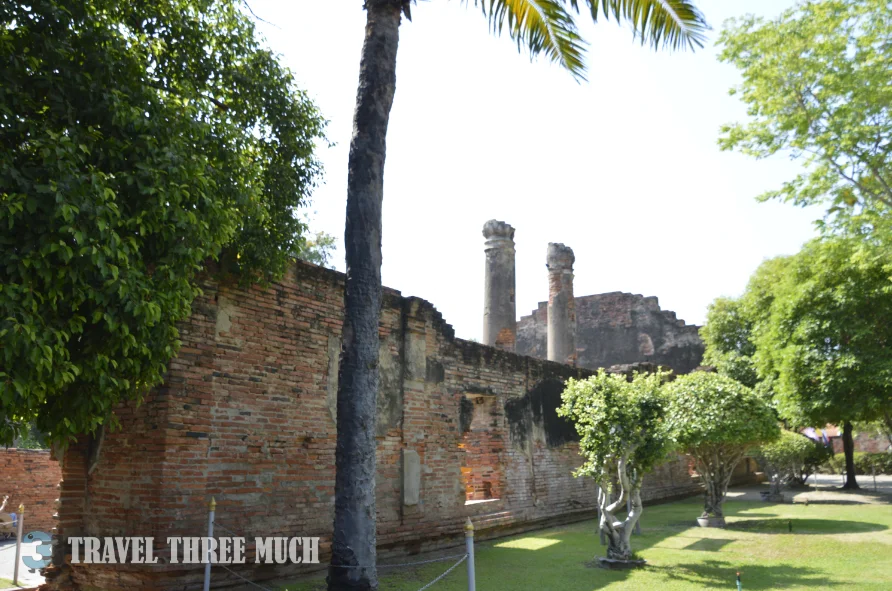
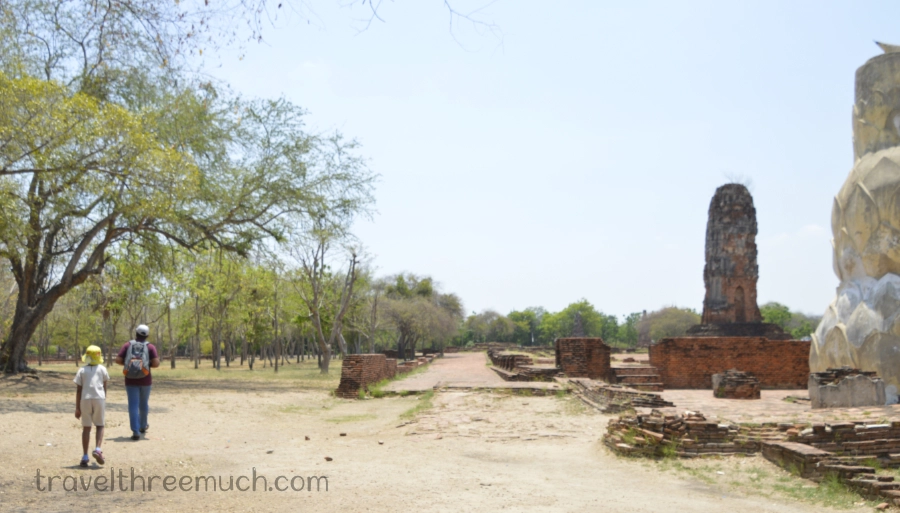
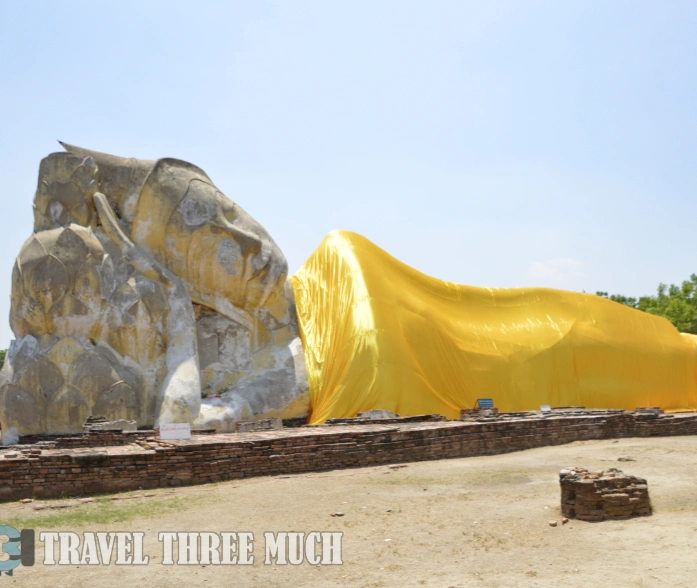
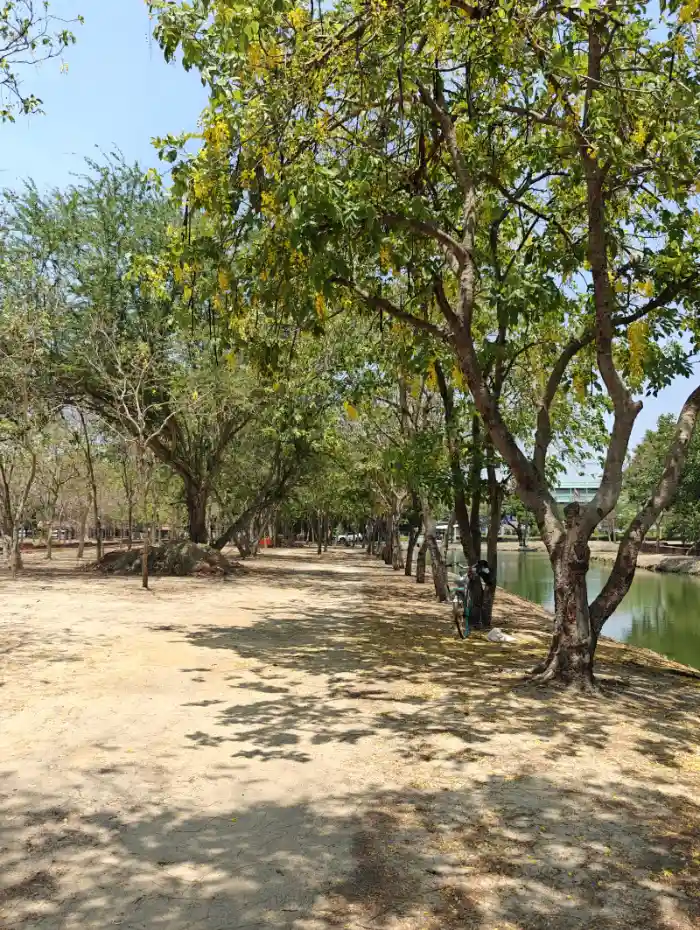
    Wat Lokkayasutha is largely ruined, with only the foundations and a singular prang (tower) remaining of the original temple. It is set a little ways off of the main Ayutthaya complex of monuments. So you may want to get a tuk-tuk or if it’s not too warm, get a bicycle to visit this place. There’s very little tree cover at the monument so, if you’re on foot, an umbrella or cap would be a good idea to shield from the sun. There’s no entry fee and the open timings are from 8:00 AM to 4:30 PM every day.

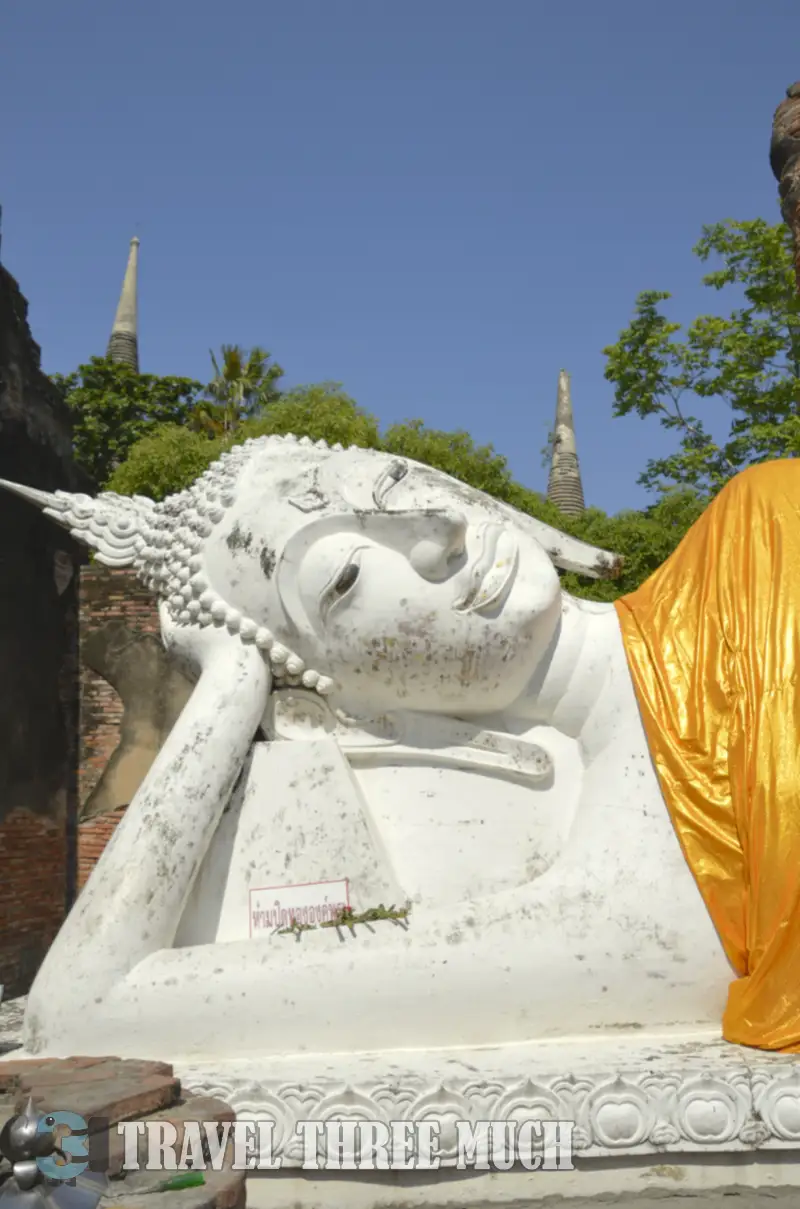
    The highlight of this place is the massive reclining Buddha who’s resting his head on a palm, which is, in turn, resting on lotus blossoms, with a hint of a smile playing on his lips and closed eyes. There weren’t many people at the monument when we visited.

    Wat Worachettharam

    Our sharp-eyed daughter spotted another ruin a little ways off but surrounded by what seemed like a moat.

    Thus we found ourselves at Wat Worachettharam, although we had never planned on visiting it.

    Wat Worachettharam was commissioned by King Ekathotsarot as the cremation site of his illustrious elder brother King Naresuan, who died due to an illness when on an expedition to counter a threat of Burmese invasion.

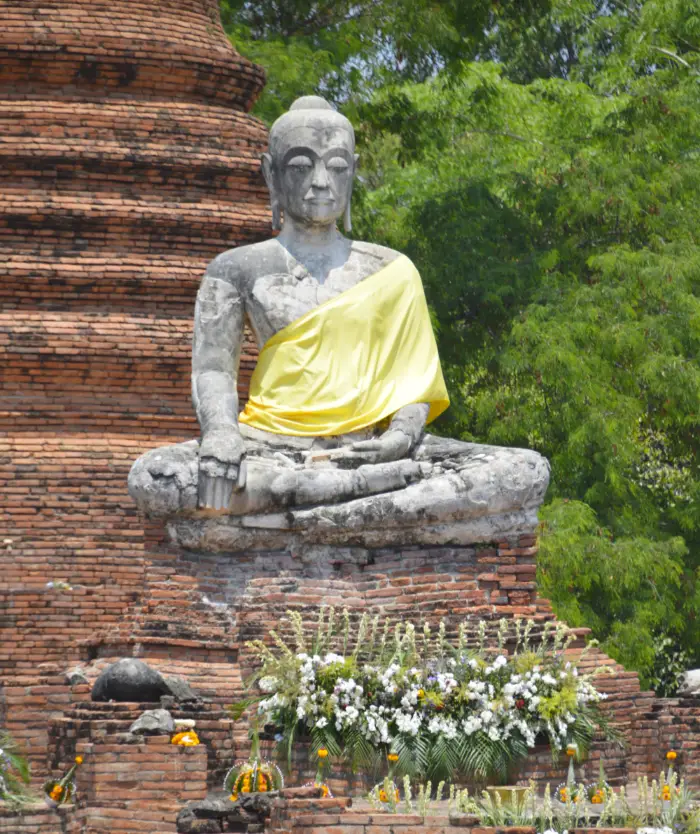
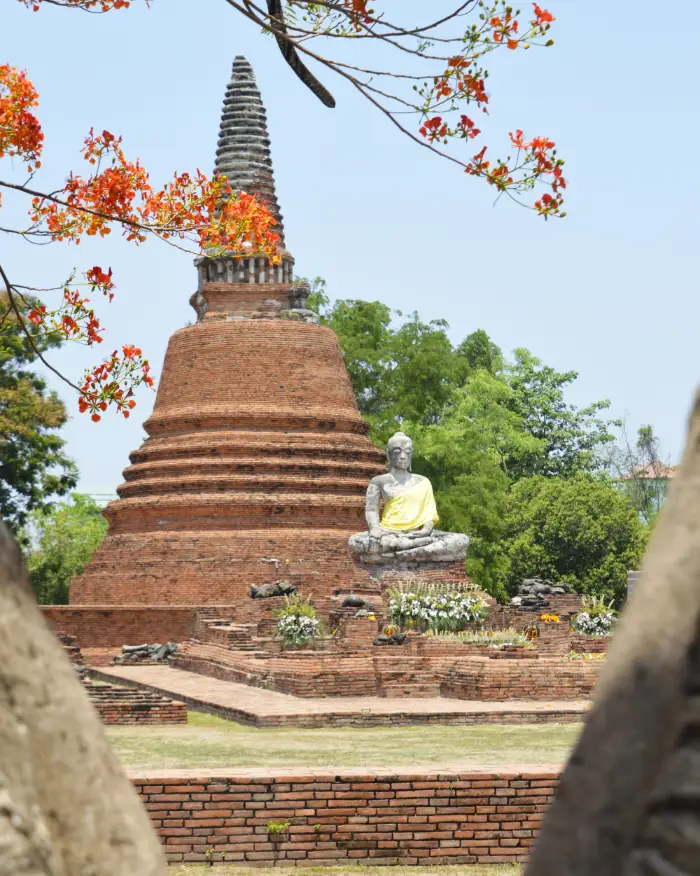
    The name of the temple in Thai translates to the Temple of the Sublime Elder Brother. We saw a bell-shaped stupa with a Buddha statue in the seated position, in front of which flower offerings had been made.

    The setting of the water body, the flame of the forest tree adding a dash of colour and the silence made us spend far more time and take many more photographs than we had originally planned! There’s an Ubosot hall with another Buddha statue, which we did not see as we still had lots more to visit on the itinerary. 

    The temples below sit within the enclosed Ayutthaya Historical Park complex — a separately ticketed area at the heart of the original royal island. After the idyllic time at Wat Lokkayasutha and Wat Worachettharam, it was time for us to visit the central complex of monuments.

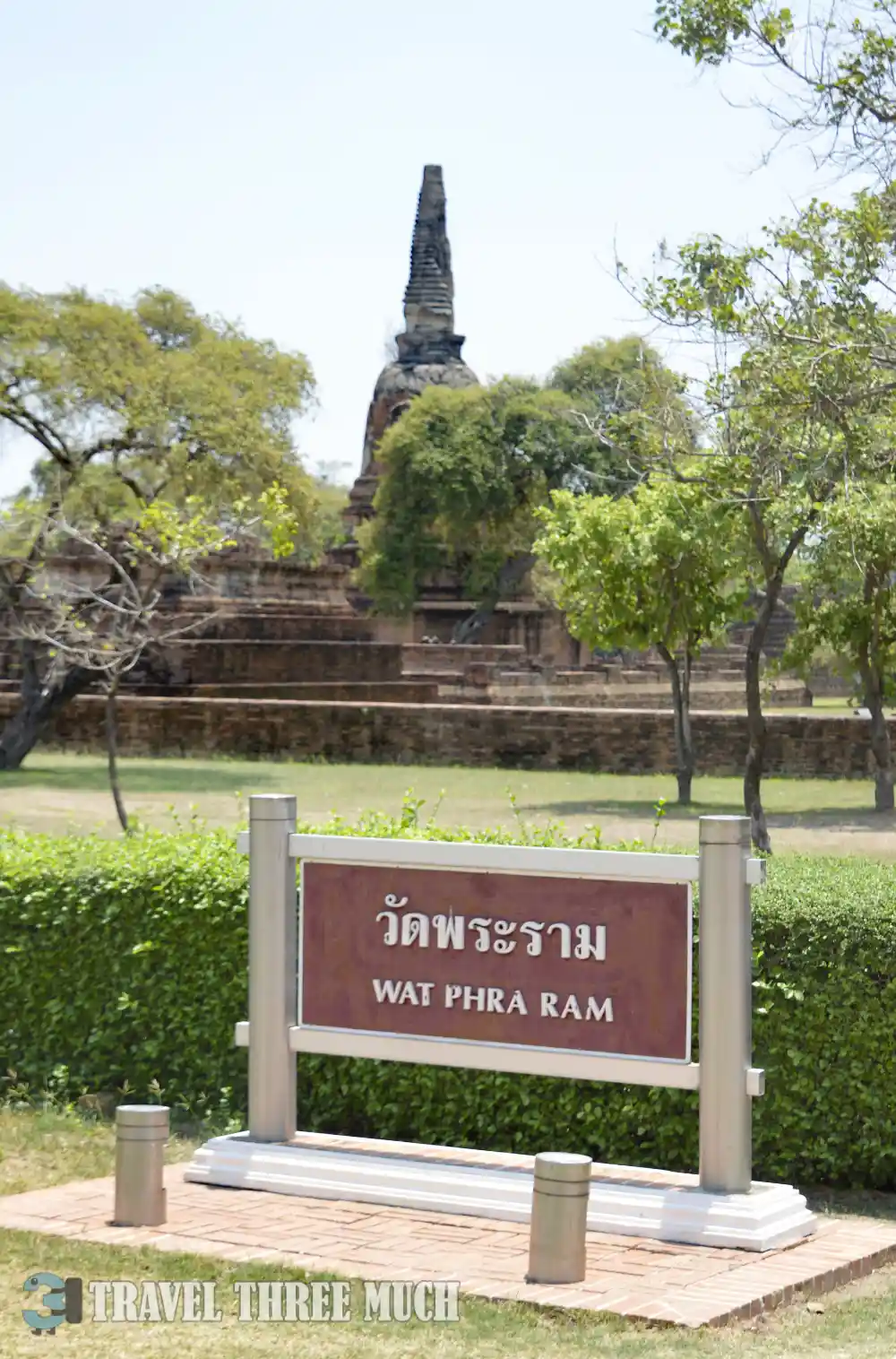
    Wat Phra Ram

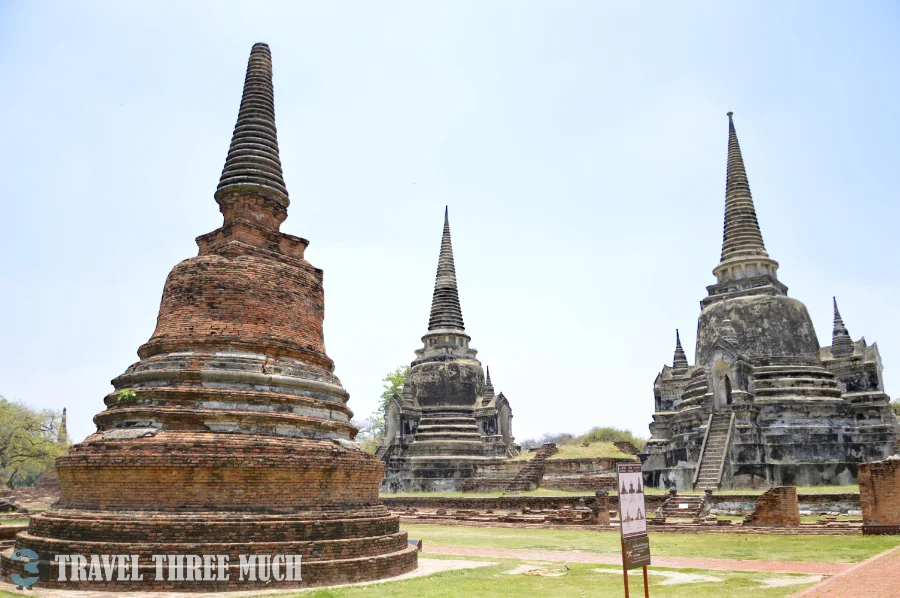
    Our first stop was Wat Phra Ram. This is a monastery constructed on the cremation site of King Ramathibodi I, the founder and first ruler of the Ayutthaya kingdom. Entry to the monument costs 50 THB per person and is free for Thai citizens and children.ayutthaya2 1

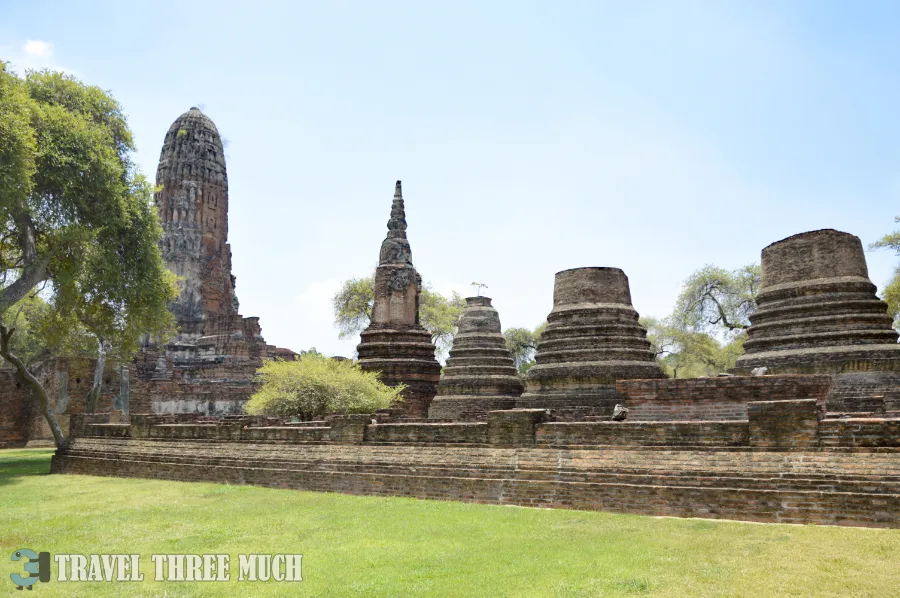
    The monument is open from 8:00 AM until 6:30 PM on all days. We encountered a set of three small chedis on a lawn. The pathway led us to some more chedis and finally, a small pond at the rear of the complex. From here, we could see the remains of the vihan. We also saw a couple of birds for the first time – an Indian Roller and a Pacific Reef Heron on the banks of the pond. The Indian Roller’s bright blue and purple hues were eye-catching. The reef heron’s drab grey form, as it remained perfectly still, scanning for prey, made it seem like a small rain cloud floating on stilts above the pond.

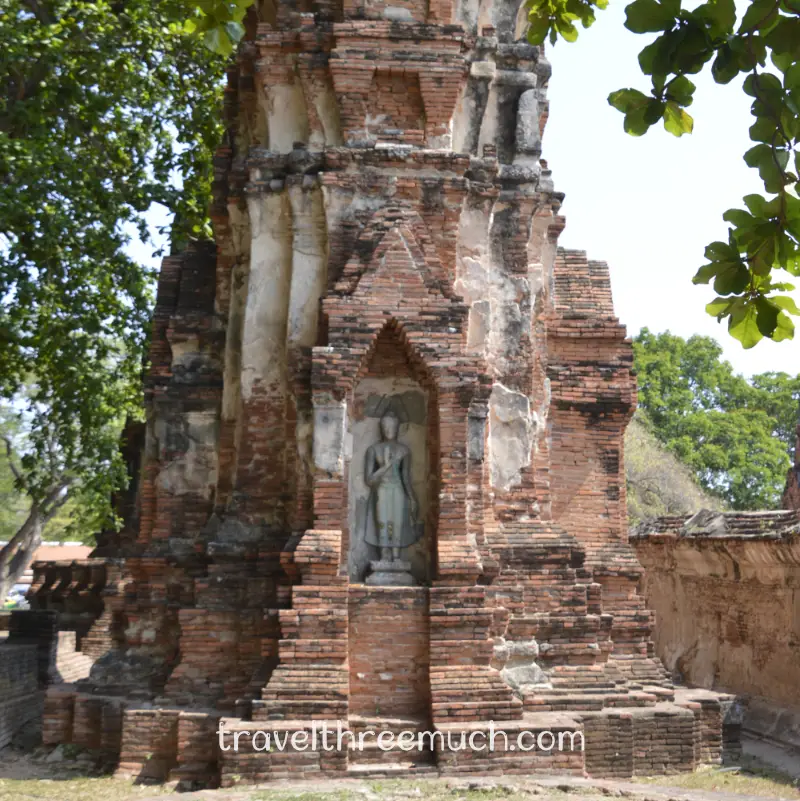
    Just past the vihan, we came to the Khmer-style central prang, surrounded by four smaller prangs on a square platform. Wat Phra Ram is one of the first temples of Ayutthaya. It follows the Khmer school of architecture in its construction. We made our way to Wat Phra Si Sanphet, next.
    Wat Phra Si Sanphet

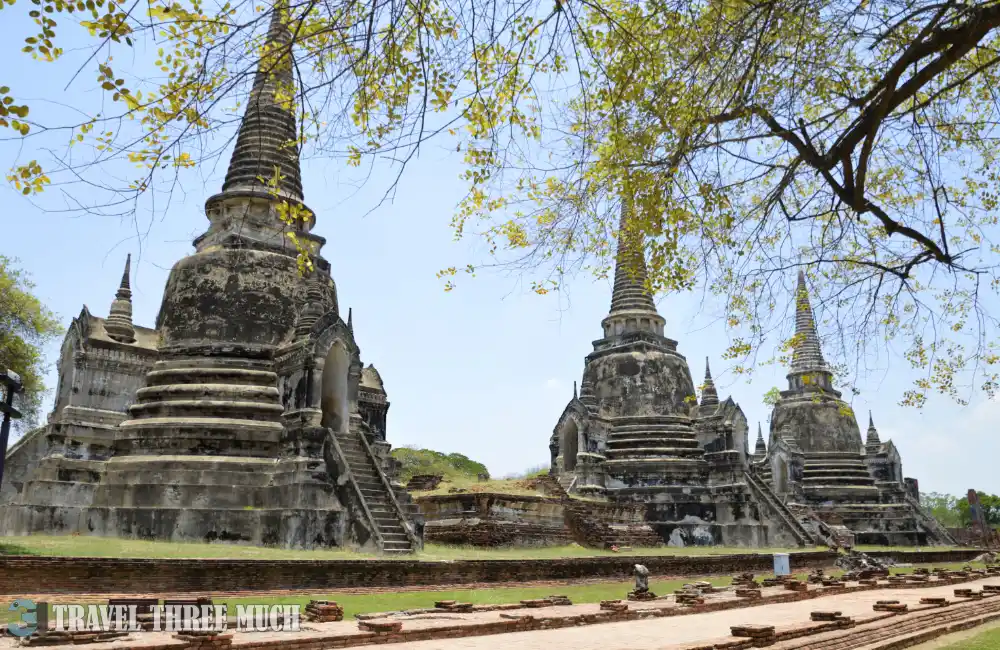
    Ayutthaya’s principal temple, Wat Phra Si Sanphet was situated within the kingdom’s Grand Palace grounds. Entry fee to the temple is 50 Thai baht per person. There is no entry fee for Thai citizens and children. Just past the entry gate, we immediately come face-to-face with the three chedis and the mandapas. These serve as reliquaries for the remains of three of the monarchs of the Ayutthaya kingdom – King Ramathibodi II, King Borommarachathirat III, and Borommatrailokkanat.

    These are the only structures that survived the Burmese invasion in 1767 CE and the accompanying sack of the capital. We sat under a Bo(Sacred Fig or Peepal) tree on the monastery lawns for a while. We took in the splendid stucco work on the chedis and mandapas. It is said that a giant image of the Buddha in a standing posture, about 16 m tall and gilt with close to 350 kg of gold, once served as the capital’s palladium at this monastery’s royal chapel.

    Similarly, five Buddha images made out of gold, copper, and silver were commissioned and installed in the chedis and mandapas. The Burmese invasion wasn’t kind to Wat Phra Si Sanphet’s treasures. Invaders stripped the gold from the chedis, mandapas, and even a giant Buddha statue, leaving only a damaged core behind. They hauled away the loot, leaving the once-gleaming temple behind.

    Some believe the massive Buddha head in Bangkok's National Museum is from Wat Si Sanphet.

    We finished walking around the central chedis and reached the remains of the viharns.

    From here, we could see a board that indicated the presence of other points of interest such as three different Throne Halls and the Royal Palace.

    We walked around for a bit but could find nothing other than the traces of the outer walls of these structures with information boards indicating the spaces they would’ve occupied. Today, other than the remains of the foundations of the buildings, and the outer walls in a few places, nothing else remains of the Grand Palace complex.

    The Fine Arts Department built a scale model of the city, using their studies of documents and past excavations to bring Ayutthaya’s grandeur back to life. The model gave an idea of the impressive scale and grandeur of the city in its heyday.

    We exited Wat Si Sanphet and had some iced tender coconut (called Young Coconut in many places in Thailand) to beat the heat.

    Some places that we skipped
    • The Wihan Phra Mongkhon Bophit, famous for its giant gilt Buddha image in the seated position, is right outside the Wat Si Sanphet entrance. We didn’t visit the wihan on this trip.
    • The Royal Kraal and Elephant Stables are nearby, where the elephants and their keepers can be hired for 20-minute rides and photos. We gave this a miss because we had many opportunities to see elephants in the wild back home, and the potential for animal abuse did not sit well with us.

    Our next stop was one of the most photographed places in Ayutthaya – Wat Maha That.

    Wat Maha That – The Buddha Head in Tree Roots

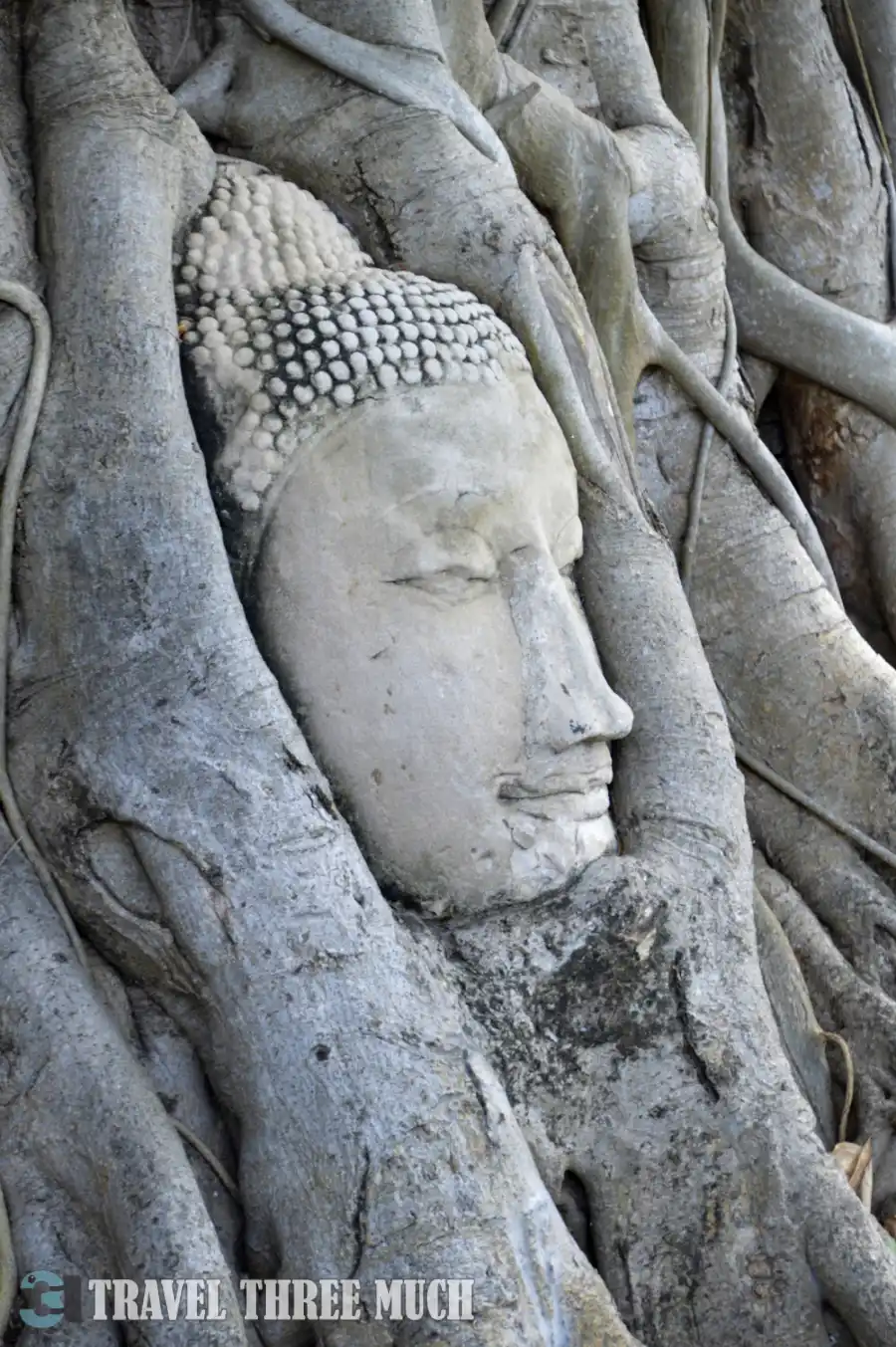
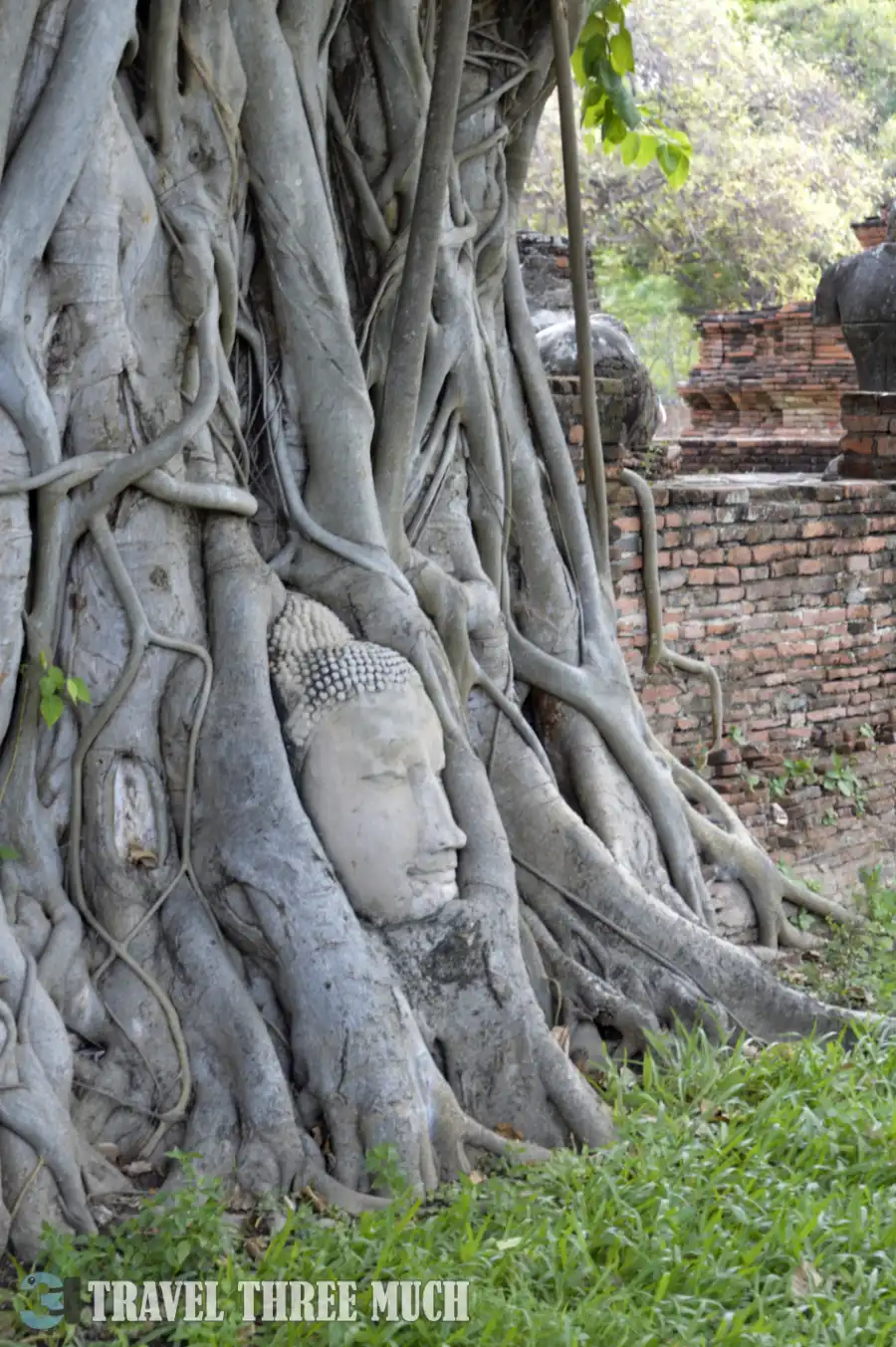
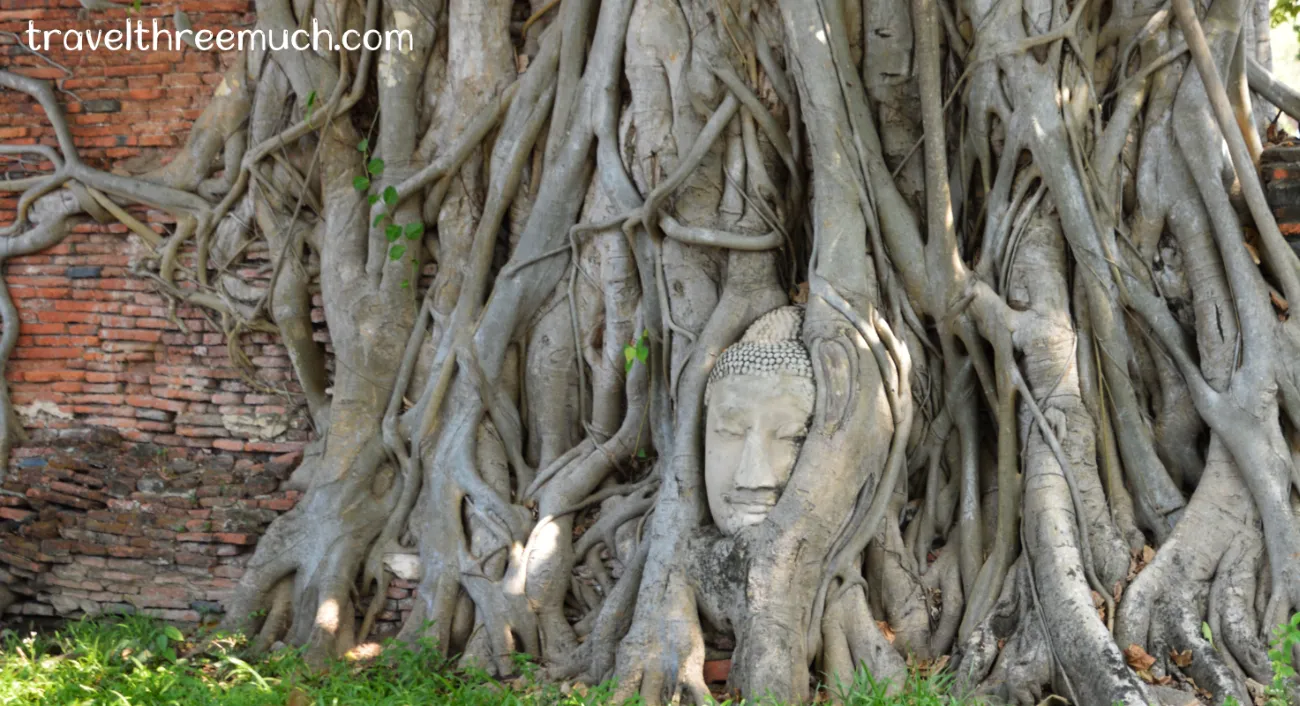
    The most photographed image in all of Ayutthaya is the sandstone Buddha head, embedded in the roots of a bodhi tree. Nobody knows exactly how it came to rest there. The widely accepted explanation is that it fell during the Burmese destruction of 1767 CE and the tree’s roots slowly grew around it over the following two and a half centuries.

    One rule before you enter: you must crouch or kneel when photographing the Buddha head. Standing taller than the head is considered disrespectful and temple staff enforce this.

    Entry to Wat Maha That is 50 Thai baht, free for Thai citizens and children. Wat Maha That remains open from 8:00 AM to 5:00 PM on all days. The entrance gate led to a pathway on the side of the temple, laid out along the East-West directions. We took a right turn on the path, past a row of chedis, to reach what’s probably the most photographed object in all of Ayutthaya.

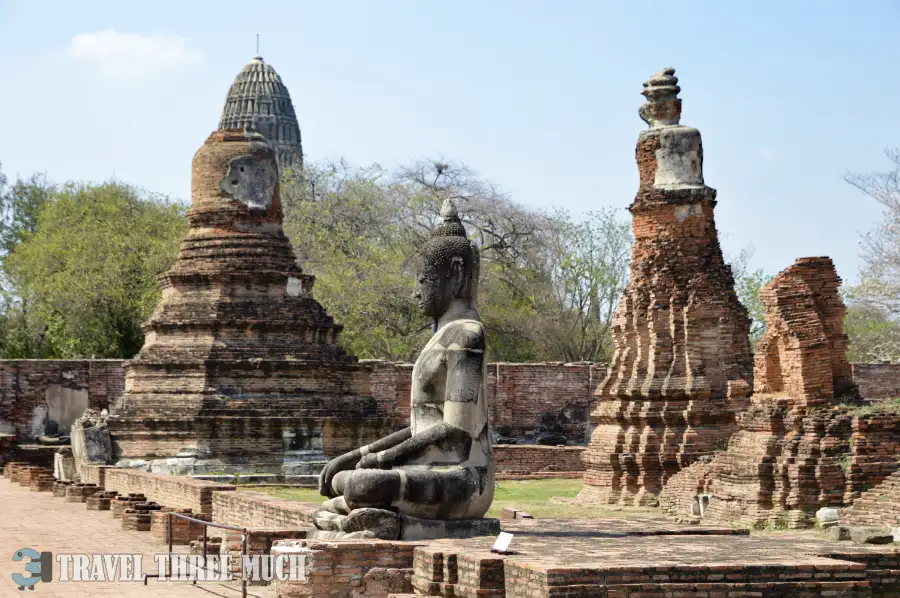
    It was a Buddha’s head in the roots of a Bo tree, which has become a symbol of Ayutthaya. There was an area reserved in front of the Buddha’s head for tourists to take pictures with it, and a guard to ensure propriety in the presence of the Buddha was followed. Specifically, standing taller than the Buddha’s head is a strict no-no as it is considered disrespectful. So, be mindful of this when taking pictures. There was a ‘satellite’ vihan, past the tree roots, with a Buddha seated in front of it. As most of the crowds were drawn to the Buddha’s head, this was a relatively calmer area.

    We took a break from the afternoon sun thanks to the trees above. The contrasting deep greens with the rich ochre shades of the brickwork only broken by the white plaster of the Buddha image and the golden wrap over the shoulder, and a gentle breeze cooling us off, all made us pause and lose track of time. While the Buddha was seemingly resonating his timeless message of this too shall pass.

    Just past this vihan is the remnant of the main prang’s base. The main prang, once a towering structure, is now a sad reminder of the importance of preserving historical sites.

    Time and neglect haven't been kind to Wat Maha That's central prang. Once a towering structure, today only the staircases leading to its base and scattered brickwork remain. This collapse in the early 20th century serves as a stark reminder of the importance of historical preservation.

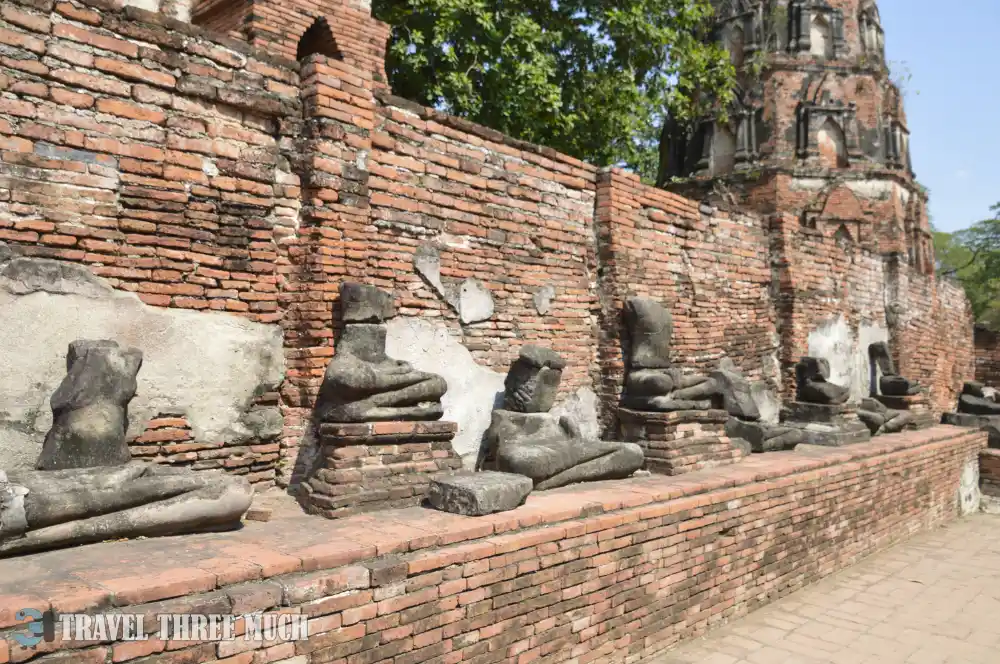
    Despite the missing centerpiece, Wat Maha That offers a glimpse into Ayutthaya’s past glory. The surrounding galleries showcase rows of headless Buddha statues, a silent testament to the large scale destruction the site endured.

    The Thai name of this temple translates to The Temple of The Great Relic. The name likely references Buddha’s relics, excavated in the 20th century. These are on display at the Chao Sam Phraya Museum in Ayutthaya. The museum also has other artifacts recovered from excavations in Wat Maha That and Wat Ratcha Burana. The museum is worth a visit if you’re a history buff or wish to learn more about the Ayutthaya kingdom’s rise and fall.

    Wat Ratcha Burana

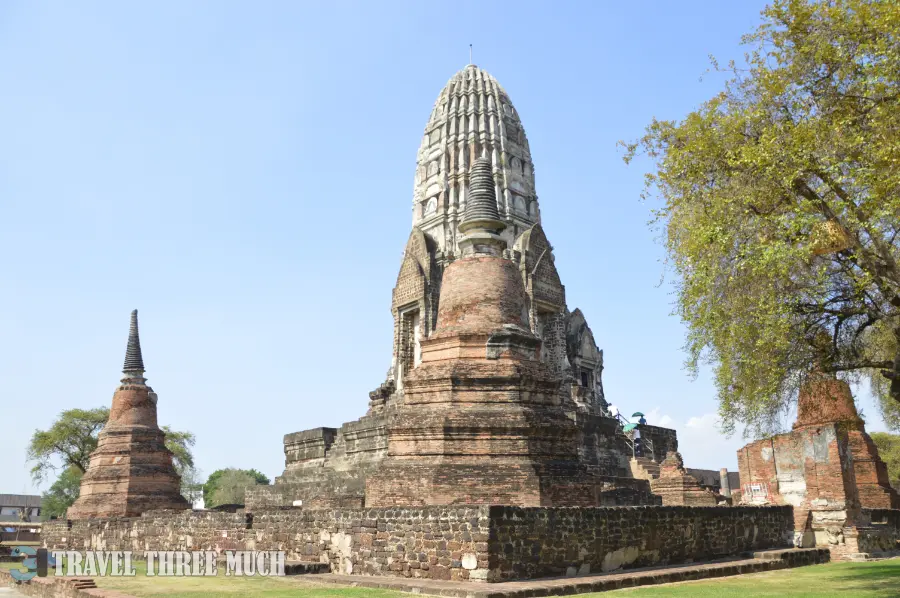
    Our last destination for the day was Wat Ratcha Burana, next door to Wat Maha That. Wat Ratcha Burana is open from 8:30 AM to 5:00 PM. The entry fee is 50 Thai baht per person and no charges for Thai citizens and children. The main prang, visible from the entrance, stood as a testament to Khmer architectural influence, much like the earlier temples. Built in 1424 CE, Wat Ratcha Burana honors the memory of two royal brothers who died in a fight for the throne.

    Just past the main entrance is the royal vihara, aligned on the East-West axis with the main prang. The construction style is Khmer, as are most of the older Ayutthaya monuments. Only the side walls and a few pillars of the vihara remain. A portion of the vihara extends into the gallery surrounding the main prang.

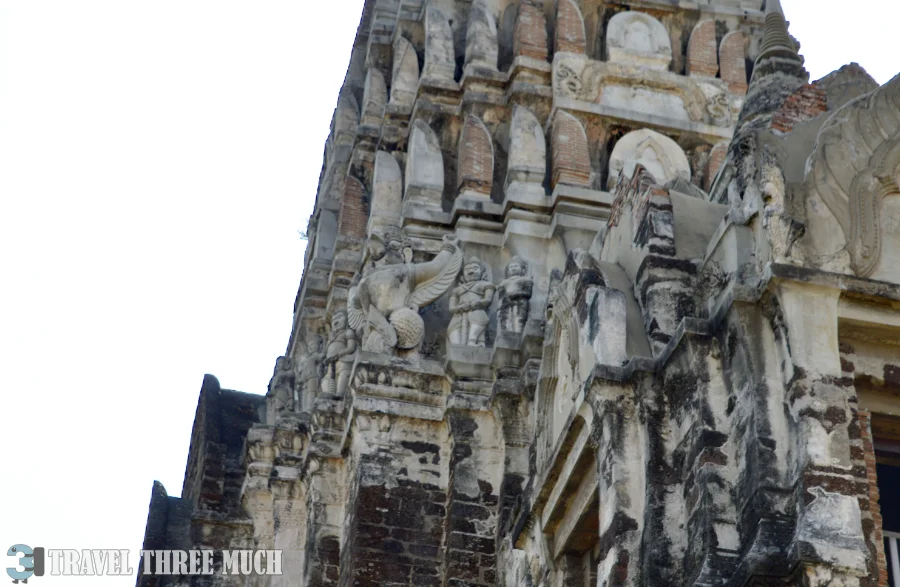
    We walked up a short flight of stairs to the first level of the prang. The prang has Garuda sculptures at the base, as well as on the tower. Another longer set of steep stairs leads up the side of the prang to the top.

    From here one gets panoramic views of the Wat’s grounds. The Ordination (Ubosot) hall with some portions of the side walls, a portion of the altar, and a couple of pillars are also visible from the top.

    When we visited, we couldn’t access the two-level crypt where the princes were once interred. The excavated relics are in the Chao Sam Phraya Museum. Only the murals on the walls of the upper and lower chamber are supposedly still in the Wat.

    After our historical exploration, we indulged in a sumptuous lunch at Burana Ayutthaya Cuisine. The Pad Thai and Pesto Spaghetti, followed by creamy coconut smoothies, provided a perfect end to our day.

    As we departed, we carried with us vivid memories of Ayutthaya’s ruins. It stood as a testament to a dynasty that achieved remarkable heights in art, economics, and society, only to fall to the very vices the Buddha warned against.

    What to Wear at Ayutthaya Temples

    Every temple in Ayutthaya is an active place of worship or a protected religious site. The dress code is the same across all of them:

    • Shoulders must be covered — no sleeveless tops, tank tops or strapless clothing
    • Knees must be covered — no shorts above the knee, no short skirts
    • Open-toed footwear is fine; remove shoes before entering any enclosed hall or shrine

    If you arrive without covered shoulders or knees, sarongs are available at most temple entrances for a small fee or refundable deposit. Light cotton or linen in pale colours works well as dark fabrics absorb the heat quickly at open-air sites.

    People ask Ask

    One full day covers the major temples if you start by 8 AM. Starting at 10 AM (as we did) still allows 8 temples with steady movement. Two days is better if you want to include the Chao Sam Phraya Museum, Bang Pa-In Palace (18 km south), and smaller sites without rushing.

    Most temples charge 50 THB per person. Thai nationals and children enter free. Wat Lokkayasutha is free for all visitors. A combined pass is available for the Historical Park cluster ask at the first ticket window you encounter.

    Hiring a cab is the easiest option. But the convenient option is the train from Hua Lamphong or Bang Sue Grand Station. These trains run throughout the day and take 1.5–2 hours (15–100 THB depending on class). From Ayutthaya station, a 4 THB ferry takes you across the river.

    Yes, with an early start from Bangkok. Bang Pa-In is 18 km south of Ayutthaya and takes 1.5–2 hours. Most people visit Bang Pa-In first in the morning, then proceed to Ayutthaya in the forenoon.

    The whole place is phenomenal. The Buddha head in tree roots at Wat Maha That is the single most distinctive sight – nothing quite prepares you for it in person. Wat Chai Watthanaram is the most photogenic from the river, especially late afternoon. Wat Phra Si Sanphet’s three royal chedis give the clearest sense of the kingdom’s original scale.

    Prasanna is the Primary Writer and Technical Expert behind the posts. He is responsible for the detailed facts, historical context, and logistical breakdowns. He has a deep love for mountains, history, nature, and is the family's expert packer.
    Leave a Reply

    Your email address will not be published. Required fields are marked *