

Rani Ki Vav Stepwell: Guide to Gujarat’s UNESCO Wonder
Updated on March 20, 2026
Contents
Rani ki Vav had been in our bucket list for a few years now. Not only because it is an UNESCO heritage site, but also because, the concept of a step well was truly intriguing. All we knew was we wanted to see this place but did not know much about its history. Unlike many of our other trips where we read up on the place we plan to visit, that month being crazy busy on the work front, we really did not get to it.
We visited Ahmedabad during the month of December in 2023. Based on the reviews, we chose a day in the start of the wee. This was to ensure there wouldn’t be too much of a crowd, being Christmas holidays season and all.
History of Rani Ki Vav
In the town of Patan in Gujarat, one of the largest examples of step wells in India – Rani Ki Vav, or the Queen’s Stepwell is situated. The ‘queen’ refers to the Chalukya queen Udayamati, who commissioned the stepwell in memory of her husband, King Bhima I. That’s right – it’s not just Shah Jahan who built a humongous monument for his wife. There are women out there who’ve also built amazing intricate architectural marvels for their husbands. And these have utility too. (But, I mean, not comparing!!)
Construction began in 1063 CE and took approximately 20 years to complete. The Prabandha-Chintamani, a 14th-century Jain text written by monk Merutunga, specifically mentions that Udayamati, the daughter of Naravaraha Khengara of Saurashtra built this stepwell at Patan, intending to outshine the famous Sahasralinga Talav nearby. At that time, Patan was the capital city of the Solanki dynasty’s empire, a period of extraordinary political stability, artistic flourishing, and religious patronage across western India.
Combine with Modhera Sun temple
The same era produced the Modhera Sun Temple and the Vimalavasahi Temple on Mount Abu and all three share the Maru-Gurjara architectural style. In fact, all three were built within decades of each other, and all three stand today as evidence of what this dynasty achieved at its peak.
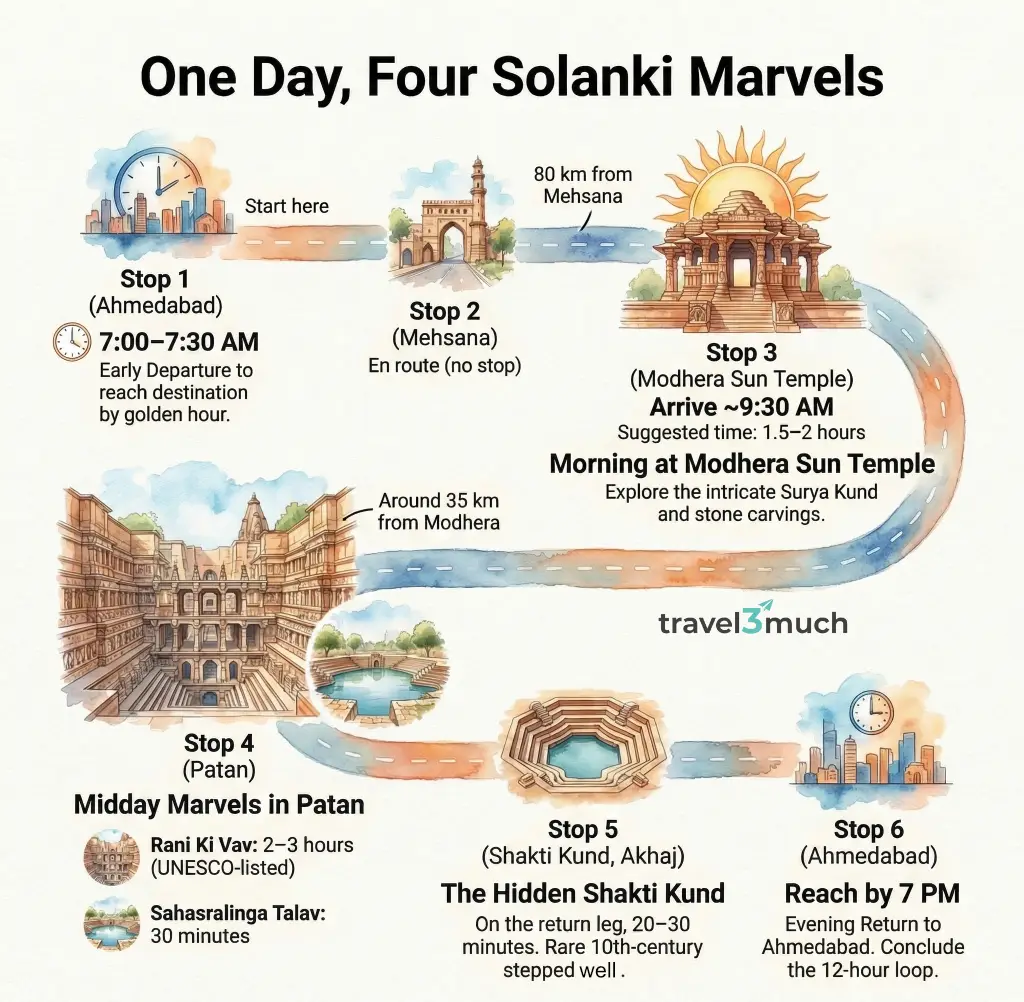
Our trip to Rani ki Vav was part of a one day trip from Ahmedabad. The below diagram would explain you how we combined the different places and how our day looked like.
Modhera Sun Temple: The Perfect Companion to Rani Ki Vav
The same kings who commissioned Rani Ki Vav built the Modhera Sun Temple just decades earlier — same dynasty, same architectural tradition, same obsessive attention to carved stone. Our guide covers the temple, the Surya Kund stepwell, the light show timings, and everything you need to plan the day.
Lost for 900 Years: The Burial and Rediscovery
Within a century of its completion, Rani Ki Vav disappeared.
A catastrophic flood from the Saraswati River buried the entire stepwell in silt, and there it remained for the better part of 900 years. When British archaeologists Henry Cousens and James Burgess visited the site in the 1890s, they found what they described as “a huge pit measuring 87 metres.”
Only the top of the well shaft and a handful of pillars were visible above ground. Everything else was under the earth, preserved perfectly by the same silt that had hidden it. Excavations carried out under the Baroda State in the 1940s first revealed the scale of what lay below. The Archaeological Survey of India then undertook a major restoration between 1981 and 1987, during which they uncovered not only the stepwell in its near-complete form, but also a sculptural image of Udayamati herself. UNESCO listed the site as a World Heritage Site in 2014. What the river buried, the archaeologists gave back.
There is no hint of the scale of the structure until you reach the entrance.
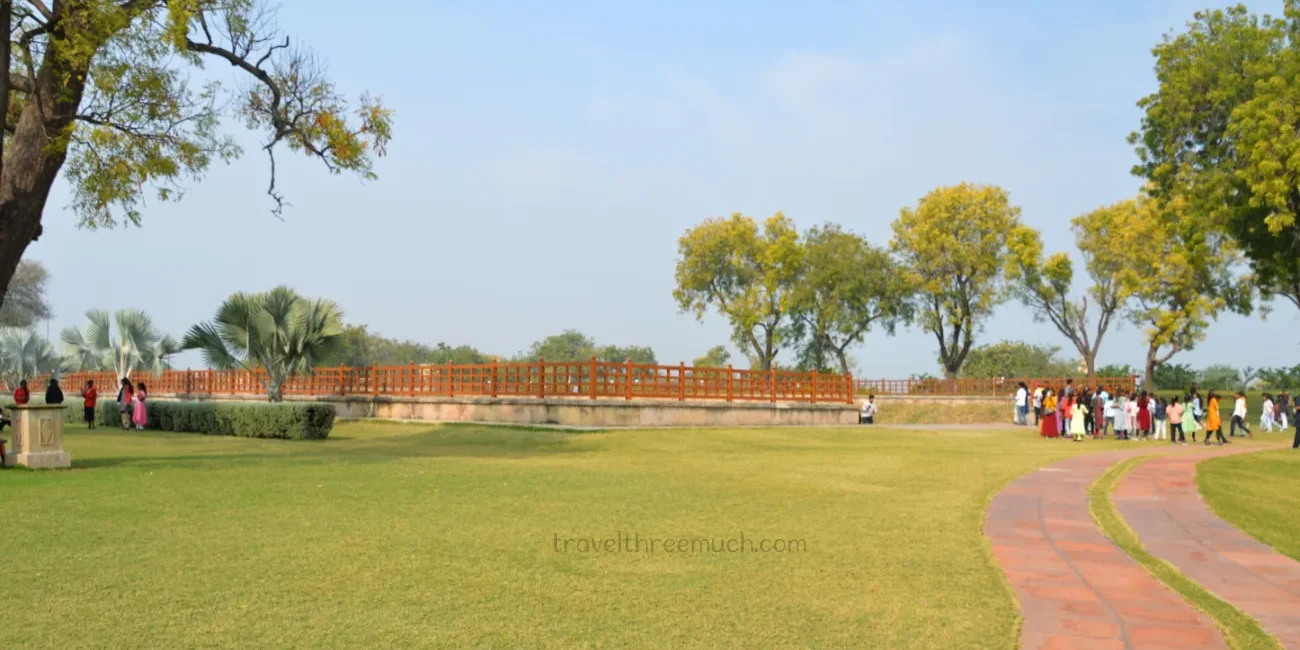
The image above – this is what you see when you walk in. And once you get to the entrance, you are blown away with what you see below.
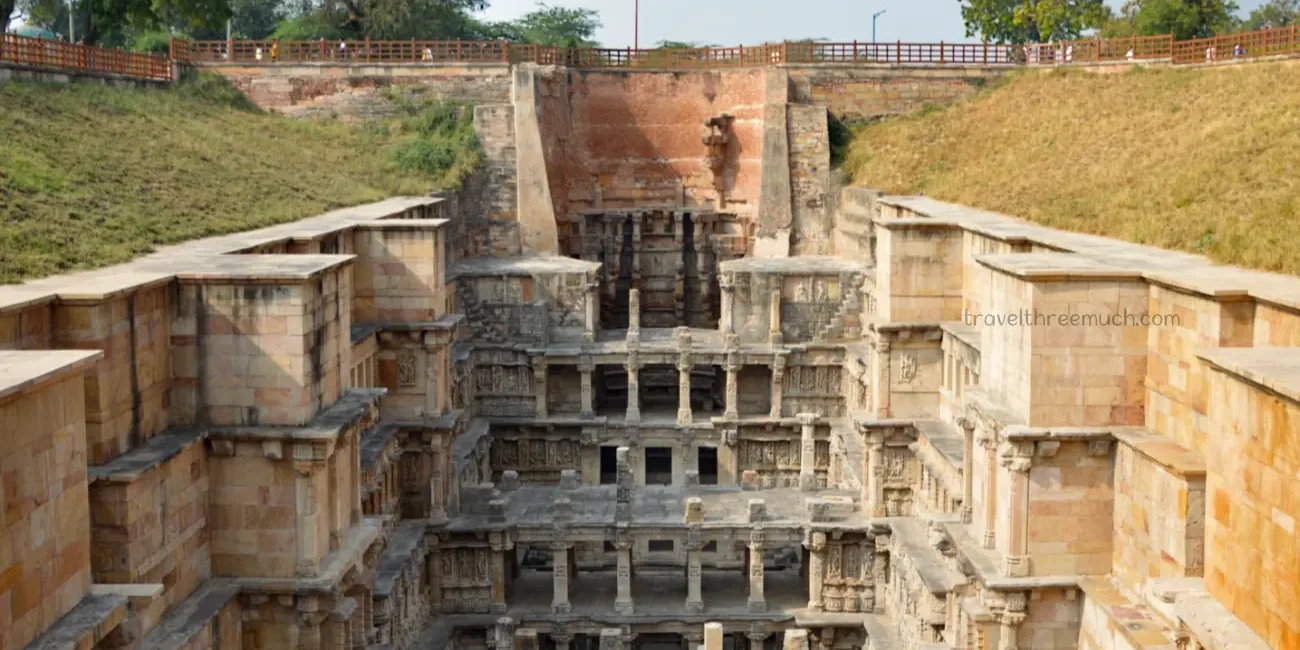
The Step well – the splendor and the glory
The construction of the stepwell took 20 years to complete and the result is nothing short of breathtaking. The unique aspect of this stepwell is that, the construction is in the form of an inverted temple. As you walk into the monument, all you see is some people walking around the lawn. The complex is totally hidden from view at the ground level.
The ‘inverted temple’ design is a theological statement beyond architecture. A conventional temple as we might have all seen, rises upward toward the divine. Rani Ki Vav descends toward it. Water, in Hindu tradition, is sacred and is the source of life, the element through which the gods manifest. By building downward, toward the water table, Udayamati created a temple whose sanctum was the water itself.
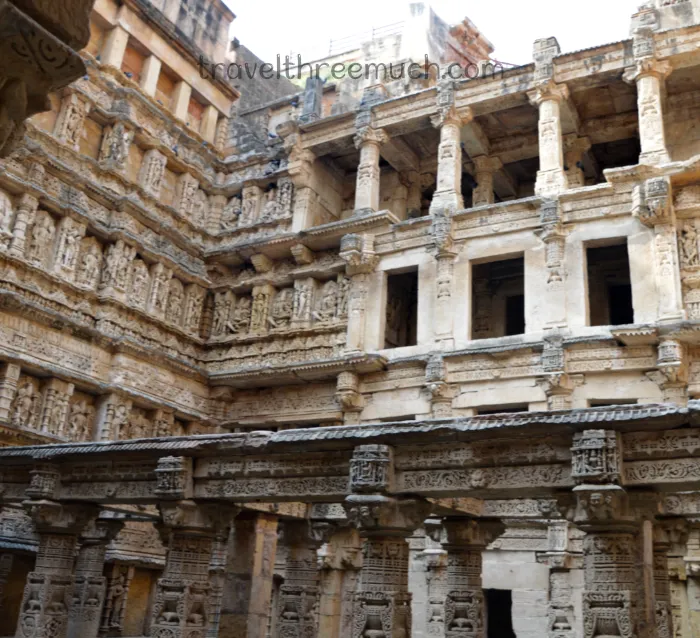
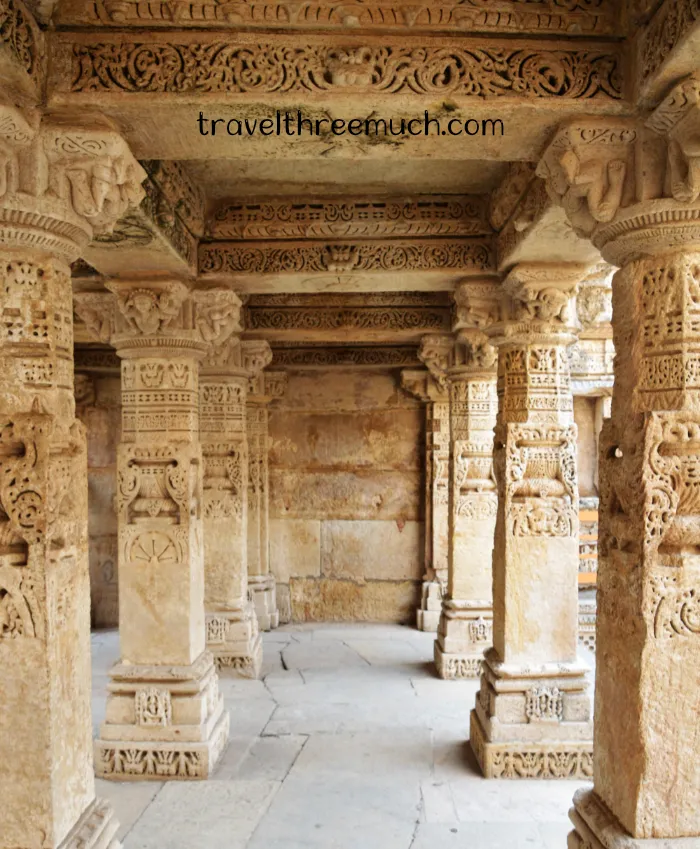
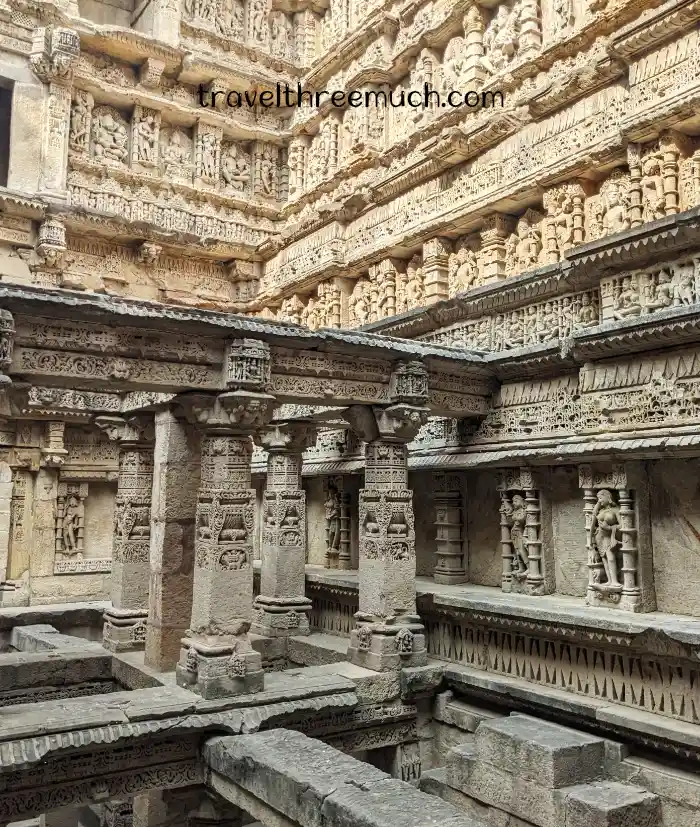
Each level you descend is a step deeper into the sacred. The Sheshashayi Vishnu, Lord Vishnu reclining on the thousand-hooded serpent Shesha in the celestial ocean which is at the lowest level is not just a sculpture. It is the presiding deity of the entire underground temple.
The Numbers That Tell the Story
Rani Ki Vav measures 65 metres long, 20 metres wide and 28 metres deep. It is divided into seven levels of stairs, four pillared pavilions of increasing height as you descend westward, a rectangular tank at the fourth level at a depth of 23 metres, and a circular well shaft at the western end is 10 metres in diameter and 30 metres deep. There are 212 pillars.
The compound with the step well has a fence with walkways around the well and lawns on which people were relaxing.
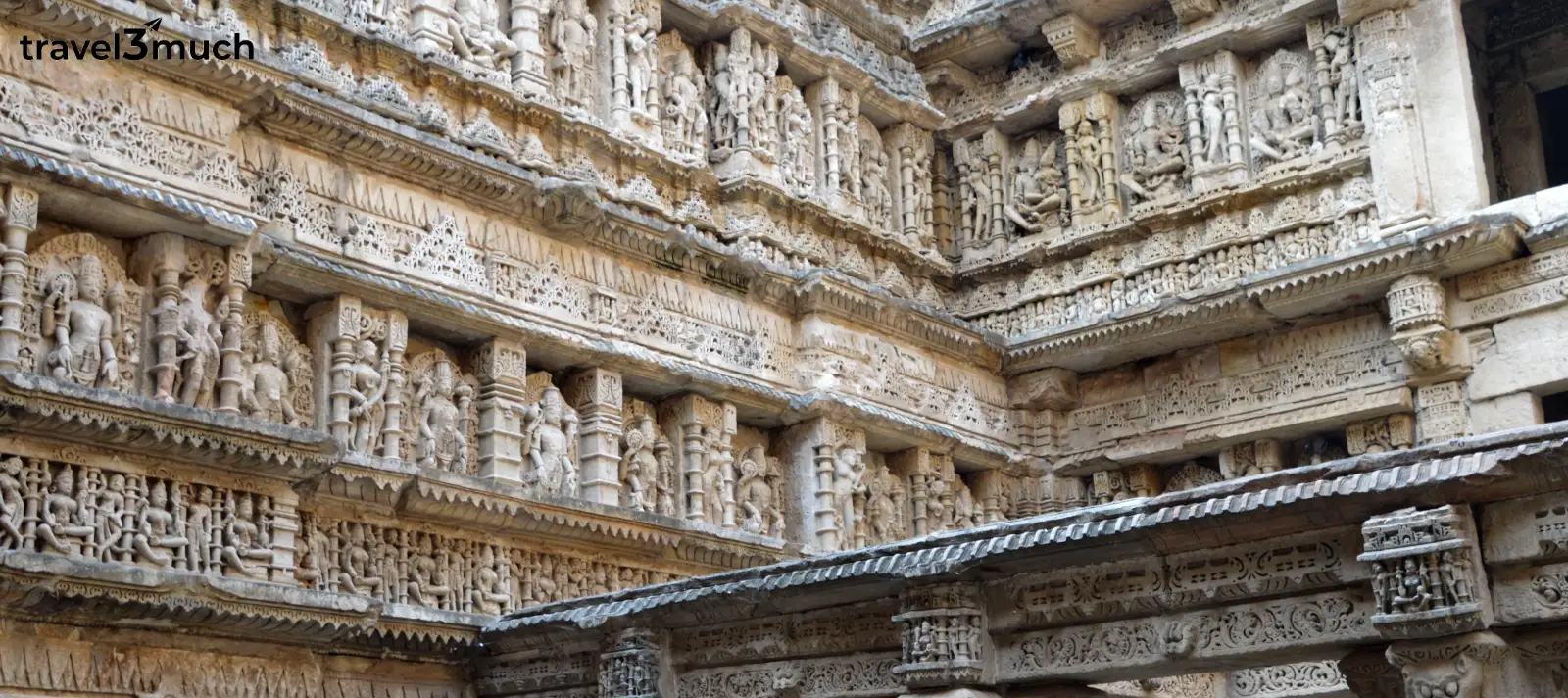
As we descended the set of stairs to the first level, not only the scale of the step well but also the intricate details on the walls and pillars came into view.
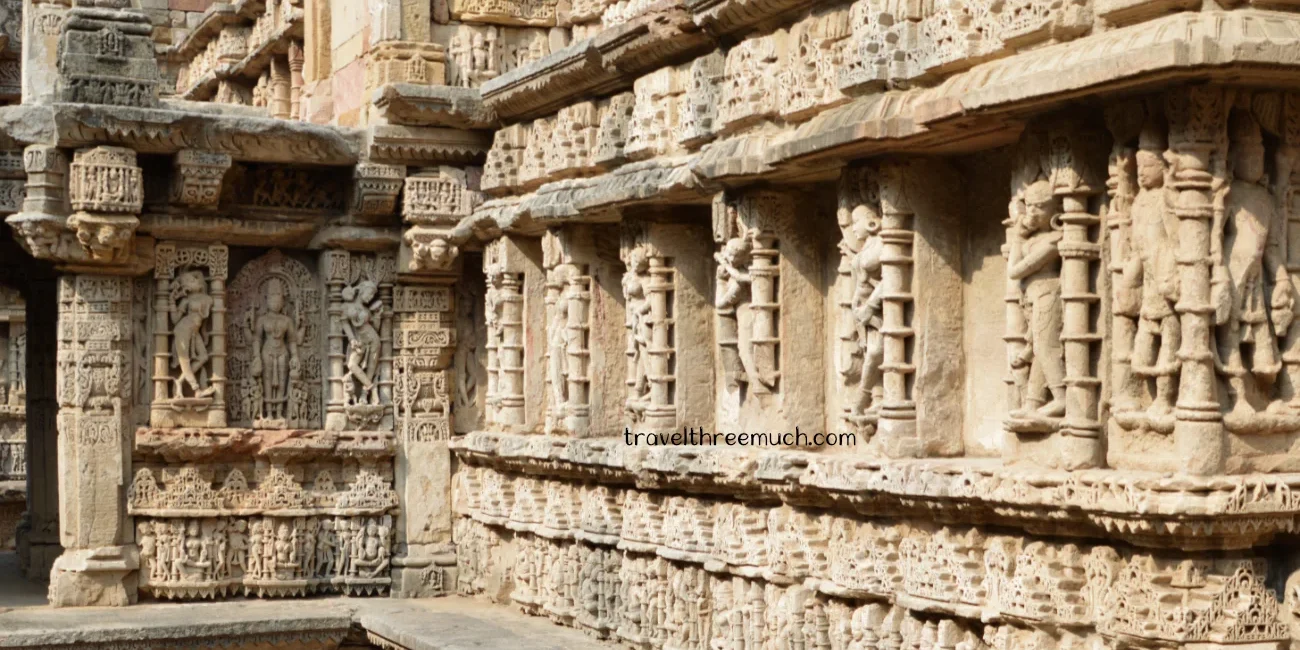
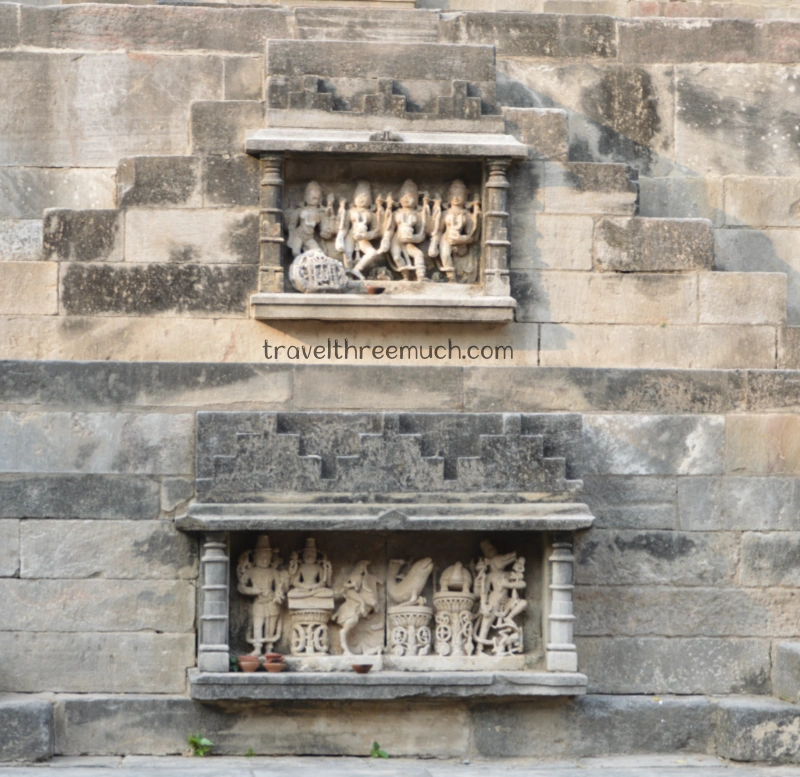
A panel had a series of deities from the Hindu mythology of the Dasavathara or the ten incarnations of Vishnu. There were also panels of motifs that are traditionally used in the Patola sarees from Gujarat.
That connection between the carvings and the textiles is not coincidental. Scholars believe the geometric lattice patterns on the northern entrance wall were likely adapted from the wood carvings and temple ceiling traditions of the region, and that the same artistic tradition flowing through Patan’s master weavers was simultaneously being expressed in stone by the sculptors of the stepwell. Two different materials, one shared visual language.
Getting around Rani Ki Vav
It was midday when we visited and the sun was quite harsh. Yet, just a few levels into the stepwell, it was noticeably cooler already.
Every pillar seemed to have a different pattern or tale sculpted on it. The array of themes were truly mind-boggling. We saw Hindu deities, both male and female such as a Mahishasuramardhini, celestial nymphs and demons. There were also secular motifs such as plants, decorative items, hunting scenes, animals and scrolls.
To help orient your eyes as you descend, here is what each major category of sculpture represents: The Dashavatara: the ten avatars of Vishnu appear on a prominent terrace wall at the third level — Matsya (fish), Kurma (tortoise), Varaha (boar), Narasimha (half-man half-lion), Vamana (dwarf), Parashurama (warrior with axe), Rama, Krishna, Buddha, and Kalki (the avatar yet to come, shown seated on a white horse with drawn sword). The Apsaras: celestial women carved in 16 distinct poses, each reflecting a different aspect of beauty, grace, or daily life.
Pay close attention to the jewellery, hairstyles, and hand positions as these are a visual record of fashion and aesthetics from 11th-century Gujarat.
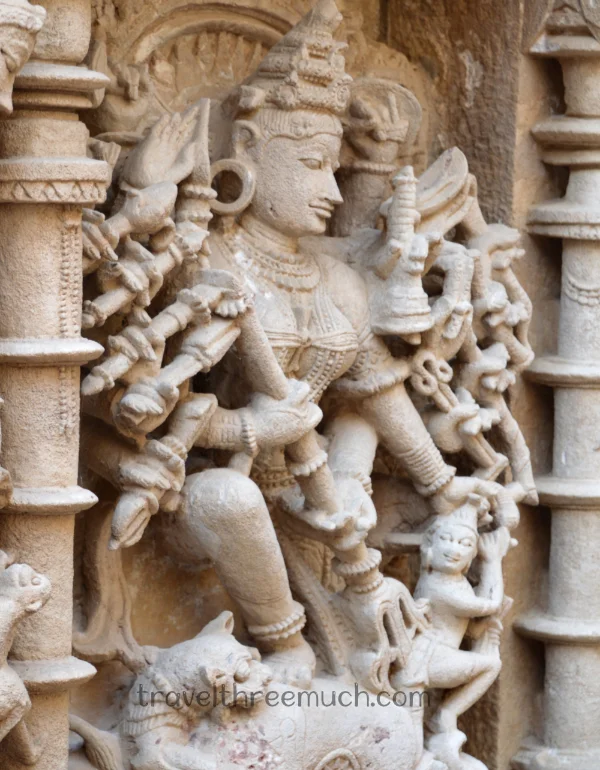
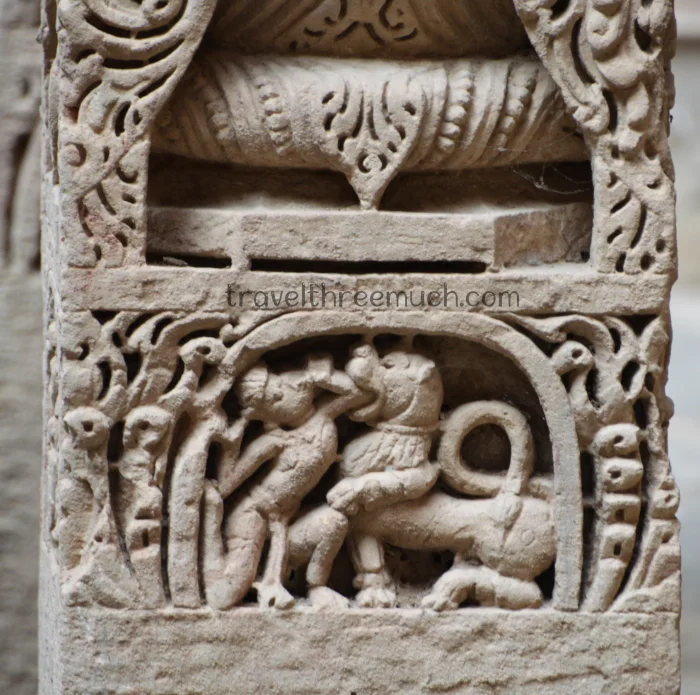
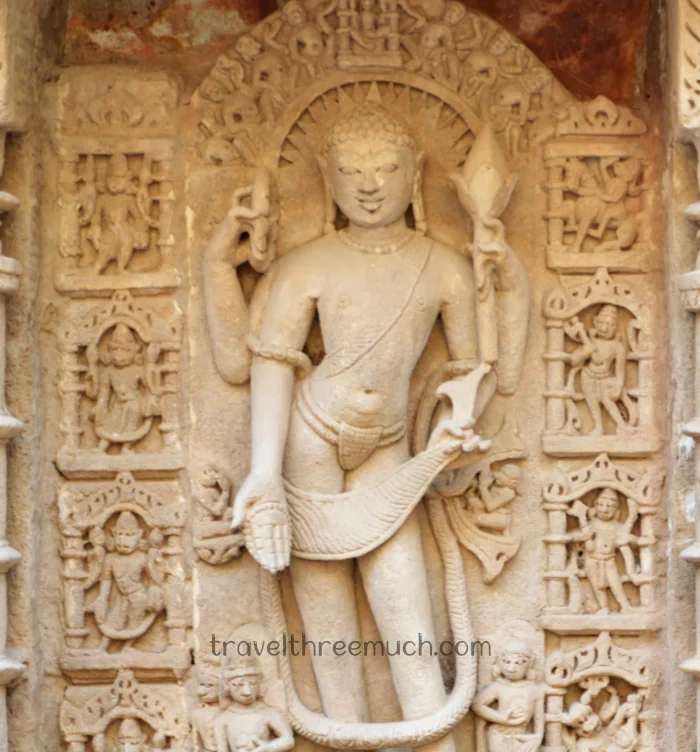
As we descended the next levels, one thing became clear to us. The artisans must’ve reached the pinnacle of their skill in working with sandstone.
The pillars that support the roofs and beams have intricately carved filigrees. These mask a solid core which takes care of the load bearing. Carved flying beings capping the pillars serve as the connecting brackets between the beams and the pillars.
The sanctum
The sanctum seems to have an image of a reclining Vishnu. We couldn’t see quite clearly because of the great distance. Only glimpses of the deity were visible through the slots in the surrounding walls.
What you’re glimpsing is the Sheshashayi Vishnu — Vishnu reclining on the thousand-hooded cosmic serpent Shesha in the celestial ocean, with Lakshmi at his feet and Brahma emerging from a lotus growing from his navel. This is the Ananta Shayana form, one of Vishnu’s most important iconographic representations, and its placement at the very bottom of the stepwell, at the water level, is precise theology: Vishnu rests on the primordial waters of creation, and the stepwell’s water is that ocean made real.
What stumped us really was how everything above - every level, every sculpture and every pillar leads down to this.
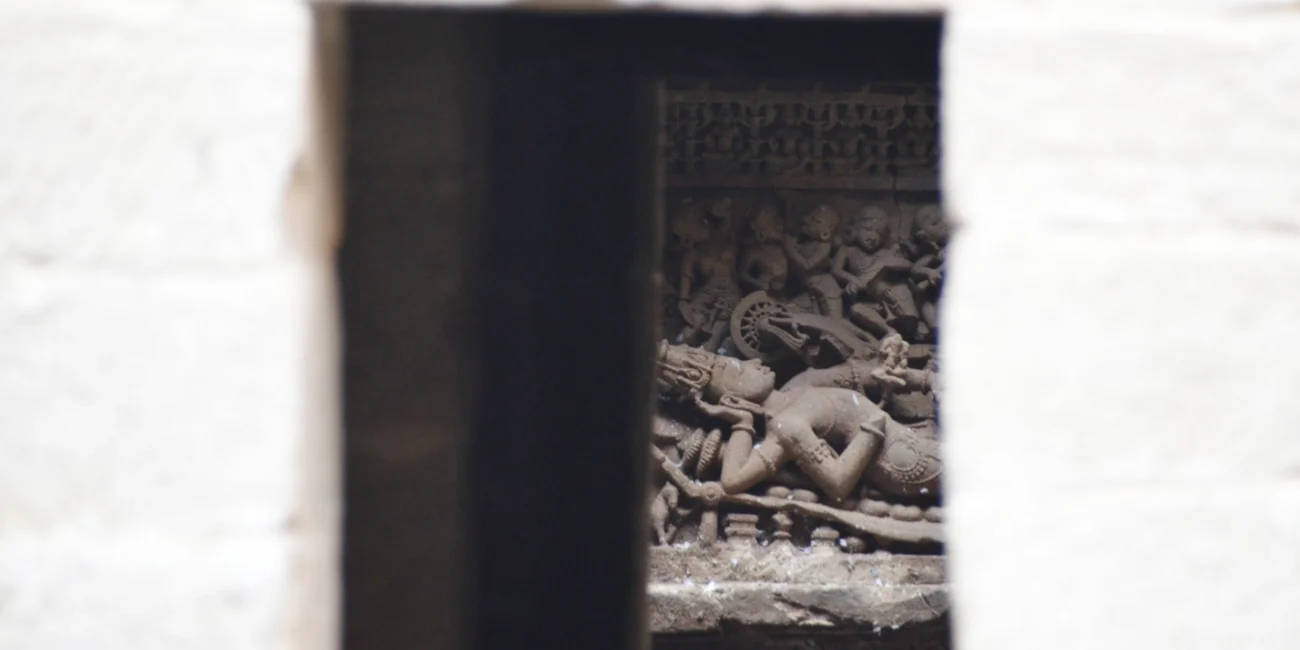
We saw some brackets in the far walls which we wanted to get a closer look at. After taking in the sights at the underground levels, we climbed the steps back up. It strolled on the walkway to near the rearmost walls. From here, the ruined brackets and even more decorative panels with further deities and other motifs were clearly visible.
Parakeets, mynahs and the ubiquitous pigeons inhabit the spaces inside the step well. And only these would be able to see the vast cavernous interiors and all the sculptures. We left this homage of a queen to her beloved husband wondering about the heady mix of practical altruism and worship of the divine thrown in.
Also in Patan: Sahastralinga Talav
Most visitors come to Patan only for Rani Ki Vav and leave. These three stops take no more than 90 additional minutes and are all within walking distance or a short auto ride: Sahasralinga Talav (2 km, 10 mins by auto)
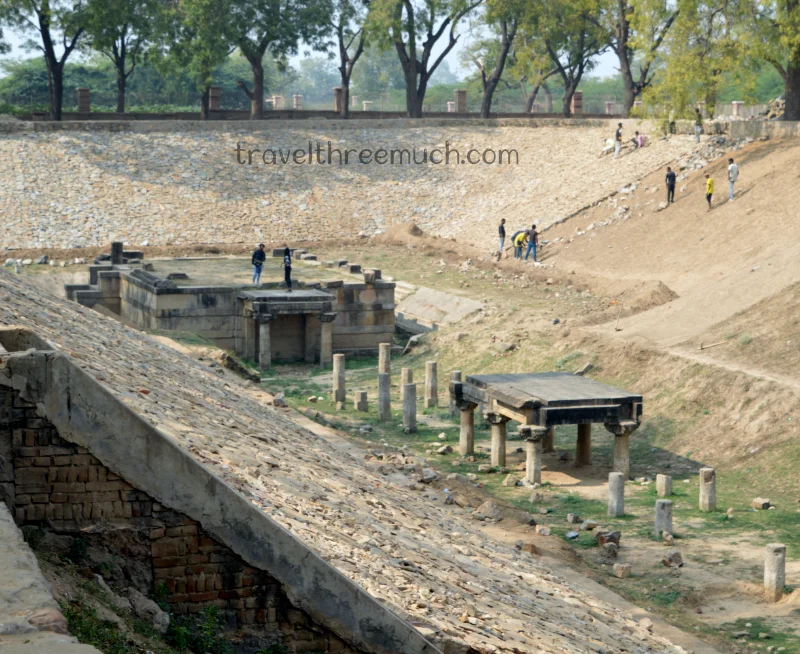
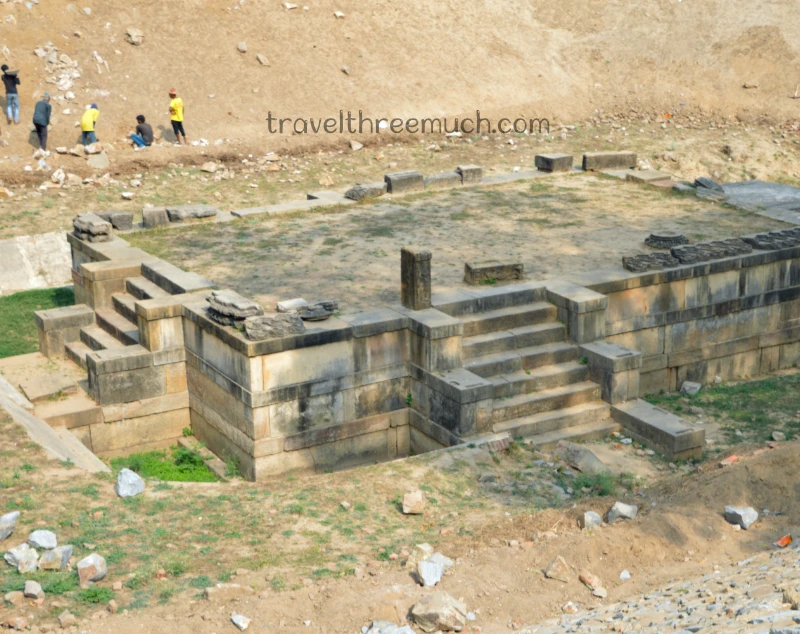
Built by King Siddhraj Jai Singh in the early 12th century, this was once a grand artificial reservoir fed by the Saraswati River, with 1,000 miniature shrines to Shiva arranged around its perimeter. Today it is in ruins and dry, but the scale of what remains tells you exactly how ambitious Patan’s Solanki kings were.
We spent about 30 minutes there trying to imaging how it might have once been. Since this is another practical construction, we used the opportunity to explain to our daughter how planning was done meticulously in those times.
Another gem on the way back
On our way back toward Ahmedabad, we stopped at Shakti Kund in Akhaj village in Mehsana. This is a 10th-century stepped reservoir predating even the Surya Kund at Modhera, built during Chaulukya rule and dedicated to a goddess whose temple once stood beside it.
Square in plan with a round well at its centre, three levels of landings descending to the water, and carved fragments of that lost temple still scattered around the site — it is completely unknown to most travellers, takes about 30 minutes, and sits almost exactly on the road between Patan and Ahmedabad. Don’t drive past it.
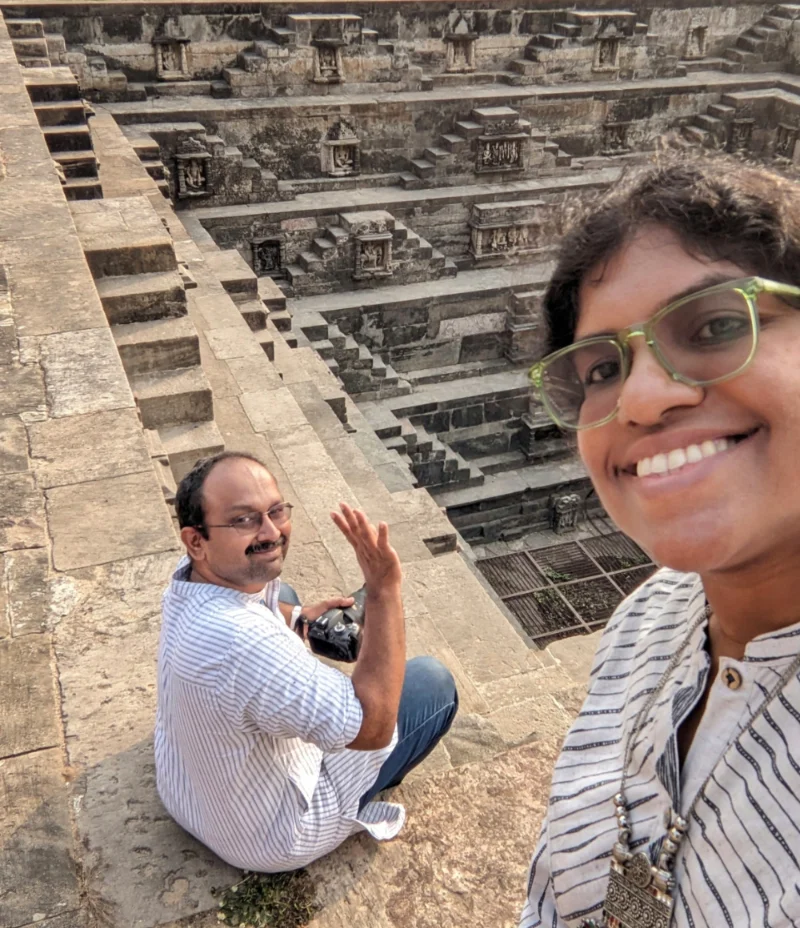
You can actually walk a bit down into the step well also! Its not scary 🙂
Essential tips for travellers
- TIMINGS: Open daily from 8:00 AM to 6:00 PM. There are no weekly closing days, but verify on national holidays before visiting.
- ENTRY FEE: Rs 40 for Indian citizens; Rs 600 for foreign visitors. Children under 15 are free.
- Photography is free throughout.
- BEST TIME OF DAY: Early morning when it opens is best. The rising sun casts a golden light across the sandstone that midday obliterates. We visited at midday and found the direct sun a little bit harsh. But we had to start the day with Modhera. So, this was really the best option for us.
- GETTING THERE: Patan is approximately 125 km from Ahmedabad, a 2.5 to 3-hour drive via NH48 and SH7. A private cab from Ahmedabad is the most convenient option, particularly if you are combining with Modhera. Patan has its own railway station (Patan Junction), approximately 3–4 km from the stepwell — auto-rickshaws are available for the final stretch. State-run GSRTC buses connect Ahmedabad and Patan regularly and are significantly cheaper.
- HOW LONG TO ALLOW: Minimum 2 hours for the stepwell alone. 3 hours is comfortable and allows you to go at a pace where the carvings make sense.
- WITH KIDS: The stepwell is manageable for children who are steady on steps. The carved figures at various heights are engaging for older children who know the stories. There are some areas where there aren’t the best fences. Keep a watch over little children.
What Other Travelers Ask
Why is Rani Ki Vav on the ₹100 note?
Rann ki vav was featured in the Indian currency to honor its status as a UNESCO World Heritage site and a masterpiece of Indian subterranean architecture.
What is the best time to photograph the stepwell?
Early morning or late afternoon when the sun highlights the intricate carvings on the seven levels. Btu according to us, early mornings are better just because the crowd is much lesser.
How deep is Rani Ki Vav?
The stepwell is approximately 27 meters deep and 64 meters long.
Is Rani ki vav stepwell far from Ahmedabad?
It is about 125 km (3 hours) from Ahmedabad, making it a popular and comfortable day trip.

Prasanna Vasudevan
Prasanna is the Primary Writer and Technical Expert behind the posts. He is responsible for the detailed facts, historical context, and logistical breakdowns. He has a deep love for mountains, history, nature, and is the family's expert packer.


Leave a Reply