

Mandore Gardens: Where Jodhpur’s Kings Became Gods in Stone
Updated on March 21, 2026
Contents
Ask any auto driver in Jodhpur to take you to Mandore and there is a good chance he will try to redirect you — to Mehrangarh, to Umaid Bhawan, to anywhere that feels more impressive on a Jodhpur itinerary. Mandore, the former capital that Jodhpur replaced in 1459 CE, has quietly slipped into the category of places that locals assume tourists won’t bother with. We’re glad we ignored that advice.
We visited Mandore on an August morning in the monsoon season. The skies were overcast, and there was a mild drizzle. A troop of langurs were playing around on the park grounds.
A stone tablet indicated the directions for the various points of interest on the park grounds. We headed for the royal cenotaphs called devals. The devals are sacred memorials, and so footwear isn’t allowed to be worn when stepping onto them.
Mandore: From Ancient Capital to Royal Garden
Mandore was the seat of the Prathiharas in the 6th century CE. Mandore changed hands several times from the Gurajara-Prathiharas to the various Rajput clans. Infighting among the Rajput kingdoms of Mewar and Marwar led to their decline.
The Pratiharas, who had Mandore as their capital since the 6th century CE, declined in the 14th century to a shadow of their former selves. They entered into a familial alliance with Rao Chunda at the start of the 15th century CE — the Pratihara princess married Rao Chunda, and the Mandore Fort passed to him as dowry. Mandore remained the capital until Rao Jodha moved it to Jodhpur in 1459 CE. Mehrangarh’s establishment meant Mandore saw a new purpose: the royal cremation grounds. Cenotaphs were raised to honour departed royalty. In 1899 CE, Maharaja Jaswant Singh II was cremated at the newly inaugurated Jaswant Thada, which took over as the royal cremation ground. Mandore was converted into a public garden and museum.
Mandore’s history goes further back than the Pratiharas, at least in legend. The city’s ancient name was Mandavyapura — and local tradition holds that it was the birthplace of Mandodari, the queen of Ravana from the Ramayana. Ravana is treated as a son-in-law of Mandore among some local Brahmin families, and the gardens contain one of the very few temples in India dedicated to him. More on that below.
What Makes the Devals Extraordinary: Temples for the Dead
Before you enter the first cenotaph, it helps to understand what makes them architecturally unusual.
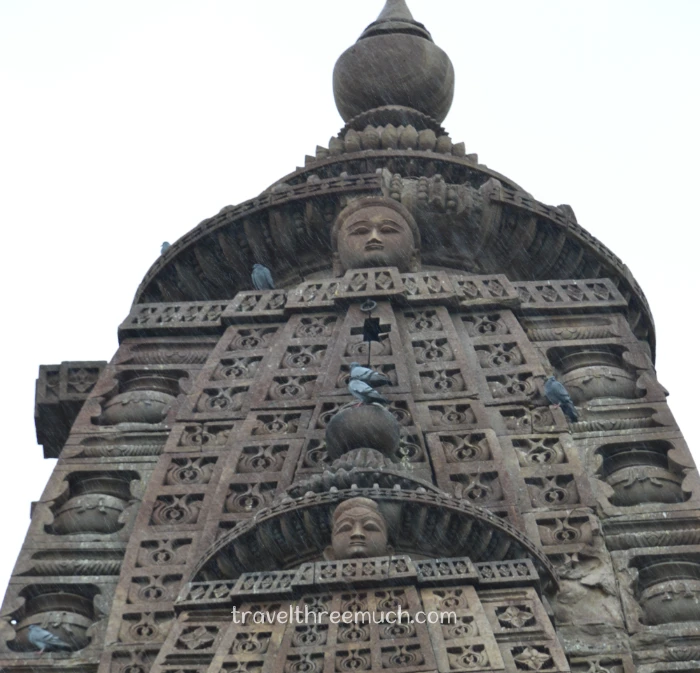
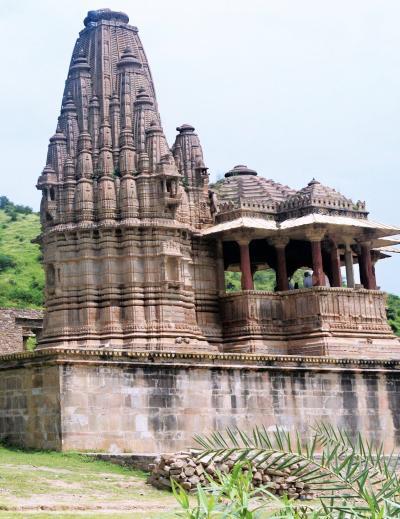
The standard Rajput memorial is a chhatri, which is a domed canopy structure on pillars, elegant but modest. The devals at Mandore are nothing like that. They are full-scale multi-storeyed structures built in the Nagara temple style. With towering shikharas, carved facades, sanctum chambers, and entrance porches, constructed entirely in red sandstone. The intent was not merely to commemorate but to deify.
By building the cenotaphs as consecrated shrines rather than simple tombs, the rulers of Marwar were ensuring their veneration as divine figures for eternity.
The Royal Cenotaphs: A Walk Through Marwar’s History
Maharaja Rao Maldeo (reign: 1532 CE – 1562 CE)
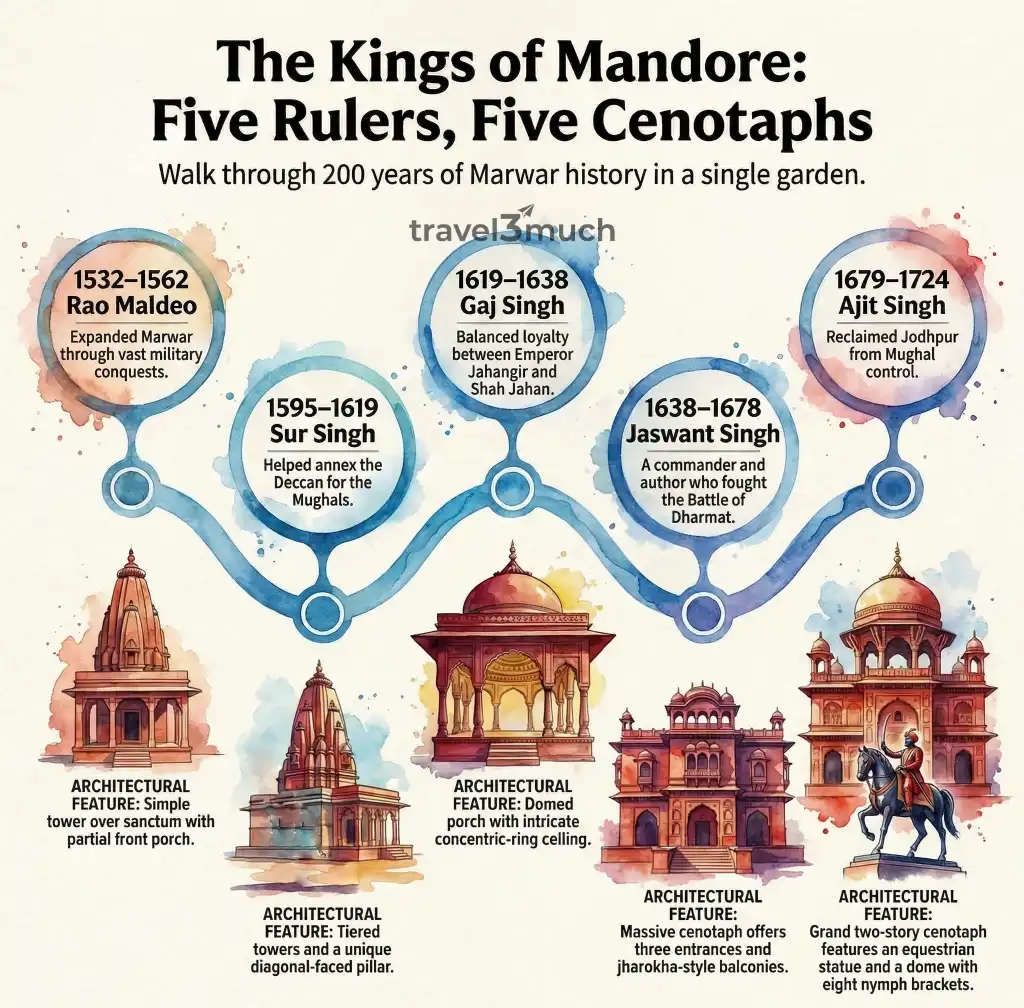
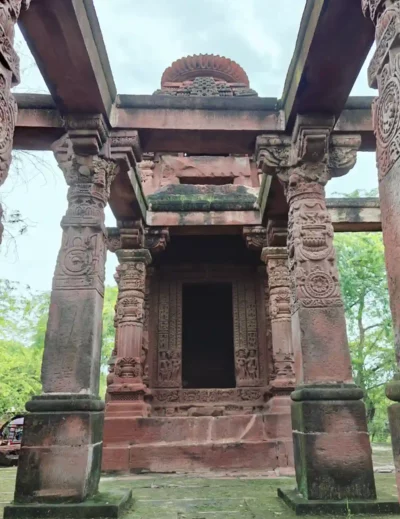
The first of the cenotaphs was dedicated to the memory of Maharaja Rao Maldeo (reign: 1532 CE-1562 CE). Maldeo expanded the small territory he inherited into a large kingdom by military conquests. Parts of Haryana, Rajasthan, Uttar Pradesh, Sindh and Gujarat were all integrated into the Mewar and its vassals. It was a simple cenotaph built like a temple with a tower over the sanctum. There was a front porch with some of the pillars and roof missing from it.
Maharaja Dhiraj Sawai Sur Singh (reign: 1595 CE – 1619 CE)
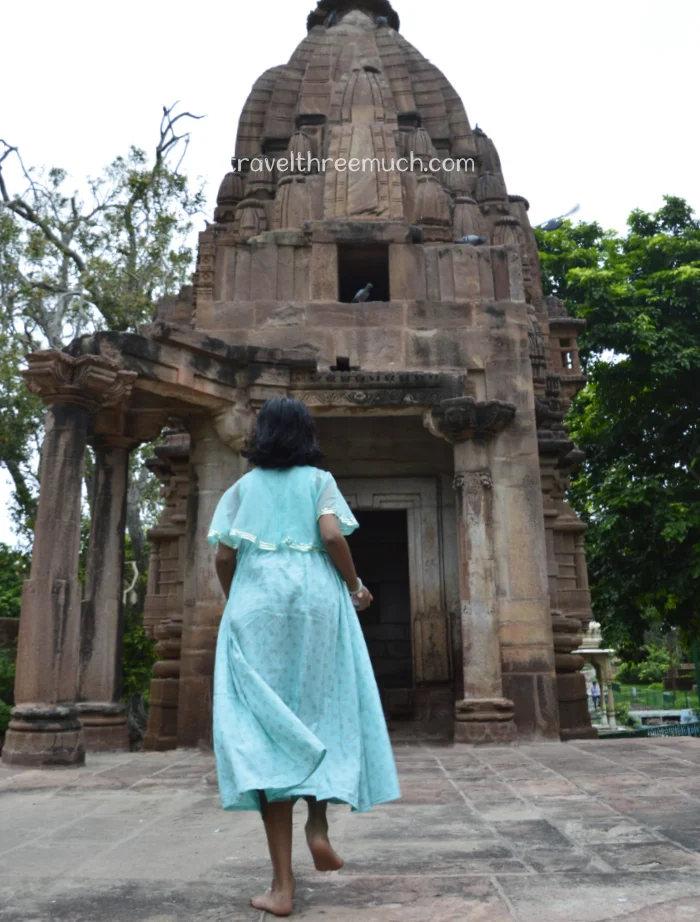
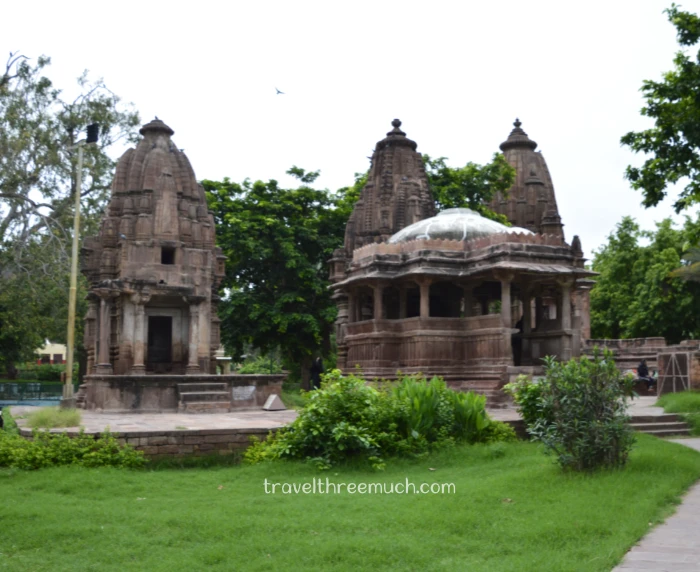
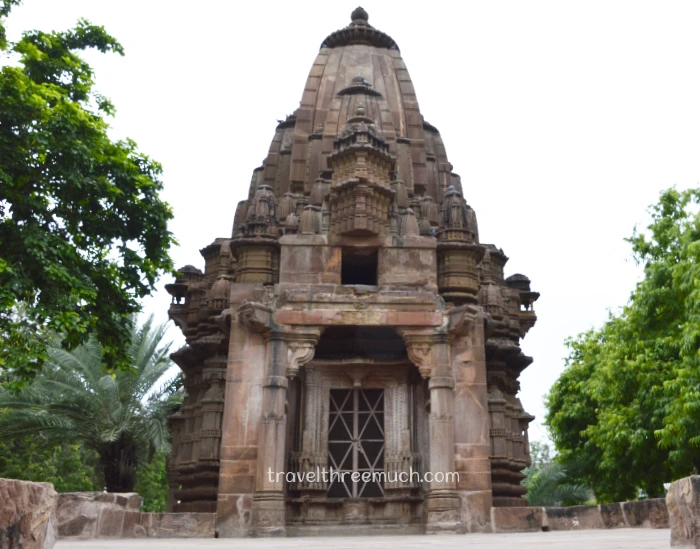
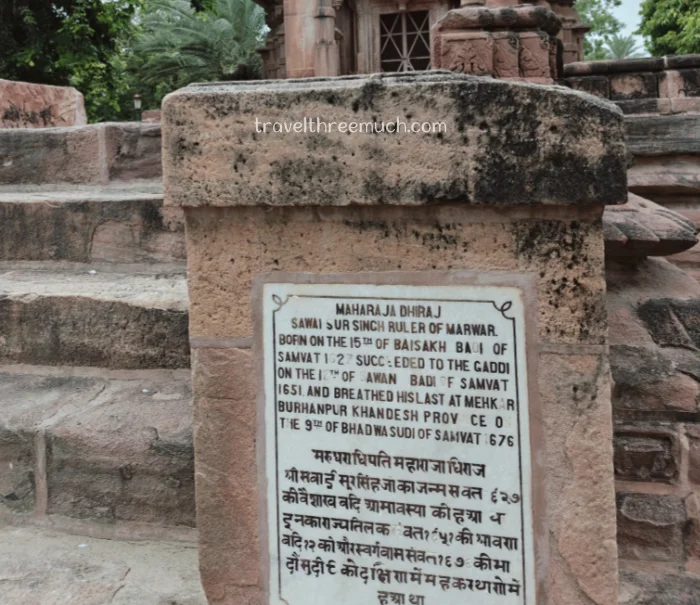
Maharaja Dhiraj Sawai Sur Singh administered Gujarat and helped the Prince Daniyal annex the Deccan for Emperor Akbar. He assisted Jahangir in quelling riots in Gujarat and was deputed with Prince Khurram to annex Mewar. The king’s cenotaph was one of the simpler designs. It featured a series of tiered towers with the principal tower capped by an amlaka. It had an unusual facade with a pillar showing its diagonal faces. The deval may have had a porch in the past, but nothing of it remains in the present day.
Maharaja Dhiraj Gaj Singh (reign: 1619 CE – 1638 CE)
Maharaja Dhiraj Gaj Singh was the next cenotaph we visited. Gaj Singh succeeded Sur Singh after his rather sudden demise. Gaj Singh was deputed by Jahangir to hunt down the rebel Prince Khurram (who’d later assume the name Shah Jahan). Gaj Singh was faced with a moral conundrum. He had to decide whether his allegiance lay with the Mughal emperor who ordered Gaj Singh to pursue and capture the wayward prince, or with Khurram, whose mother was Gaj Singh’s aunt.
Although fate forced Gaj Singh’s hand to defeat the prince, the same fate also resolved the dilemma. Jahangir breathed his last, and Khurram ascended to the throne as the new emperor Shah Jahan. Shah Jahan received Gaj Singh favourably and maintained his grants. Gaj Singh subdued the Bijapur sultan on the emperor’s orders but died soon after returning to Agra.
The king’s cenotaph is built to resemble a temple with a porch. The porch with bench-style seating had a ceiling of concentric rings capped by a domed roof.
Maharaja Dhiraj Jaswant Singh (reign: 1638 CE – 1678 CE)
Maharaja Dhiraj Jaswant Singh was a prominent Rathore ruler of Marwar and a distinguished author. He served as a Mughal commander under Shah Jahan and Aurangzeb, leading campaigns in the Deccan and against Persian forces. He faced defeat at the Battle of Dharmat due to his opinion that nightly attacks are ‘unmanly’. Despite this setback, he remained a powerful political figure and an influential administrator.
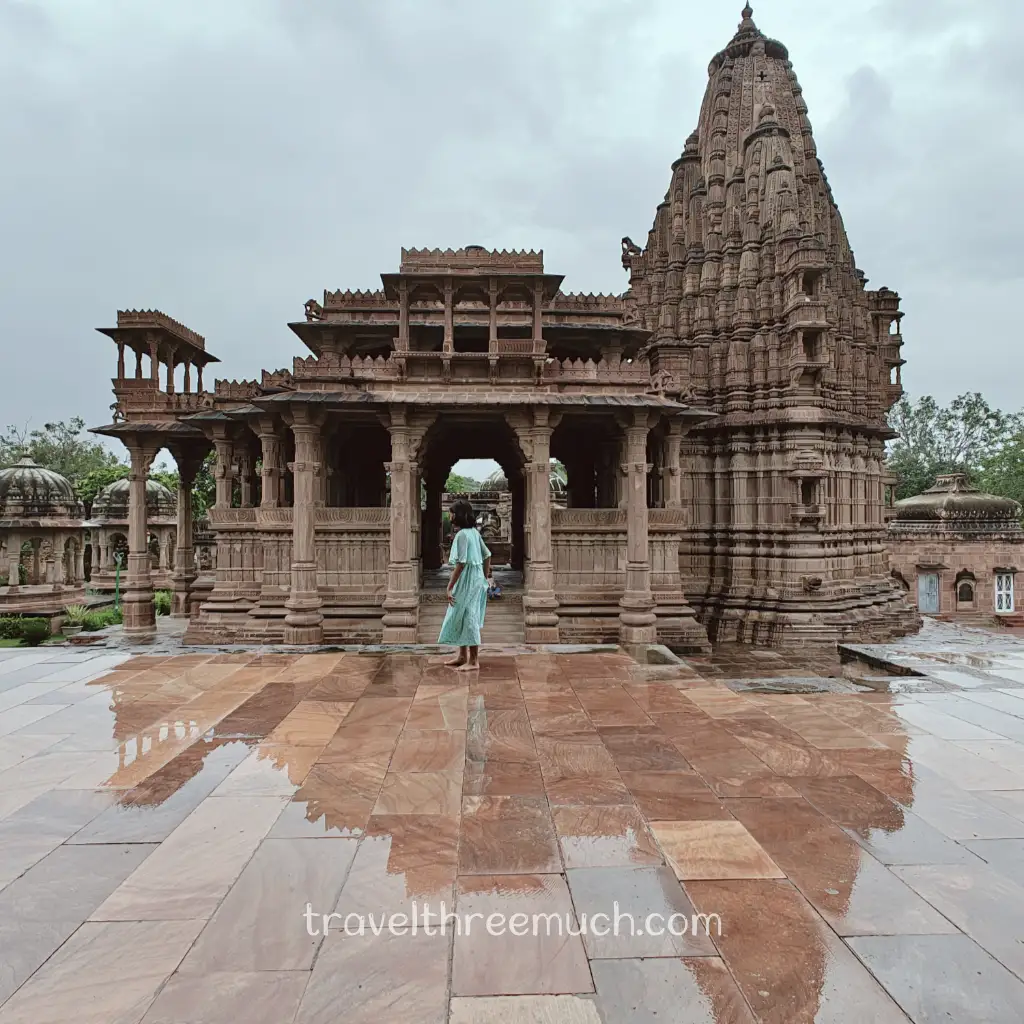
Jawant Singh’s was one of the largest cenotaphs on the grounds. The massive deval sits atop a raised platform. Entrances are in three directions. Each entrance had a jharokha-like balcony without the usual jaali windows. An immense porch with bench-style seating led to an empty sanctum. Massive tiered Nagara-style towers capped the sanctum.
Maharaja Ajit Singh (reign: 1679 CE – 1724 CE)
Maharaja Ajit Singh had to spearhead a long struggle for Marwar’s independence from Mughal control. After spending years in exile and leading a guerrilla war, he successfully reclaimed Jodhpur following Aurangzeb’s passing. He later became a powerful political player in the Mughal court, serving as the Governor of Gujarat and playing a pivotal role in the deposition of Emperor Farrukhsiyar. His rule concluded after he expanded his territory and asserted Rajput influence across northern India. The king’s demise saw one of the most massive instances of sati – the custom where queens and concubines accompany the ruler to his funeral pyre and end their lives as well. Sixty-three wives and concubines accompanied the Maharaja onto his funeral pyre, marking a sombre end to his influential and turbulent rule.
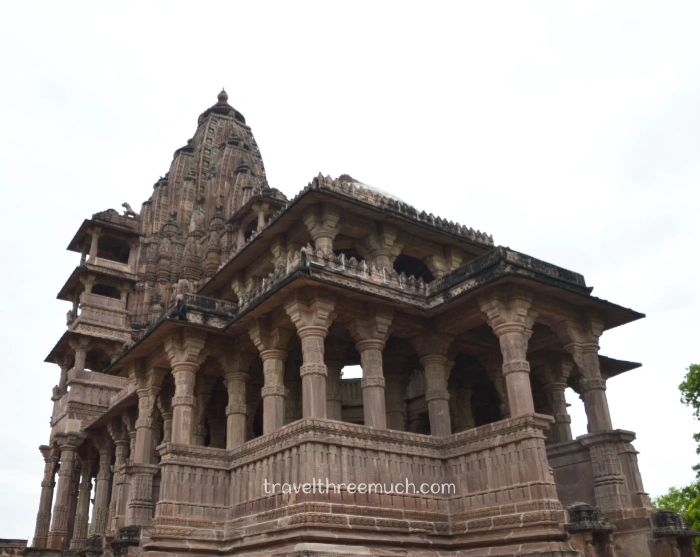
Ajit Singh’s royal cenotaph was the largest of them. There were two floors, of which only one was accessible to the public.
The profusion of carvings on the walls and ceilings was magnificent. Many of the deities of the Hindu pantheon, including the elemental gods such as Agni, the fire god, Vayu, the wind god, and Yama, the god of death, could be seen in pediments on the walls. Don’t forget to look up while you are in the devals. The ornately carved dome had eight brackets with graceful nymphs atop them.
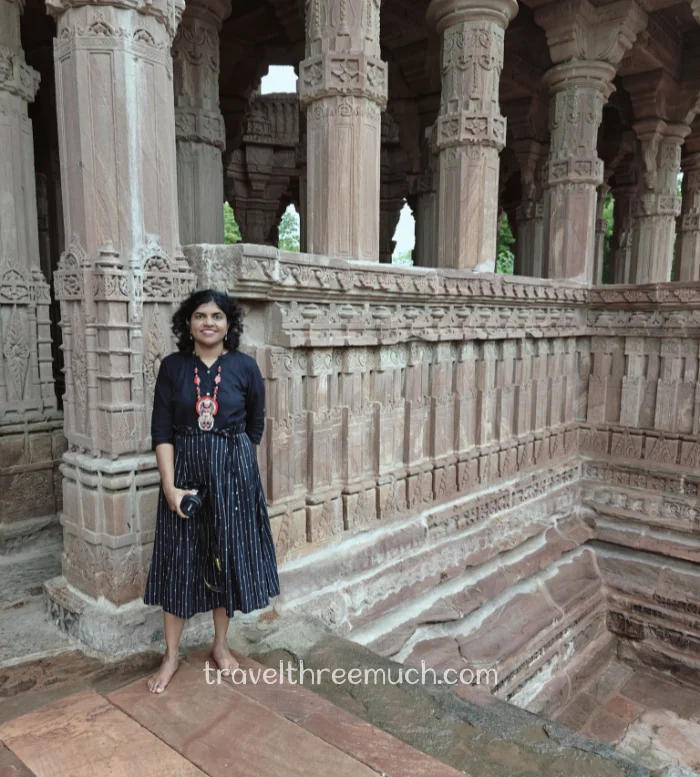
Two things to look for specifically at this cenotaph that are easy to miss: at the entrance stands a carved statue of Ajit Singh on horseback — one of the few equestrian representations of a Marwar ruler at Mandore. And adjacent to the main structure is a smaller, sobering marker indicating where the 63 queens and concubines committed sati on his funeral pyre. You’ve already read the number. Standing at the spot makes it real in a different way.
The Hall of Heroes and the Shrine of 33 Crore Gods
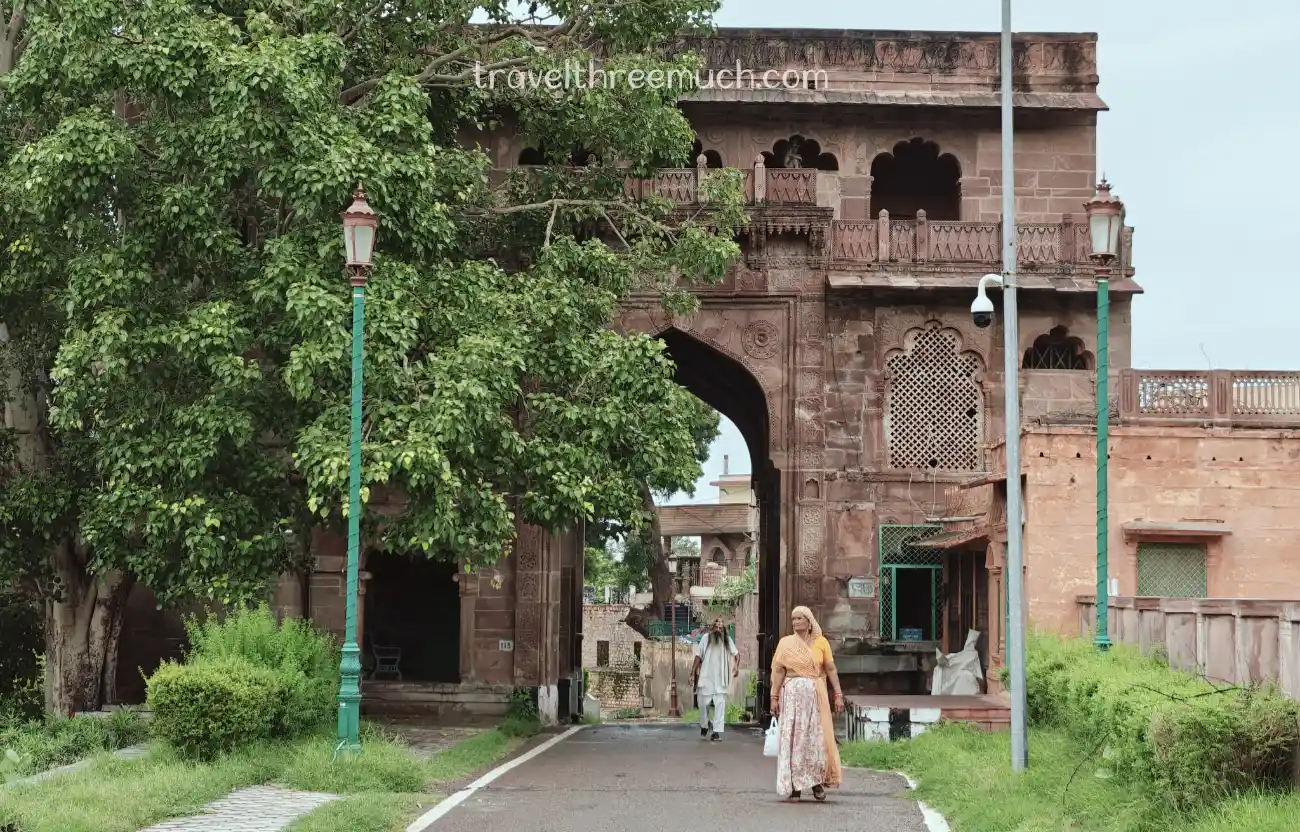
After backtracking a bit and wandering some more in the garden, we came across a gate, named the Ajit Pol, which led us to a hall with shrines of local gods (supposedly some 33 crore of them!) and heroes cut into the cliffside. Protected from the elements by glass walls, this structure was called the Devtaon ki Saal and Veeron Ki Daalaan. Since we knew nearly nothing about the local deities, we didn’t spend too much time here.
Even if you don’t know the deities by name, the Hall of Heroes is worth 10 minutes of your time. Sixteen figures of Rajput warriors and folk heroes are carved from a single monolithic rock face — painted in vivid reds, oranges, and golds, some on horseback, some standing in martial poses. The adjacent Shrine of 33 Crore Gods is exactly what it sounds like: a cave-like space lined floor to ceiling with brightly painted images of Hindu deities from across the country.
Ek Thamba Mahal and the Zenana Palace Museum
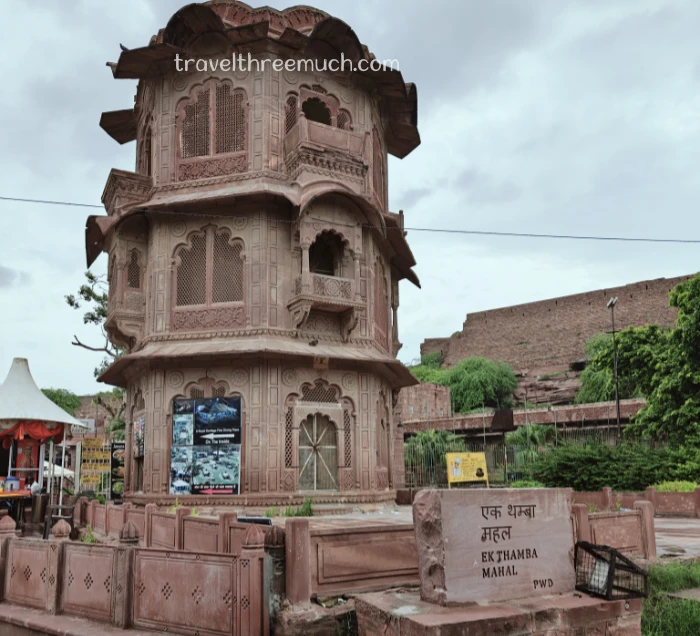
Our next stop was the unusual Ek Thamba Mahal, or the one-tower palace! This three-tiered ‘palace’ was built during Maharaja Ajit Singh’s reign to serve as a strategic lookout, but now serves as a prop for the hoardings advertising the attractions on the garden grounds.
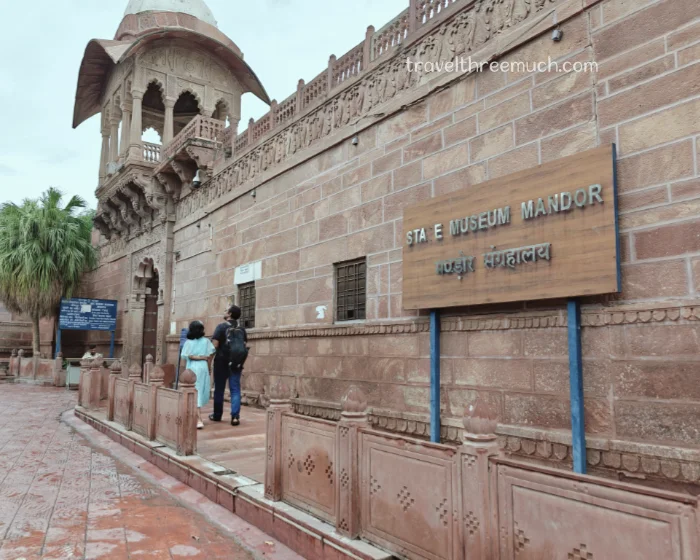
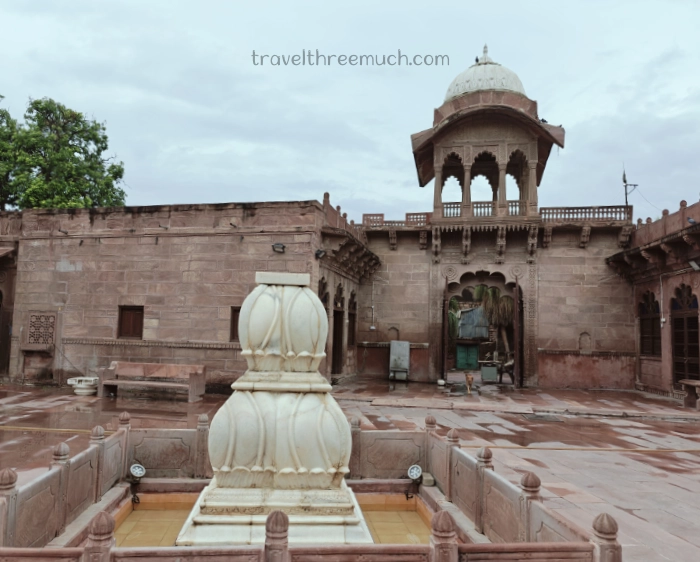
There’s also a Zenana Palace (also known as Janana Palace), built by Maharaja Ajit Singh as a summer residence for his queens. This palace has now been turned into a Museum. The museum requires an entry ticket and has exhibits showcasing daily life in Rajasthan, royal portraits, and paintings from the Rajput school. The museum and its exhibits felt a bit contrived for tourists and can be given a miss if you’re pressed for time. The architecture visible from the outside is definitely the better part of the experience in our view.
The Ravana Temple: One of India’s Rarest Shrines
Most visitors walk straight past the Ravana Temple, which is easy to miss in the far corner of the gardens. It is worth finding. Mandore’s ancient name was Mandavyapura, and local tradition holds this as the birthplace of Mandodari, the queen of Ravana from the Ramayana. Ravana, having married a princess of this city, is considered a son-in-law here rather than a villain, and some local Brahmin families still maintain this view. The temple is one of a tiny number of Ravana temples in India as most of India regards him as the villain of the Ramayana, but in Mandore he is venerated as family. It is a small shrine, but the story behind it is extraordinary.
Panchkunda: The Maharanis’ Necropolis
We had heard about the Panchkunda Chhatriyan with cenotaphs of the Marwar rulers predating Jodhpur’s founding. We took an auto rickshaw from Mandore Gardens to Panchkunda. It is also possible to walk there from Mandore Gardens, but there is nearly no tree cover to shade you from the harsh sun. It takes about half an hour to walk from the gardens to the Panchkunda. If you plan to walk, bring an umbrella and sunblocker for protection.
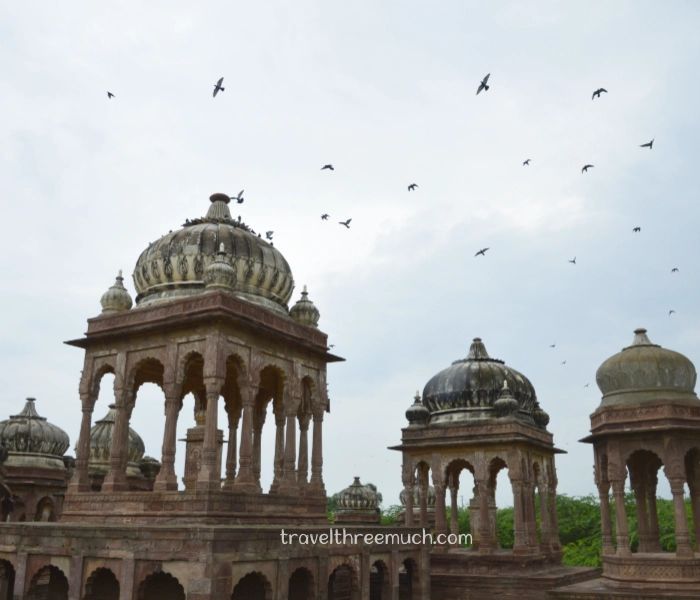
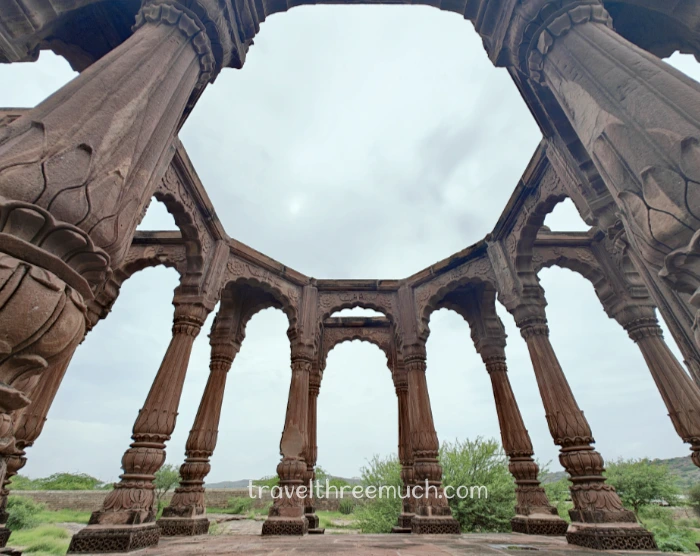
Panchkunda, meaning five pools, supposedly has cenotaphs of the older rulers. These cenotaphs are purportedly from the reign of Rao Chunda (1394 CE to 1423 CE) until Rao Ganga (1515 CE to 1532 CE), and their queens. Unfortunately we found no signage or inscriptions to show us which ruler was memorialised in each cenotaph. The atmosphere was serene and the overcast skies with distant calls of peacocks added to the majestic but somber atmosphere.
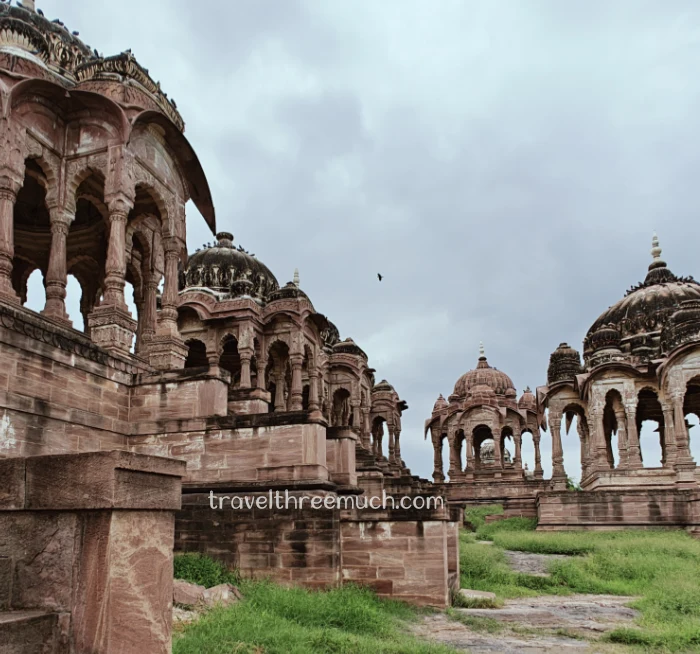
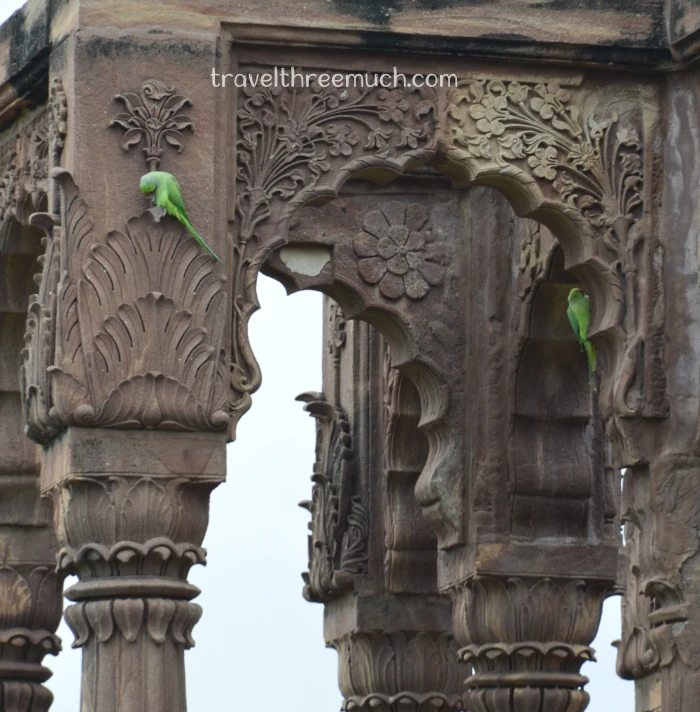
The chattris seamlessly fused Islamic and Rajputana architecture schools in their domes and the aesthetically drooping chajjas. The curved eaves reaching towards the ground seemed to signify the eternal struggle of royalty to ascend out of earthly pursuits in search of immortality, and the futility of the human condition which makes it moot.
In the midst of the elaborate chhatris, one cenotaph with a collapsed roof gave an ethereal air to the setting.
The Mandore Fort Ruins: The View from the Hill
Continue past Panchkunda and climb the small hill at the rear of the gardens and you will reach the ruins of the original Mandore Fort — the capital that predated Jodhpur by centuries. Not much survives structurally, but the elevated position gives you an excellent view over the entire garden complex below, and on a clear day the silhouette of Mehrangarh Fort is visible in the distance. Allow 15 minutes for the climb.
The Sound and Light Show: Worth Staying For
The gardens host a sound and light show every evening between 6:30 PM and 8:00 PM. The narration covers the history of Mandore and its rulers — the same history you’ve walked through during the day — while the cenotaphs are illuminated in shifting colours. The red sandstone glows dramatically after dark in a way that the daytime visit simply doesn’t replicate. If your timing allows, plan to arrive in the late afternoon, explore the gardens, and stay for the show.
How Mandore Fits into Your Jodhpur Itinerary
The honest answer: Mandore and Mehrangarh are not competing for the same slot in your day. They are completely different experiences. Mehrangarh is a fortress — commanding, imposing, commercial. Mandore is a living park where locals walk in the morning and children play around structures that are 300 years old. Two hours here, ideally in the late afternoon followed by the light show, is the right way to do it. Combine with Jaswant Thada (15 minutes away) for a full half-day that costs almost nothing beyond the museum entry fee.
Visiting Mandore with Kids — What to Know Before You Go
- The gardens have many langurs.
- Langurs are not generally as aggressive as the rhesus monkeys.
- Secure any food, snacks and sunglasses you carry to avoid attracting them.
- If you are visiting in the monsoon months like us, carry umbrellas or raincoats for kids.
- This site is mainly for history and architecture buffs. If these aren’t interesting for your kids, you could give Mandore a miss.
- Consider planning your visit in the latter part of the day to beat the heat and to watch the sound and light show.
How Mandore Fits into Your Jodhpur Itinerary
The honest answer: Mandore and Mehrangarh are not competing for the same slot in your day. They are completely different experiences. Mehrangarh is a fortress — commanding, imposing, commercial. Mandore is a living park where locals walk in the morning and children play around structures that are 300 years old. Two hours here, ideally in the late afternoon followed by the light show, is the right way to do it. Combine with Jaswant Thada (15 minutes away) for a full half-day that costs almost nothing beyond the museum entry fee.
 Plan Your Visit: Everything You Need to Know
 Plan Your Visit: Everything You Need to Know
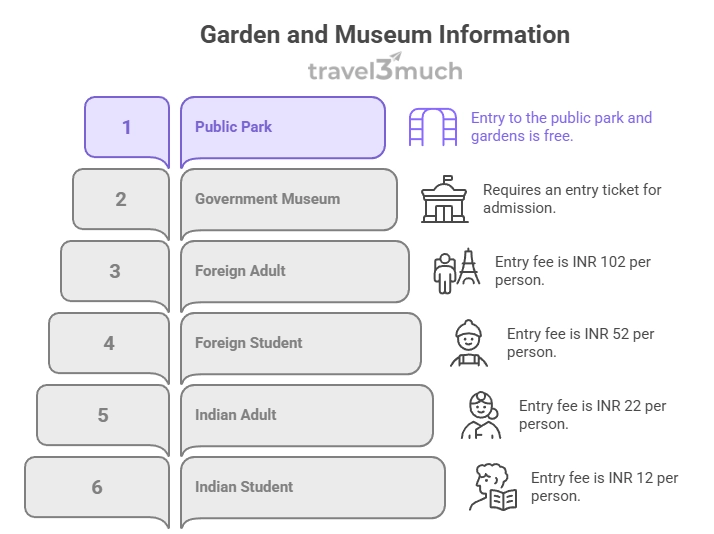
Entry Fees
Timings
The museum timings are from 10:00 AM to 5:00 PM
Set aside 2 to 3 hours if you want to see the gardens leisurely. There are no closing timings for the gardens.
You can plan a visit before 8 PM and avoid the mid-day hours, as it generally tends to be quite warm in the summer months.
There is a sound and light show that happens every day between 6:30 PM and 8:00 PM.
Getting There
Jodhpur is the nearest airport. Mandore is 13 km from Jodhpur Airport. Other major cities with airports closest to Jodhpur are Jaipur (340 km) and Delhi (620 km).
Jodhpur is the nearest railway station, and Mandore is 10 km from the station. Jodhpur is well-connected by road to other cities in Rajasthan. Mandore is 8 km by road from the Jodhpur bus stand. Mandore can also be reached by shared transport from Jodhpur. Mandore is 10 km from the old town and about 9 km from the city centre, by road. Shared autos and cabs are available from the city to Mandore.
A word on the cab situation: drivers may try to talk you out of Mandore in favour of Mehrangarh or Umaid Bhawan Palace. Both are worth visiting, but Mandore is worth the separate trip.
We took an auto rickshaw (tuk tuk) and we took his number for the return trip. We didn’t find many auto rickshaws in that region.
What Other Travelers Ask
Is there an entry fee?
The Garden: Entry to the public park and gardens is free. The Government Museum: Requires an entry ticket.
How is Mandore different from Jaswant Thada?
Jaswant Thada is a royal cremation ground. It features a blend of Mughal and Rajput architectural schools. Mandore is a public park where locals picnic and the cenotaphs here are closer in resemblance to Hindu temples.
When is the best time to visit?
Time of Day: 4:00 PM – 6:00 PM is ideal. The evening sun hits the red sandstone, turning the cenotaphs a deep, glowing orange. Season: Like all of Jodhpur, it is best visited between October and March. Avoid the incredibly warm midday in summer.
Is Mandore worth visiting if I’m short on time in Jodhpur?
Yes, but with a caveat. If you only have one day in Jodhpur, prioritise Mehrangarh in the morning. If you have a day and a half or more, Mandore absolutely earns its place — it is free, uncrowded, and offers a completely different side of Jodhpur’s history than the fort does. The late afternoon visit combined with the light show makes for an excellent second day.
Is the Ravana temple really at Mandore?
Yes. It is a small but genuine shrine, and one of a handful of Ravana temples in India. The connection is through Mandodari, Ravana’s queen in the Ramayana the old name for Mandore. Whether historical or legendary, the temple exists and is worth a look.
And thus, our trip to the Mandore Gardens came to an end. While the museum and the park could definitely use some upkeep, the cenotaphs are unique structures deserving a visit.

Ramya
Ramya is the Itinerary Mastermind and travel planner for the family. She specializes in crafting efficient, culturally-rich trips, with a passion for India’s art, heritage sites, forests, and waterfalls. She brings the human emotion and logistical precision to their journeys.


Leave a Reply