
Orchha Fort: Bundela History and the Palace Built for One Night
Updated on July 3, 2026
Contents
The Hidden Town of Orchha
Orchha, in present-day Madhya Pradesh, was the Bundela Rajputs’ bastion. The Orchha Fort is the name given to a complex of many monuments that were built by King Rudra Pratap Singh and successive Bundela rulers between the 16th and 17th centuries CE, as they expanded their territories into what became known later as ‘Bundelkhand’ or the Bundela nation. Internal strife caused the ‘princely states’ of Datiya and Panna to secede from Orchha. The dynasty fell prey to the Mughals and later the colonialists, who took advantage of the perennial conflicts and intrigue between the different Bundela ‘states’.
The main fort sits on an island. The island is at the confluence of the rivers Betwa and Jamni.
Plan your trip
- Construction date: 16th century CE to 17th century CE
Best time to visit: October to March. Avoid May–June (Bundelkhand heat is severe). - Timings: 8:00 AM to 6:00 PM, open on all days
- Entry fee: INR 50 for Indians and INR 750 for non-Indians
Getting there:
*16 km from Jhansi (nearest major railway station) — 35–45 min by cab
*120 km from Gwalior — approximately 2.5 hours
*230 km from Bhopal — approximately 4 hours
*Within Orchha: 10-minute walk from Ram Raja Temple
Note:
The tickets are valid for one day to visit all the monuments in Orchha town (except for the chattris). One ticket covers Raja Mahal, Jahangir Mahal, Sheesh Mahal, Rai Praveen Mahal, Diwan-e-Aam, and outer structures. The chatris (cenotaphs) by the Betwa river require a separate ticket.
Orchha was our year-end vacation destination. The motivation to head to a heritage site was mainly to avoid the holidaying crowds. A good night’s sleep and a hearty breakfast of poha (a dish of beaten rice seasoned with turmeric, onions, coriander and peanuts) and toast saw us ready to explore the royal citadel of Orchha State’s erstwhile rulers.
Rudra Pratap Singh founded the Orchha State in 1501 CE and constructed the fort. His successors built the monuments within the complex over nearly two centuries.
Getting to the fort
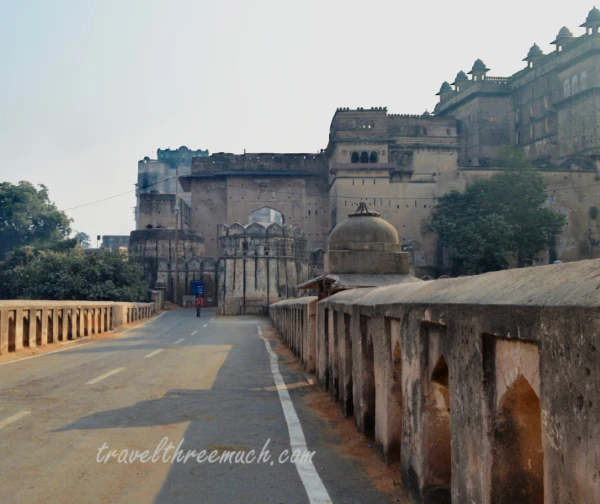
The fort was a 10-minute walk away from the hotel. We took a lane directly opposite the Ram Raja Temple to reach the fort’s causeway entrance. The bridge with arches was built on a natural moat across the river. The trees near the bridge were home to many parrots, whose songs filled the air.
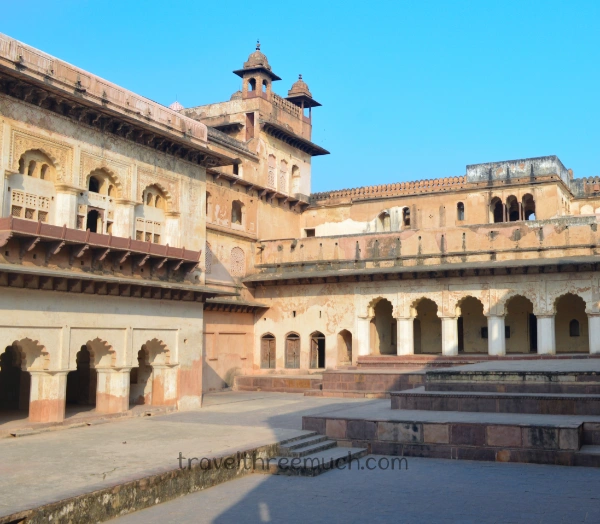
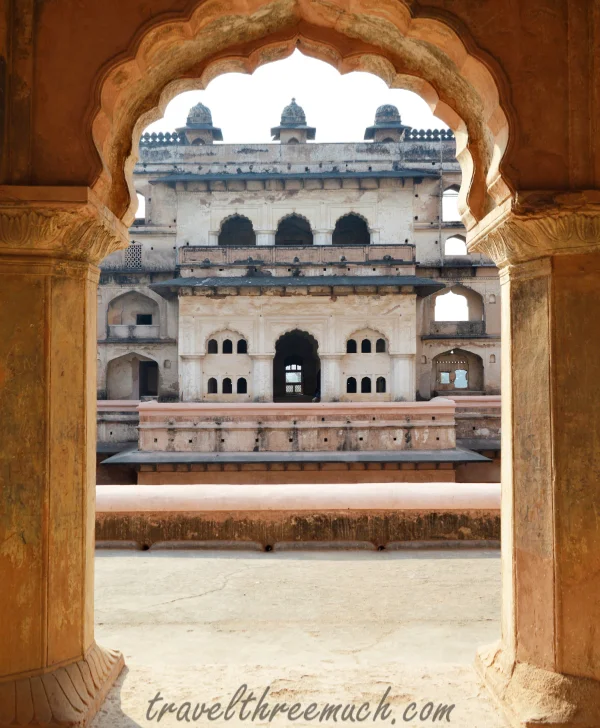
We crossed the bridge and reached two massive wooden doors with iron spikes to ward off enemies. The doors, named the ‘Kanteela Darwaja’ or the ‘thorny gate’ led us to the ticket counter. A quadrangle surrounded by the palaces – Raja Mahal, Sheesh Mahal, Jahangir Mahal, and Sawan Bhadon Mahal ushered us to the first stop.
Diwan-e-Aam
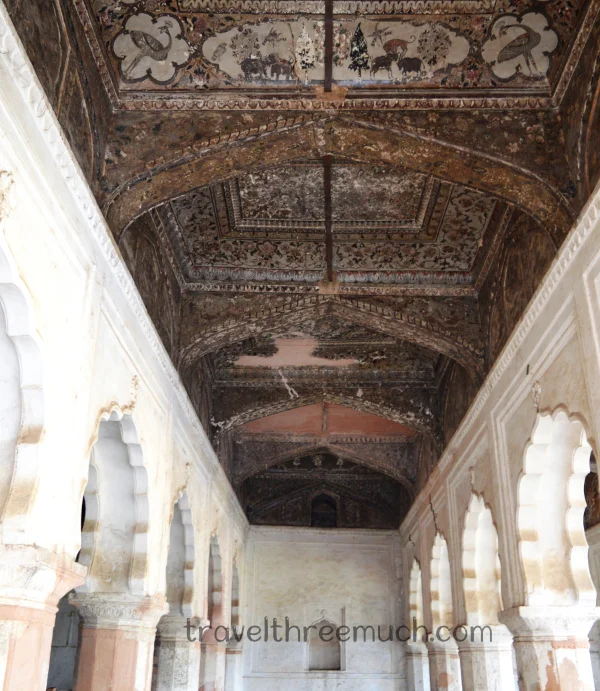
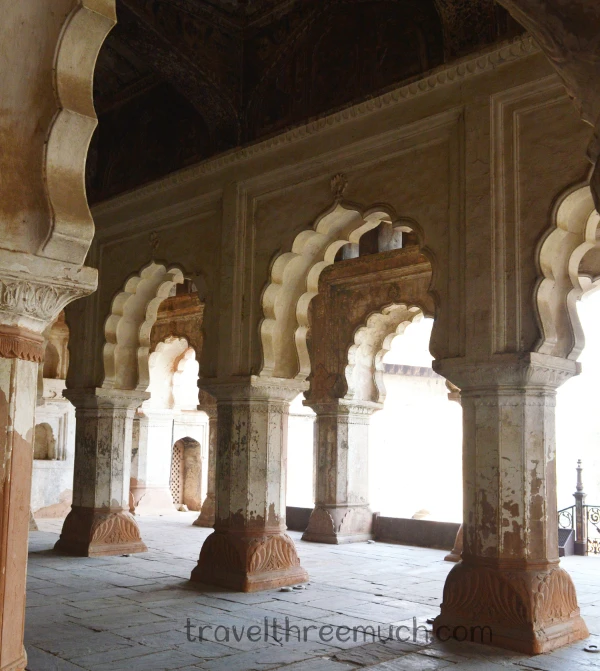
The Diwan-e-Aam was a chamber for a public audience with the king. The room had an elevated platform on which the king sat, with a row of bench seats with backrests for his courtiers and nobility.
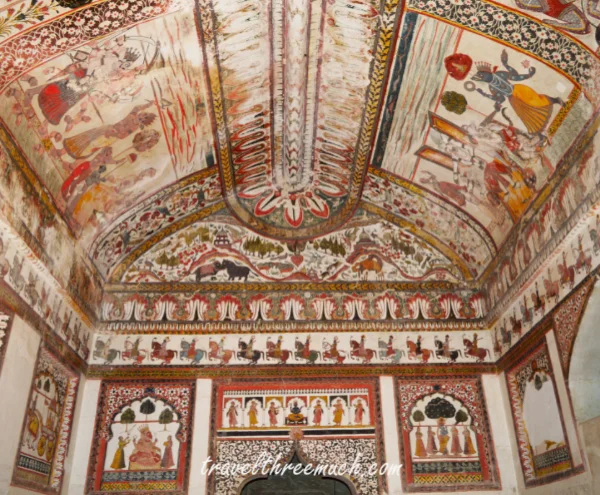
The ceiling of the Diwan-e-Aam had many murals with fine details painted on it. Unfortunately, most of them were in a state of disrepair.
The murals were of floral motifs, animals, birds and hunting scenes. This room is probably part of the original structure constructed during the founding of the Orchha State.
Raja Mahal
The various kings of Orchha Rudra Pratap (1501 CE to 1531 CE), Bhartichand (1531 CE to 1554 CE) and Madhukar Shah (1554 CE to 1591 CE) all built parts of the Raja Mahal or the King’s Palace. The palace remained the residence of the rulers of the Orchha State even in colonial times until its abandonment in 1783 CE.
The exteriors were simple and gave away nothing of the interiors that befitted the royalty! The central courtyard of the Raja Mahal led to rooms on the ground floor with murals on the walls and ceilings. Scenes from the Ramayana, the story of Krishna, other incarnations of Vishnu, the elephant-headed god Vinayaka and a peacock-like bird attacking an elephant-headed mythical beast named the Gaja-Vyala, devouring seven elephants were the subjects of these paintings.
You can reach the upper floors via staircases, but choose wisely lest you pick up eight-legged friends or disturb winged furry ones from their roost! For your labour and courage, the upper floors will reward you with breathtaking views of the Chaturbhuj Temple’s spires.
Murals of palace scenes and women decorated the rooms on this level. Arches with intricately painted floral motifs on the inner sides were the other highlights.
Vir Singh Deo (1605 CE to 1627 CE), to commemorate his ascension to the throne of Orchha State and welcome Emperor Jahangir to the coronation, built the Jahangir Mahal. It is said that the emperor stayed just one night in this palace.
Jahangir Mahal
Abu Fazal, a noble in Akbar’s court, instigated the emperor to disown Jahangir (then Prince Salim) for his pursuit of the dancer Anarkali. Vir Singh had Abu Fazal assassinated to prevent him from waging war against Salim at Agra on Akbar’s orders. Jahangir and Vir Singh had a high regard for each other, especially for the king’s help in ensuring the emperor’s claim to the throne. Thus, when Jahangir became the emperor of India, he gifted Bundelkhand to Vir Singh.
Jahangir Mahal has 136 rooms painted with murals, however only a few remain intact to give us an idea of the perfection Orchha’s artisans achieved in their heyday. The latticework in the windows had elephant and bird motifs on them.
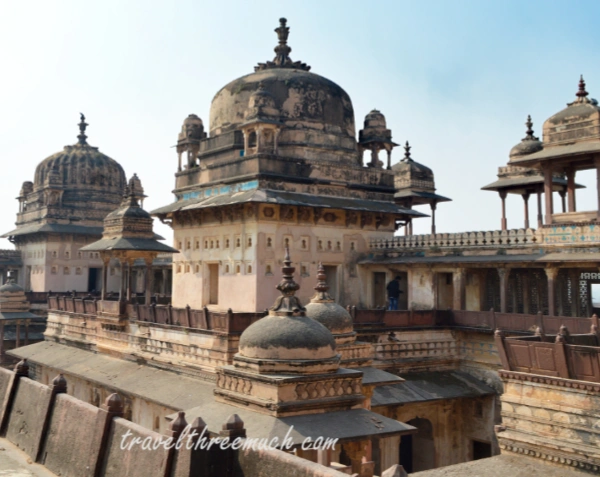
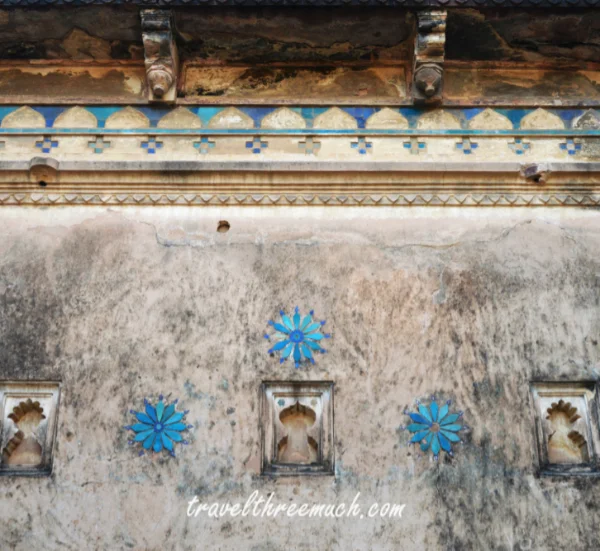
Jahangir Mahal’s chhatris still have the turquoise and teal tiles intact at a few places, giving us a peek into the riot of colours that the palace would’ve been when newly built.
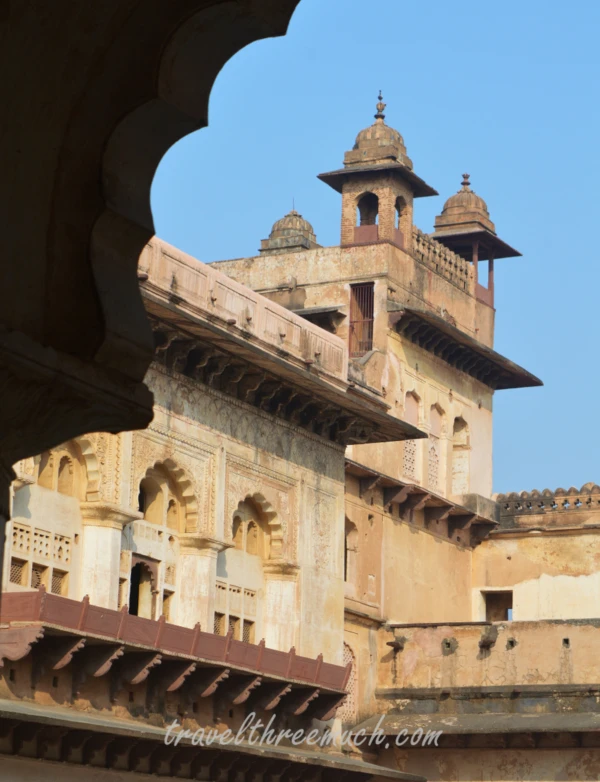
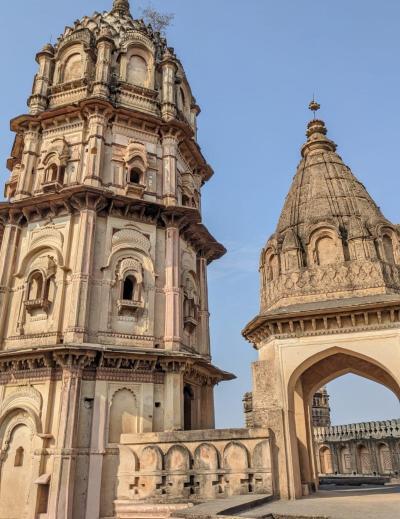
The roof is accessible through a steep stairway. The round domes topping the upper floors with chhatris at the corners fuse the Islamic and Rajput schools of architecture seamlessly.
Sheesh Mahal
The Sheesh Mahal or the ‘Mirror Palace’ has been converted into a hotel with rooms for boarding and a restaurant, run by Madhya Pradesh Tourism. This seemed to be popular with foreign tourists.
The Fort Complex
Outside the Raja Mahal, within the fort complex are other interesting buildings. One such building is the Tope Khana (Cannon Foundry). This was reputedly used to forge the cannons used in the fort’s defence, and to stow them away in peacetime.
The Haathi (elephant) and Oont (camel) Khaana are structures where these creatures were stabled. A garden in front of the fort complex named the Phool Bagh had a line of fountains with an underground structure. This water-based ventilation system coupled with the underground location served as a cool getaway for the royalty.
Rai Praveen Mahal is a palace built in 1618 CE by Indrajeet Singh for his consort Rai Praveen. Rai Praveen was an accomplished poetess, singer and dancer. Akbar heard much praise for her beauty and talent. He summoned her to the royal court in Delhi to be a courtesan. Rai Praveen declared her love for Indrajeet in a couplet at the court. Akbar, impressed by her courage, sent her back to Indrajeet respectfully.
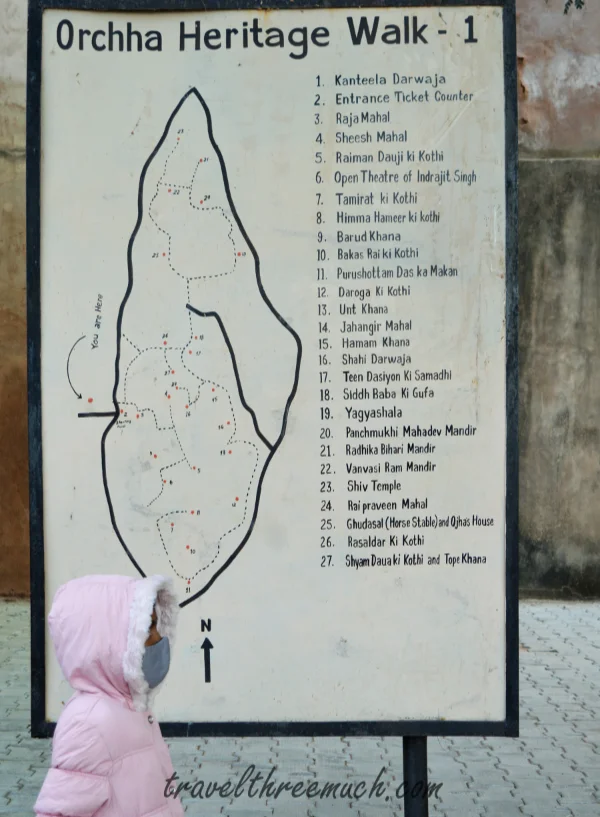
Some restoration work was in progress at the end of 2022 when we visited. It was possible to get a bird’s-eye view of the other buildings in the complex from the upper levels of the Raja Mahal and Jahangir Mahal. We correlated the buildings' locations with the layout map from the entrance to the fort complex.
So, we did not explore the outer reaches of the complex with the Ram, Shiva and Radhika Bihari temples.
The fort and the monuments inside gave us a peek into the Bundela Rajputs’ heyday, the lengths they went to for friendship and love, and the patronage of arts and architecture that must’ve flourished in their reign. After a fulfilling day which got our vacation off to an excellent start, we headed back to the hotel.
History of Orchha Fort and the Bundela Rajputs
Rudra Pratap Singh founded the Orchha State in 1501 CE and began construction of the fort on an island at the confluence of the Betwa and Jamni rivers. His successors expanded it over nearly two centuries: Bhartichand (1531–1554 CE), Madhukar Shah (1554–1591 CE), and most significantly Vir Singh Deo (1605–1627 CE), who built the Jahangir Mahal to commemorate Emperor Jahangir’s coronation visit.
The Bundela Rajputs’ relationship with the Mughals was complicated — Vir Singh had Abu Fazal, a nobleman in Akbar’s court, assassinated to protect Prince Salim (later Jahangir). When Jahangir became emperor, he rewarded Vir Singh with Bundelkhand. This political alliance is literally built into Orchha’s architecture.
The fort served as the seat of the Orchha State until 1783 CE, when it was abandoned. Internal conflicts within the Bundela clan — which caused the states of Datia and Panna to splinter off — and later Mughal and British pressure ended the Orchha dynasty’s power. What remains is one of the best-preserved Bundela Rajput fort complexes in India, with murals, palaces and a water ventilation system intact after four centuries.
What Other Travelers Ask
Is there a light and sound show at Orchha Fort?
There is a nightly show in both English and Hindi that explains the history of the Bundela kings. We haven’t personally seen the show and hence cannot vouch for how good it is.
How far is Orchha from Jhansi?
The distance is around 18 km and will take about 35-45 mins time to go from Orchha to Jhansi by cab.
Can you stay inside Orchha Fort?
There are no stay options inside the fort of Orchha. But there are heritage hotels and beautiful riverside resorts located very close to the fort complex. We stayed at MPT Betwa Retreat and it was very conveniently located.
Is it safe to visit Orchha with kids?
Orchha felt safe for us. The open courtyards and murals are fascinating for children, though supervision is needed near steep stairs and dimly lit walk ways.
How much time do you need inside Orchha Fort?
Budget 3 to 4 hours minimum for the main monuments such Raja Mahal, Jahangir Mahal, Rai Praveen Mahal, the Diwan-e-Aam, and the outer structures including the Tope Khana and Phool Bagh. If the murals are your focus, add another hour. The fort pairs well with Laxmi Narayan Temple, which is just outside the complex – plan a full day for both. For all of Orchha including the chatris and other temples, plan two days.
What does the Orchha Fort ticket include, and what is excluded?
The ₹50 ticket (Indians) / ₹750 (foreigners) is a combined ticket for the entire Orchha monument complex – Raja Mahal, Jahangir Mahal, Sheesh Mahal, Rai Praveen Mahal, Diwan-e-Aam, and the outer structures on the island.
Prasanna Vasudevan
Prasanna is the Primary Writer and Technical Expert behind the posts. He is responsible for the detailed facts, historical context, and logistical breakdowns. He has a deep love for mountains, history, nature, and is the family's expert packer.
Leave a Reply