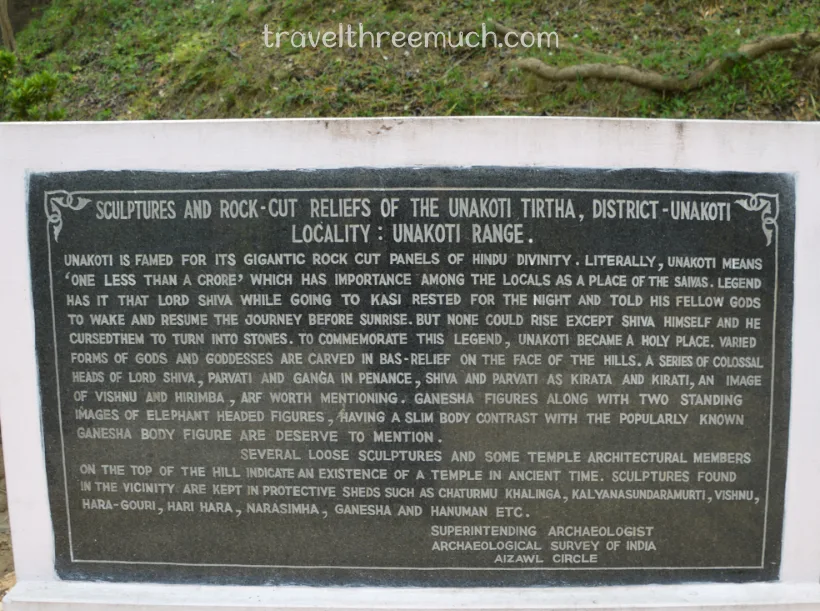

Unakoti rock carvings in Tripura - India's largest open-air sculpture complex

Unakoti Rock Carvings, Tripura: 99,99,999 Gods Frozen in Stone

Updated on July 2, 2026

Contents

    planplanettm How to Visit Unakoti: Timings, Entry Fee & Route

    • Construction date: 7th–9th century CE
    • Entry fee: Free. Bag check at the gate — no single-use plastic or tobacco.
    • Photography: Allowed for personal use. No fee.
    • Time needed: 2.5–3 hours minimum
    • Best time to visit: October to March. Do not visit June–September (monsoon — the last 30 km of road becomes extremely poor).
    • Maintained by: Archaeological Survey of India (ASI)
    • UNESCO status: World Heritage Site tentative list (added 2022)
    • Nearest town: Kailashahar, 8 km from the site

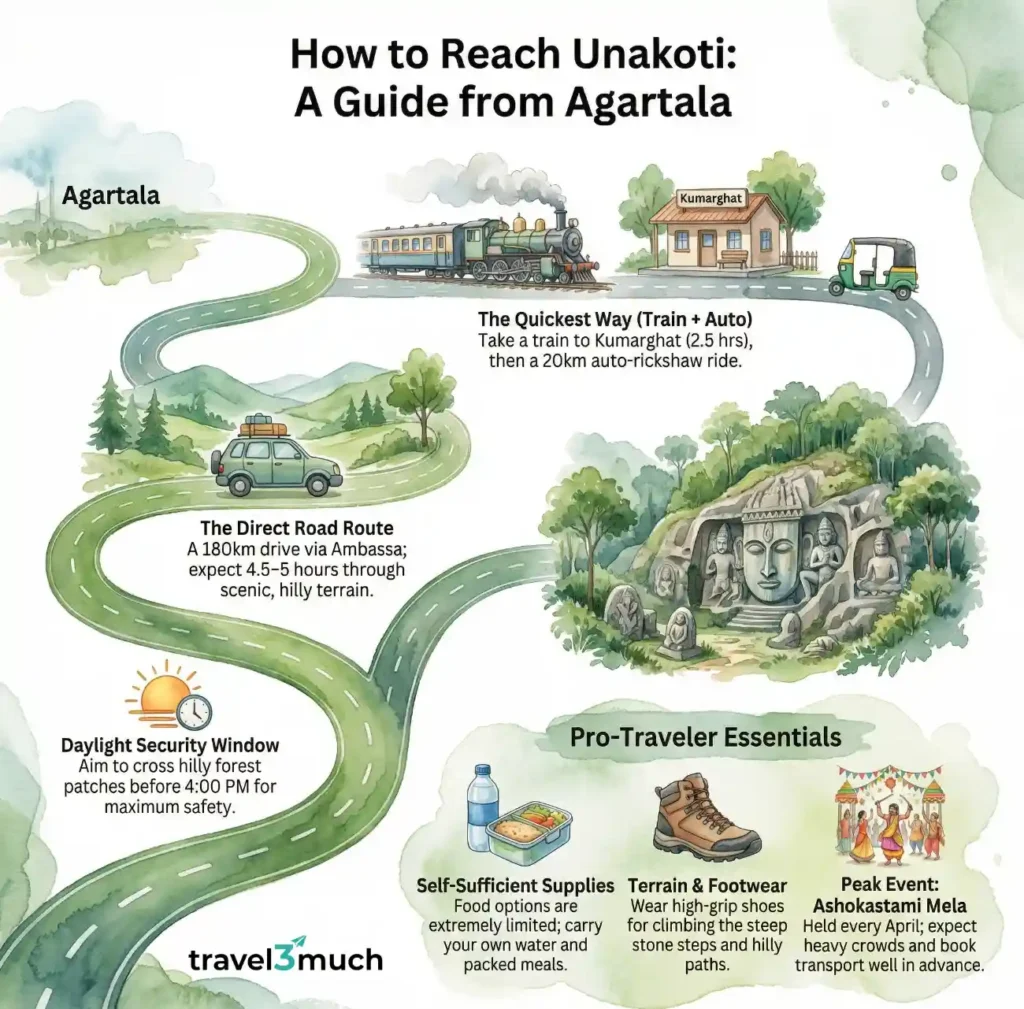
    Getting there:

    • By road from Agartala: 178–185 km via NH8, 4.5–5 hours. Carry packed food — no restaurants on route.
    • By train: Agartala → Kumarghat station (Lumding–Sabroom line), then taxi 19.6 km to site, approximately 30 minutes.
    • Tip: Start no later than 7 AM from Agartala to allow 2–3 hours at the site and return before dark.
    Unakoti visitor guide — timings, entry fee, route from Agartala

    The Journey to Unakoti from Agartala

    We had planned to visit the Unakoti rock carvings as the first destination in Tripura. The rock carvings are located about 180 km from Agartala, where we stayed. We started from Agartala at about 7 AM as we wanted to be back before sundown.

    Once we left Agartala, there was a short stretch of state highways before the road rapidly ascended into a hilly section. The two-lane road gradually became a 4-lane well-paved highway but still traversed across the hills. The weather was overcast and the greenery in the hills made for some breathtaking views. Options for food stops on the way to Unakoti are extremely limited. So, consider bringing packed lunches and ample water. The last stretch of roads for a distance of about 10 km before Unakoti was work-in-progress and so our speed dropped.

    Soon, we came to a halt, seeing a row of pots placed across the road blocking us from proceeding further. We understood that the local populace was protesting and wanted to draw the attention of the administration to some issue. The locals guided us to another route that took us on a slight detour around the protest, back on some more village roads. A signpost informed us to leave the highway and take a left turn to reach the rock carvings. A few stalls with light snacks and tender coconuts were the only options for food and drink.

    The 99,99,999 Gods: Unakoti’s Legend Explained

    There are at least two different legends as the origin stories for this complex of monumental reliefs.

    Termed by some as the ‘Angkor Wat of North East India’, in one of the stories, Shiva along with the other gods on the way to Varanasi, rested for the night here with instructions that the journey was to resume before sunrise.

    When none of the other gods woke up at the appointed hour the next morning, Shiva cursed them all to turn to stones.

    In another legend, Kallu Kumhar, an ardent devotee of Parvati wanted to accompany Shiva and the goddess to Mount Kailash. Shiva laid a condition that he could take Kallu along with them only if he finished making 1 crore (a word for 10 million, used in India) idols before sunrise.

    However, the potter could only finish making one less than the 1 crore idols required to secure his position as a part of Shiva’s entourage and so, was left behind. This is also the reason for the place to be called Unakoti – one less than 1 crore.

    History of the Unakoti Rock Carvings – Key facts

    The rock-cut images at Unakoti are attributed, on stylistic grounds, to the 7th–9th century CE. The patron dynasty is believed to be the Deva Dynasty of Sribhumi in Samatata — a kingdom in what is now Bengal and Bangladesh. The only inscription found at the site dates to the 11th–12th century CE, written in Bengali script, and mentions a pilgrim named Sri Jayadeva. That inscription tells us the site was already old and established as a place of pilgrimage by the medieval period.

    The site was documented by K. Chaudhuri in 1910–11, followed by Captain Williams, the British political agent to Tripura, in 1914. The Archaeological Survey of India published an authoritative account in its Annual Report of 1921–22. The Manikya kings who later ruled Tripura were followers of Hinduism and added small temples to the region, but the core rock carvings significantly predate their rule.

    In 2022, Unakoti was added to the UNESCO World Heritage Site tentative list recognising it as India’s finest example of monumental open-air rock carving at scale, comparable in ambition (though not in style) to sites like Ajanta, Ellora, and the rock carvings of Mahabalipuram.

    The Rock-Cut Sculptures of Unakoti: What You Will See

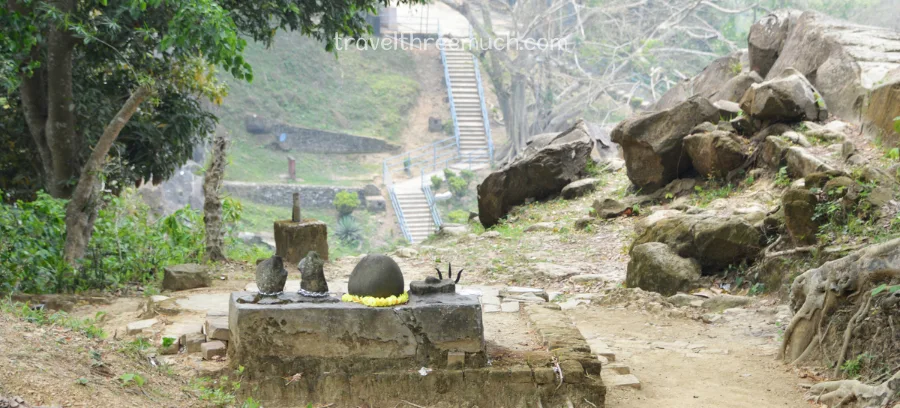
    Just past the parking is the entrance to the complex housing the hillsides with the carvings and sculptures. The entry itself was free but our bags were checked to make sure single use plastics, tobacco and the likes don’t get through. The area has been adopted by the Archaeological Survey Of India (ASI) and was well maintained.

    Unakoti contains two categories of carvings. The first are the large rock-cut reliefs — images carved directly into vertical hillside surfaces, some reaching 30 feet in height. These are the sculptures you encounter on the trail. The second category are smaller loose stone sculptures that have deteriorated from their original positions and are now stored in a protected room at the summit. The ASI has not published an official count, but the site claims 99,99,999 sculptures and bas reliefs – the exact number that gives Unakoti its name. And considering the number of sculptures we saw scattered all around, that could have definitely been a possibility!

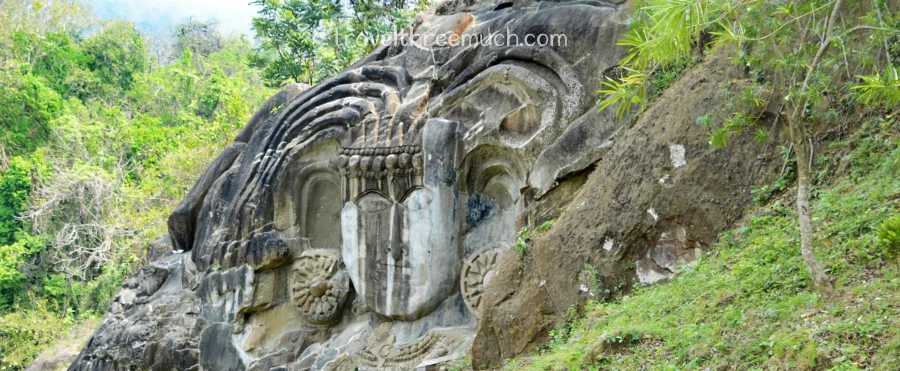
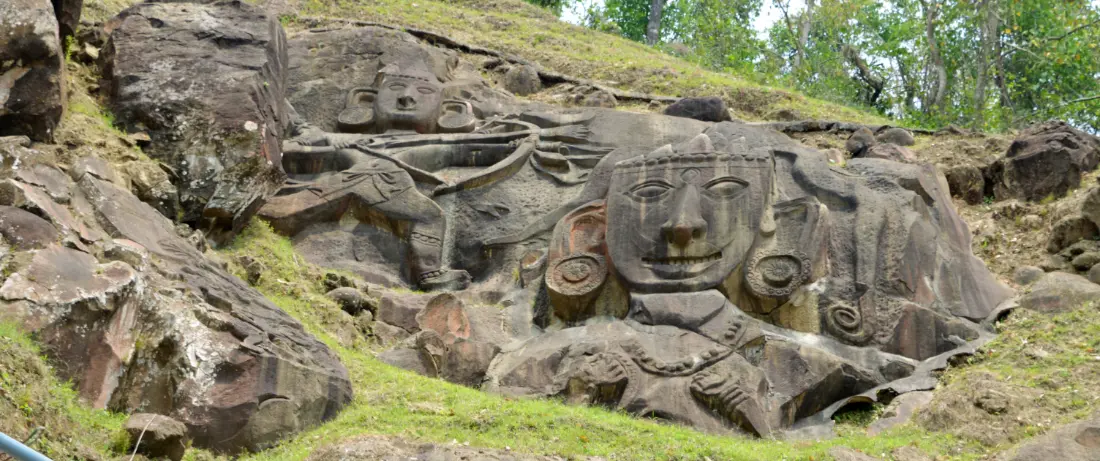
    Just past the first flight of stairs and a bend, you come face to face with a nearly two storey-tall head of Shiva carved on the side of a hillside. Shiva’s flowing dreadlocks are parted by a hint of a crescent moon.

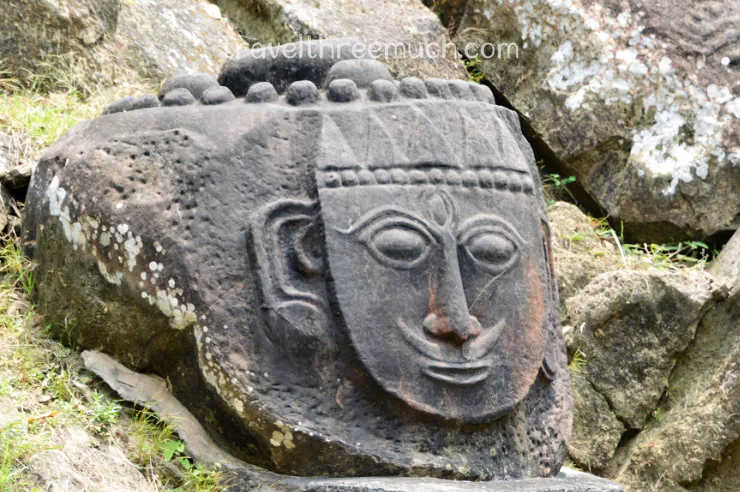
    We see the moustachioed mouth with slightly parted lips showing the teeth inside, wheel-like earrings and the elaborate head-dress. The necklace carved with beads, each nearly the side of a closed fist, are all motifs that make repeated appearances in other carvings and sculptures throughout the complex.

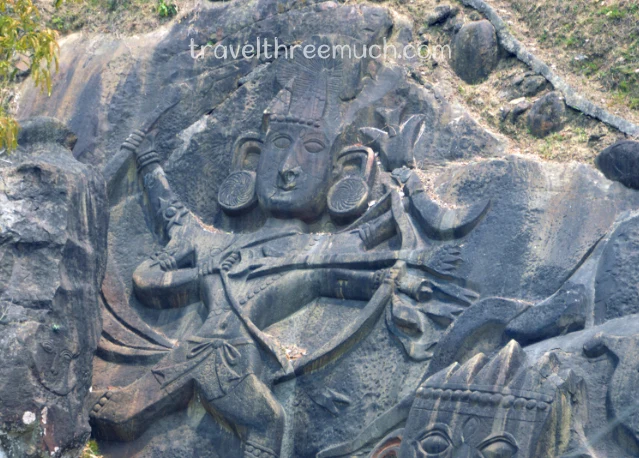
    Kalabhairava sculpture

    There was a smaller relief a little way further, of a 4-armed Kalabhairava in a pose where he’s about to let an arrow loose from a drawn bow, with another arm brandishing what seems to be the remains of a trident.

    Another relief seemed to be a couple – Shiva in the hunter’s form or a ‘kirata’ and another of a goddess in the huntress’ form – a ‘kirati’.

    The Mighty Shiva – Key relief

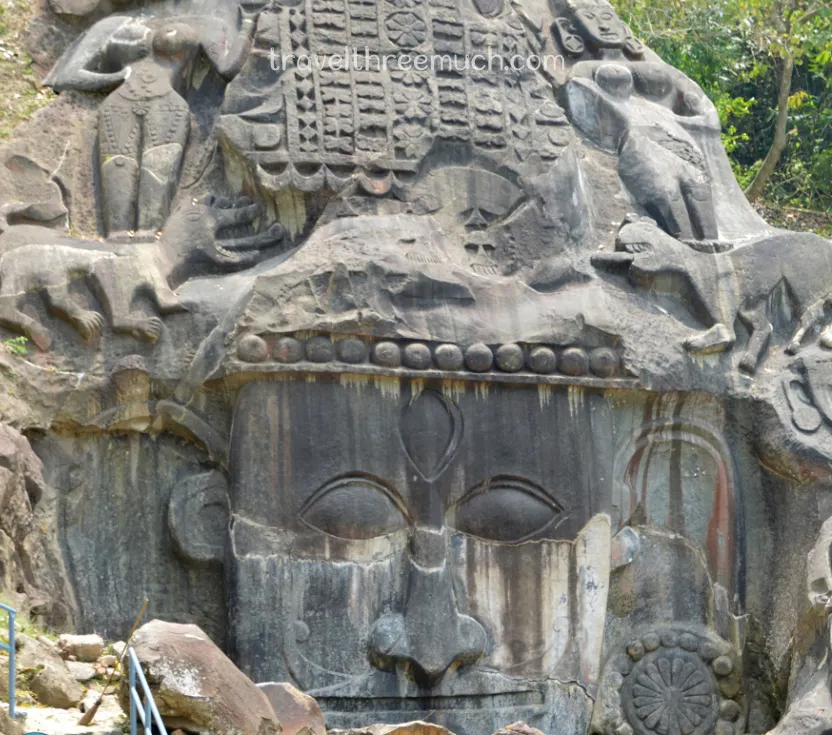
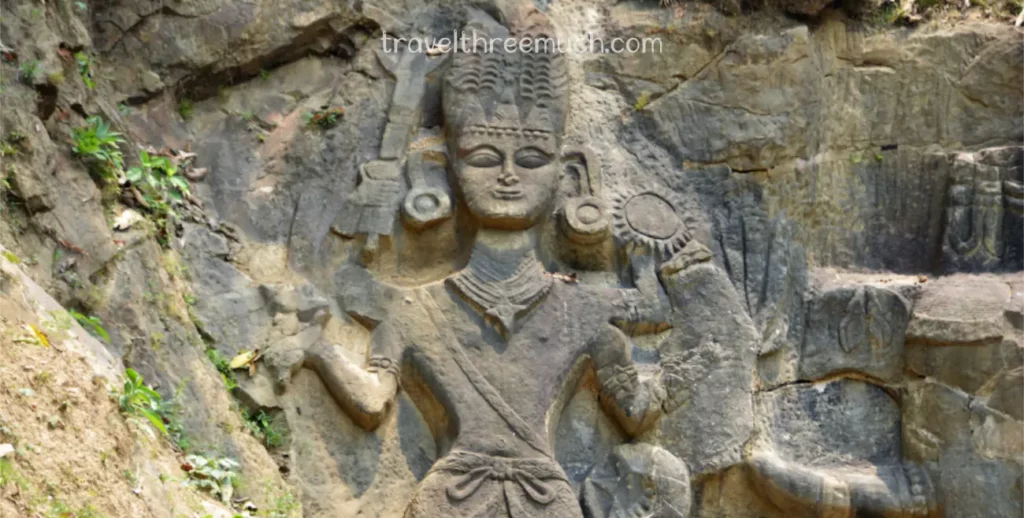
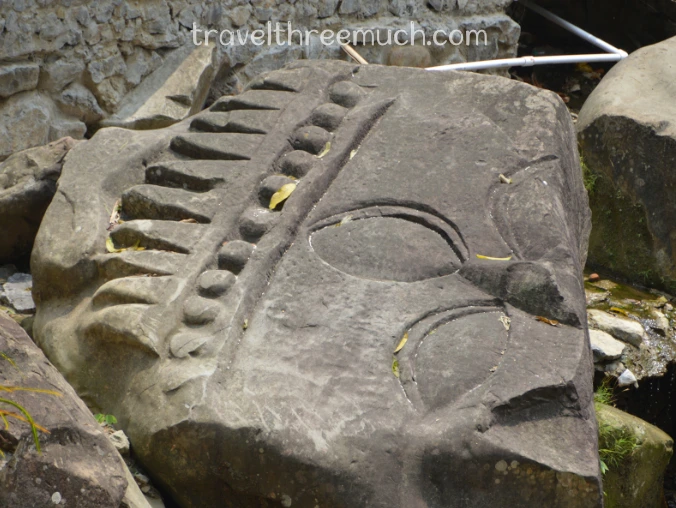
    Just to the right of these reliefs is the star attraction of the complex – a nearly three storey tall head of Shiva.

    The mighty Siva has an elaborately carved head-dress which alone makes up more than one-third of the height.

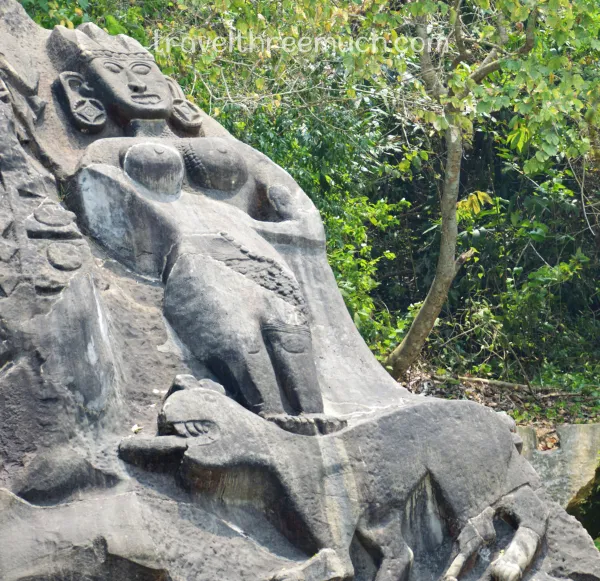
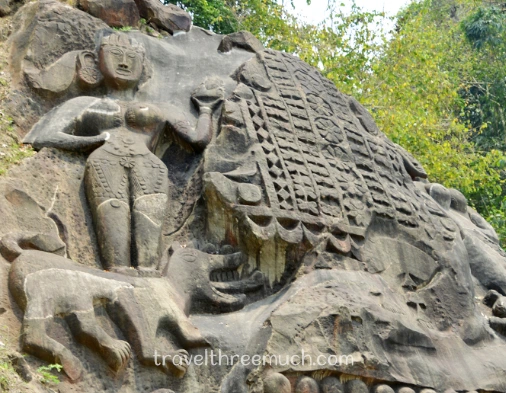
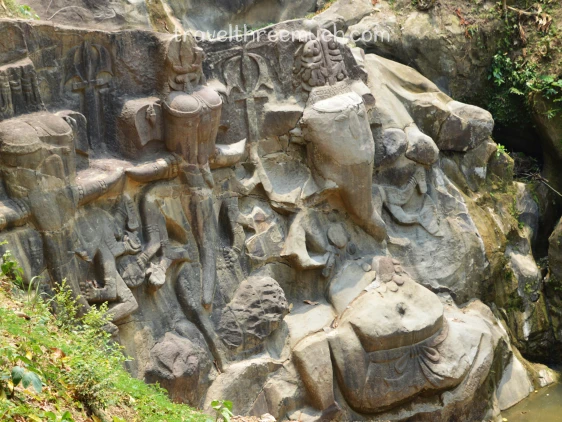
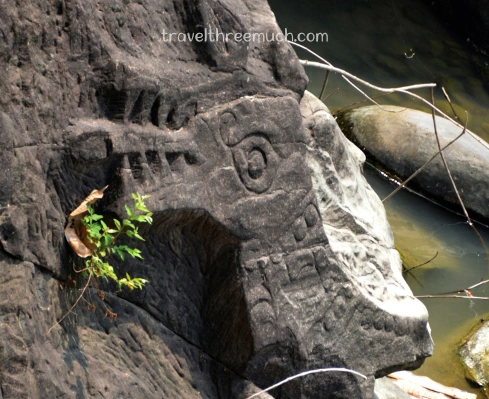
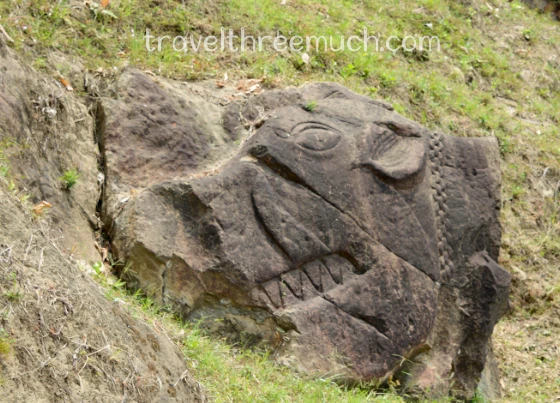
    On either side of this head stand goddesses standing atop their roaring and snarling steeds.

    This is possibly a Makara with Ganga on the left of the head and a lion/tiger with Parvati on the right side. At the foot of the towering head are half-buried in the terrain, at least three sculptures of Nandi. Nandi is the divine bull which is also Shiva’s steed.

    We moved on to the next group of carvings with some interesting features.

    Vishnu Relief

    These were a standing Vishnu with a sword, mace, and discus.

    Vishnu relief at Unakoti rock carvings, Tripura

    Ganesha Reliefs

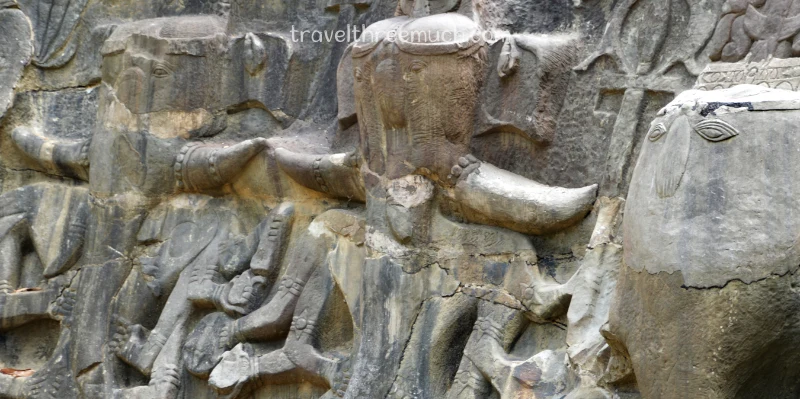
    Next to the Vishnu are three elephant-headed Ganeshas each with 8 hands but sculpted with interesting deviations from conventional representations of the deity.

    Two of the Ganeshas don’t have the generously proportioned belly popularly associated with the deity’s penchant for sweets. These two Ganeshas also have their prominent tusks sized realistically instead of the diminutive proportions seen in contemporary times. The third Ganesha has the pot-belly and near-invisible tusks associated with representations we see in the present day.

    The variations position, size and shape of the eyes and noses are very interesting because they seem to be faithful to those of real elephants in the 2 Ganeshas with slim midriffs. However, the third Ganesha, remains faithful to the same rules as that of the Shiva heads seen elsewhere in the complex – humanoid eyes located at the top of the head (instead of on the sides) and located closer to the centerline of the face, parted by a block of relief probably denoting a ‘nose’ on the forehead!

    Other reliefs

    Just past these sculptures we came across a few Irrawaddy squirrels calling loudly to each other and scampering about on trees. It was the first time we saw this squirrel in real life and it took a while to be able to spot them!

    As we walked along the steps, we were able to see many more sculptures depicting various deities and animals.

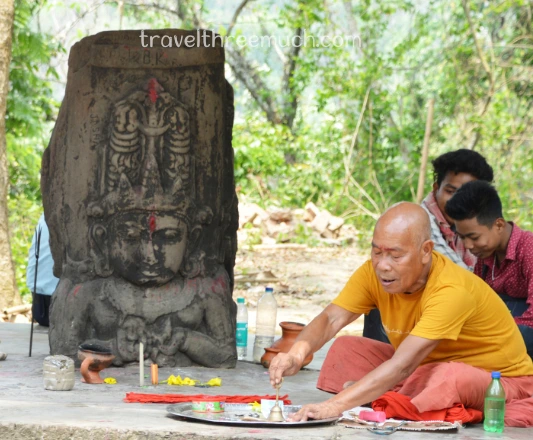
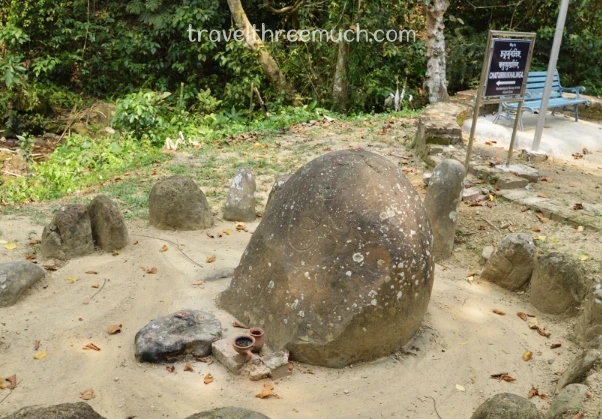
    There was an example of a Chaturmukhalinga (a 4-faced abstract representation of Shiva) with priests still making offerings to the deity.

    We also saw few other depictions with sharp features. There is something really surreal about being surrounded mountains with sculptures and we could really feel that!

    The tiny hill top museum

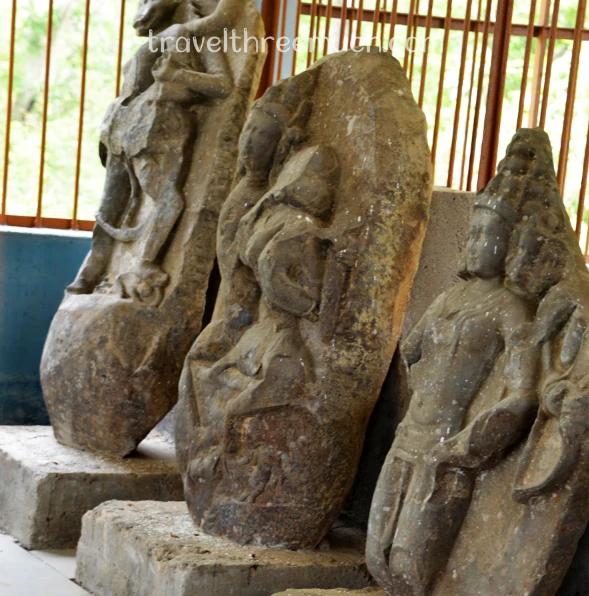
    A steep but short trek to the top of the hill complex brings one to a room with windows protected by grillwork, where the sculptures recovered from the complex are kept to protect them from further deterioration by exposure to the elements and graffiti.

    The room houses among others, a Hanuman, a Narasimha, a Ganesha and other forms of Shiva and Vishnu.

    We caught our breaths for a few moments, took in the views, and trekked back to the parking lot for the trip back to Agartala, bidding the magnificent and serene Unakoti hills and its singing squirrels a fond adieu.

    unakoti sculptures

    What Other Travelers Ask

    If you are planning to go by train, then you can take a train to Kumarghat and then a taxi to the site. We were staying in Tripura and hence we took a taxi from Tripura to Unakoti. It took us about 4 hours to get there. We started early in the morning. 

    The word Unakoti means “one less than a crore.” Legend says Lord Shiva cursed his followers and they turned to stone here. You can read the blog above to read in detail about the other legend. 

    Not much actually. There are stairs that are setup all over the place so you can walk up and down them to see the sculptures and the bas reliefs up close. It is easy for people with moderate fitness to do. It is not difficult for children as well. 

    There is not entry fee to visit the place. Neither is there any fee for Camera and photography is allowed (for personal use).

    Unakoti is unlike any other site in India — there is no comparable open-air rock carving complex at this scale and in this condition. What you get at the other end is worth the effort: a quiet, well-maintained ASI site where you will almost certainly have the main sculptures largely to yourself, unlike the crowds at more famous heritage sites.

    Yes. Photography is allowed for personal use and there is no fee. Outdoor reliefs on the hillside are fully open.

    The site, named for the legend of “one less than a crore” deities, features two types of carvings:

    Monumental Reliefs: Massive hillside carvings including the 30-foot tall Unakotiswara Kal Bhairava, flanked by Durga and Ganga/Parvati, alongside Nandi bulls, various Ganesha forms, Vishnu, and the hunters Kirata and Kirati.

    Loose Sculptures: Smaller, detached images of Hanuman, Narasimha, and Ganesha housed in a protected summit room.

    There are two mysteries, one mythological and one historical. The mythological one gives the site its name – Lord Shiva cursed 99,99,999 gods to stone when they failed to wake before sunrise. The historical mystery is more interesting: nobody knows who actually carved these images, why they carved them at this scale, or why this remote forested hillside in what is now Tripura was chosen.

    Prasanna is the Primary Writer and Technical Expert behind the posts. He is responsible for the detailed facts, historical context, and logistical breakdowns. He has a deep love for mountains, history, nature, and is the family's expert packer.
    Leave a Reply

    Your email address will not be published. Required fields are marked *